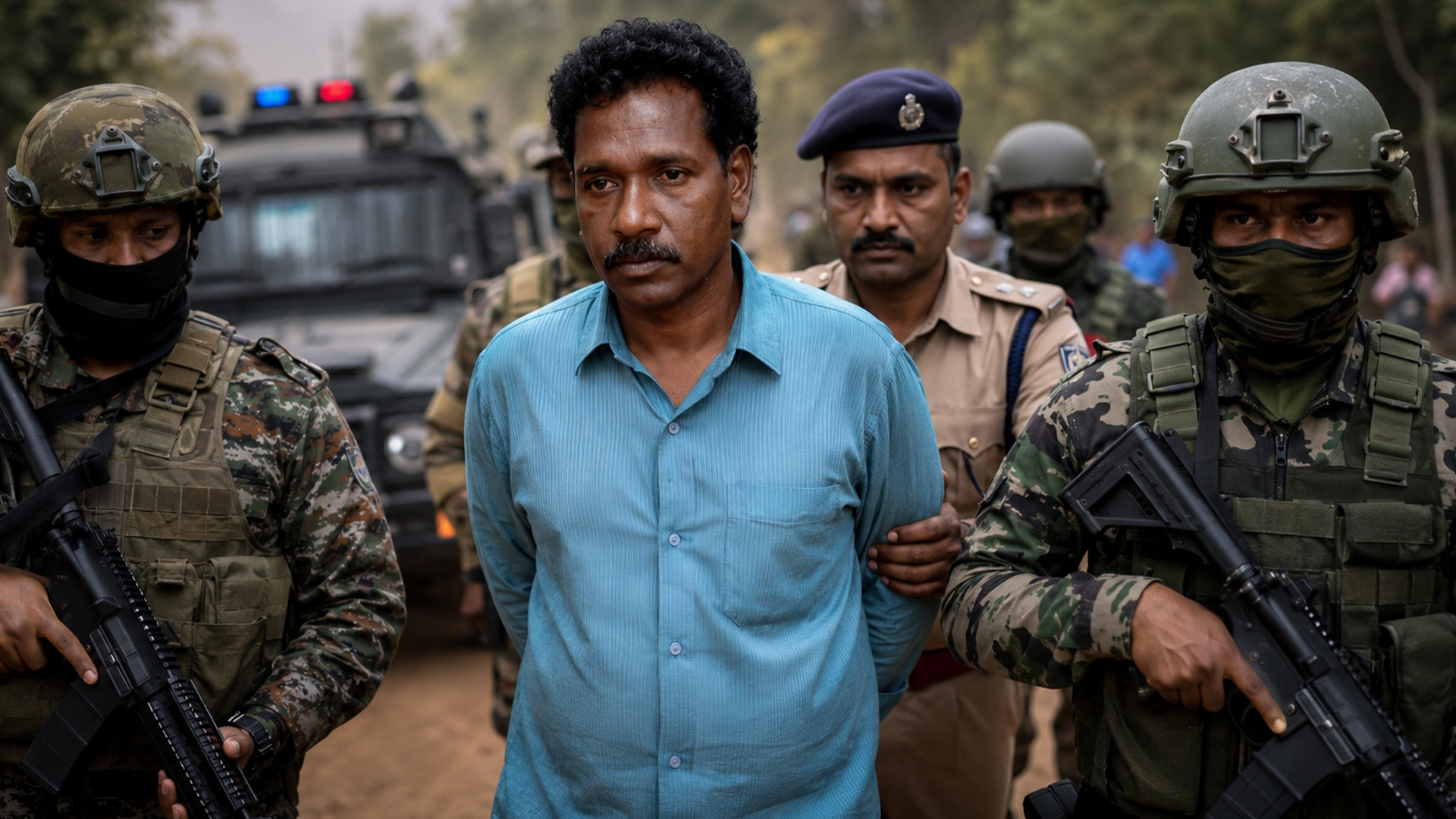
In a major success for India’s security forces, Jharkhand Police have arrested senior CPI (Maoist) leader Misir Besra, one of the country’s most wanted Maoist commanders, ending a manhunt that lasted nearly two decades. Carrying a combined reward of over ₹1 crore announced by several states and central agencies, Besra’s arrest is being hailed as a landmark achievement in India’s ongoing fight against Left-Wing Extremism.
The operation was carried out in Jharkhand‘s Dhanbad district after weeks of intelligence gathering and surveillance. Acting on specific inputs about the movement of senior Maoist leaders, a joint police team launched a carefully planned operation that led to the arrest of Besra without any exchange of fire. Officials described the mission as a well-coordinated intelligence-led operation that prevented the accused from escaping once again.
Along with Besra, police also arrested two other Maoist operatives. They have been identified as Mehnat alias Mochhu, a Regional Committee member carrying a reward of ₹5 lakh, and another cadre, Gaurav alias Saurav. Security agencies believe the arrests will provide valuable information about the remaining Maoist network, including its leadership, finances, movement and future operational plans.
Misir Besra, also known by aliases such as Sagar, Bhaskar and Ramkrishna, is a Politburo and Central Committee member of the banned Communist Party of India (Maoist). For years, he has been considered one of the organisation’s top military strategists and among the most influential leaders operating in eastern India. His role extended across Maoist-affected regions of Jharkhand, Bihar, Odisha, Chhattisgarh and parts of West Bengal, where he allegedly coordinated armed activities and organisational expansion.
Police records show that Besra was wanted in more than 141 criminal cases registered across multiple states. These include charges of murder, criminal conspiracy, attacks on security personnel, extortion, illegal possession of weapons and offences under anti-terror laws. Investigators say he played a key role in planning several deadly Maoist attacks that claimed the lives of security personnel and civilians over the years.
Authorities said the total reward on Besra had crossed ₹1 crore after various state governments and central agencies announced separate cash rewards for information leading to his capture. Despite several operations launched over the years, he managed to evade arrest by frequently shifting locations, using dense forest terrain as cover and relying on an extensive underground support network.
Originally from Jharkhand’s Giridih district, Besra joined the Maoist movement at a young age and gradually climbed the ranks to become one of its top decision-makers. Following the deaths, arrests and surrenders of several senior Maoist leaders in recent years, he emerged as one of the most prominent faces of the insurgent movement. His experience, organisational influence and military planning made him a high-priority target for security agencies.
Officials said Besra had earlier been arrested years ago but managed to escape from police custody, allowing him to return to underground activities. That dramatic escape further strengthened his image within Maoist ranks and intensified the nationwide search for him. His latest arrest is therefore being viewed as a significant symbolic and operational victory for the security establishment.
According to police officials, investigators are now questioning all three arrested Maoists to gather crucial intelligence on the current structure of the banned organisation. Agencies hope the interrogation will reveal information about active Maoist commanders, weapons supply routes, funding channels, recruitment methods and communication networks operating in different states.
Security experts believe the arrest could weaken the already shrinking Maoist leadership. Over the past few years, sustained anti-Naxal operations by central and state forces have led to the elimination, arrest or surrender of several senior Maoist leaders. Increased deployment of security personnel, improved intelligence sharing, modern surveillance technology and better coordination between states have significantly reduced the operational strength of the insurgent group.
The arrest also comes on a day when Jharkhand Police reported the surrender of 16 Maoist cadres, including several carrying cash rewards. Officials said continuous security operations, along with rehabilitation and development programmes introduced in affected districts, are encouraging more insurgents to surrender and rejoin mainstream society.
For residents of Maoist-affected regions, the arrest carries significance beyond security statistics. Many villages across Jharkhand and neighbouring states have lived with the fear of violence, extortion and armed conflict for decades. Development projects, road construction, education and healthcare services have often suffered because of Maoist activities. Local people now hope the weakening of the insurgent leadership will bring greater peace and allow faster development in remote areas.
Union and state governments have repeatedly maintained that their strategy combines strong security action with development initiatives aimed at addressing the socio-economic challenges in Left-Wing Extremism-affected districts. Officials say improved infrastructure, employment opportunities, education and welfare schemes are gradually reducing the influence of Maoist groups among local communities.
Investigators are now examining documents, digital devices and other materials seized during the operation to identify additional Maoist operatives and uncover possible hideouts. Further arrests and follow-up operations are expected in the coming days based on information obtained during the interrogation.
While security agencies have described Misir Besra’s arrest as one of the biggest successes against the Maoist movement in recent years, they caution that the fight against Left-Wing Extremism is far from over. However, with one of the organisation’s most experienced leaders now in custody, officials believe the arrest has dealt a major blow to the CPI (Maoist)’s leadership and operational capabilities, marking another important step in India’s long-running campaign to eliminate the Maoist insurgency.