The Supreme Court on Thursday stopped short of ordering a blanket ban on pellet guns for crowd control, but made it clear that allegations of their misuse during a recent Delhi protest can be examined. The court also directed authorities to preserve the Rapid Action Force’s ammunition records from the incident and ensure proper medical treatment for those injured.
A Bench headed by Chief Justice of India Surya Kant, along with Justices Joymalya Bagchi and V Mohana, was hearing a petition filed by former IPS officer Yashovardhan Azad and two alleged victims of pellet injuries, Prashant Kumar Singh and Sheikh Irshad Mansoori. The petition seeks restrictions on the use of metallic pellets and other kinetic projectiles for dispersing civilian gatherings.
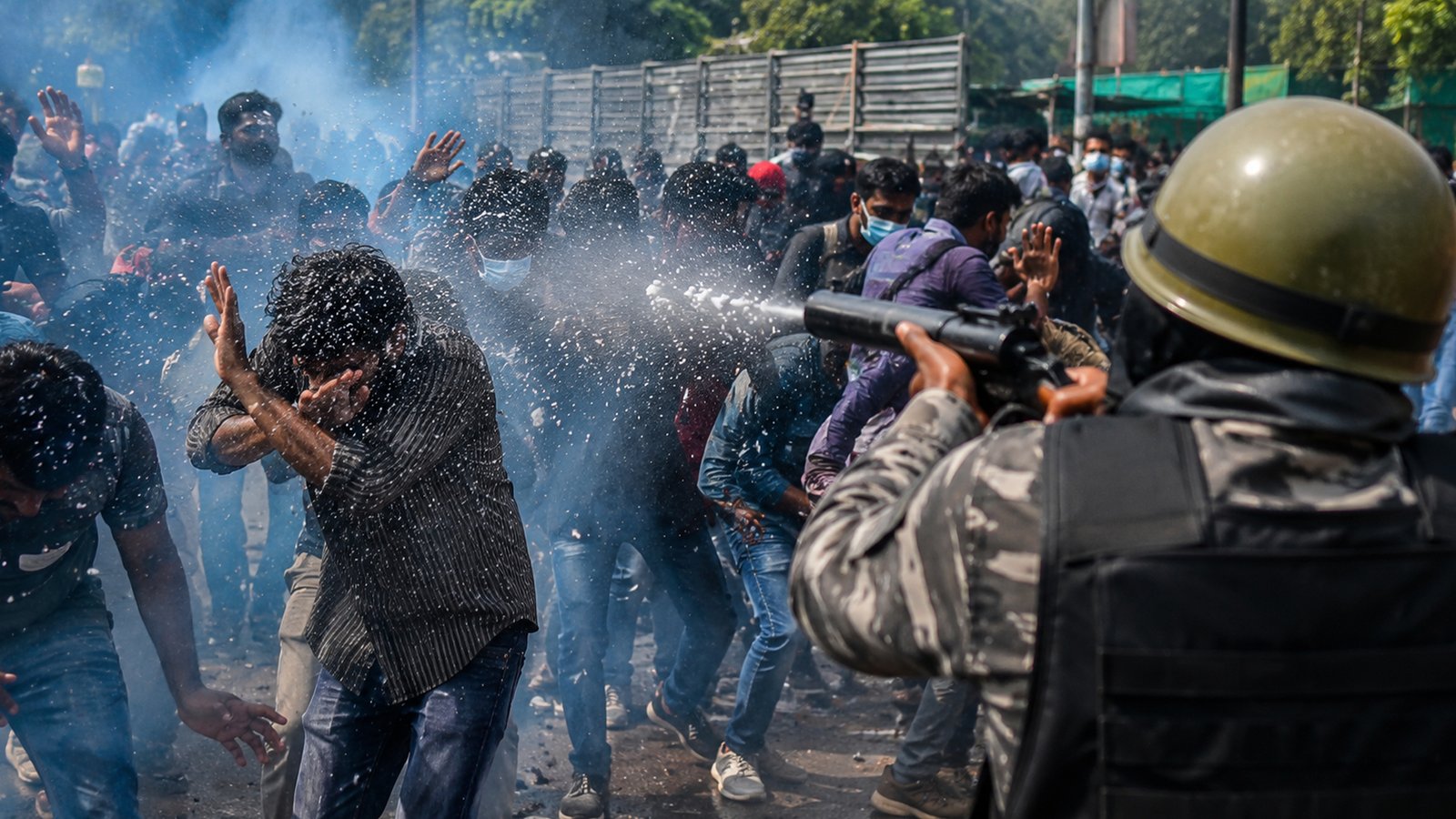
The case relates to the July 20 “Sansad Chalo” protest in Delhi over alleged examination paper leaks. Singh and Mansoori told the court that they were injured when the Rapid Action Force allegedly fired metallic pellets during the demonstration.
Their lawyers argued that pellets recovered from the bodies of the two men showed the seriousness of the injuries. The petitioners have sought action against the use of metallic pellet ammunition, arguing that such projectiles can cause severe and lasting injuries when fired into a crowd.
The Supreme Court, however, indicated that a complete prohibition cannot simply be ordered without first challenging the existing rules and advisories governing the use of force by security agencies.
Justice Joymalya Bagchi observed that police regulations permit the use of pellet guns in exceptional circumstances as part of a graded response to crowd situations. If the petitioners want pellet guns to be phased out altogether, they would have to challenge the legal validity of the provisions permitting their use, including on the touchstone of Article 21, which protects the right to life and personal liberty.
At the same time, the Bench said it was willing to examine whether pellet guns were appropriately used in the specific July 20 incident.
Advocate Vrinda Grover, appearing for the petitioners, stressed that the plea was particularly concerned with metallic pellets. She said the petitioners were not arguing that pellet guns should never be part of the RAF’s arsenal, but questioned their use against civilians during protests.
The petitioners also raised questions about the availability and transparency of police guidelines governing crowd control. Grover told the court that it was difficult to obtain the relevant Bureau of Police Research and Development guidelines and that she had obtained a 2016 document only through a Right to Information application.
She further said she could not find a Delhi Police standing order specifically permitting the use of pellets. The lawyer urged the Centre and Delhi Government to place any such order before the court if one exists.
The Bench discussed the principle of a graded response to force, under which authorities are expected to assess the nature of a gathering and use proportionate measures. The court noted that protests can sometimes turn violent and that law-enforcement agencies may have to respond differently depending on circumstances.
Chief Justice Surya Kant indicated that the petition could also seek a clearer protocol governing the use of force during such situations. Justice Bagchi stressed that the question was not merely whether a particular weapon exists in the armoury, but whether its deployment in a given situation was reasonable, necessary and proportionate.
The court also focused on preserving evidence from the July 20 incident. The petitioners sought specific directions to preserve the RAF’s ammunition logs, pointing out that an earlier interim order had directed the preservation of CCTV footage, drone and body-camera recordings and wireless logs, but had not specifically mentioned ammunition records.
The court subsequently directed that the relevant ammunition log of RAF personnel deployed at Jantar Mantar be preserved. Reports cited in the proceedings said the RAF logbook recorded seven rounds of pellet guns being fired during the July 20 incident.
The issue of medical care also came up during the hearing. Grover told the Bench that one of the injured petitioners was receiving proper treatment while there were concerns about the treatment being provided to the other. The Supreme Court directed the Delhi Government to ensure adequate medical treatment for the injured petitioners and others similarly affected.
The petitioners have also sought compensation for victims of the alleged pellet firing. They argue that metallic pellets are unsuitable for dispersing peaceful civilian assemblies because of their unpredictable trajectory and their potential to cause serious injuries.
The Supreme Court has therefore left the larger question open. For now, pellet guns remain permissible under existing rules in exceptional circumstances, but the court has signalled that their actual use during civilian protests can be subjected to judicial scrutiny.
The next stage of the case is expected to focus on the rules governing pellet guns, the circumstances surrounding the July 20 firing and the records that can establish what ammunition was used and under whose directions.