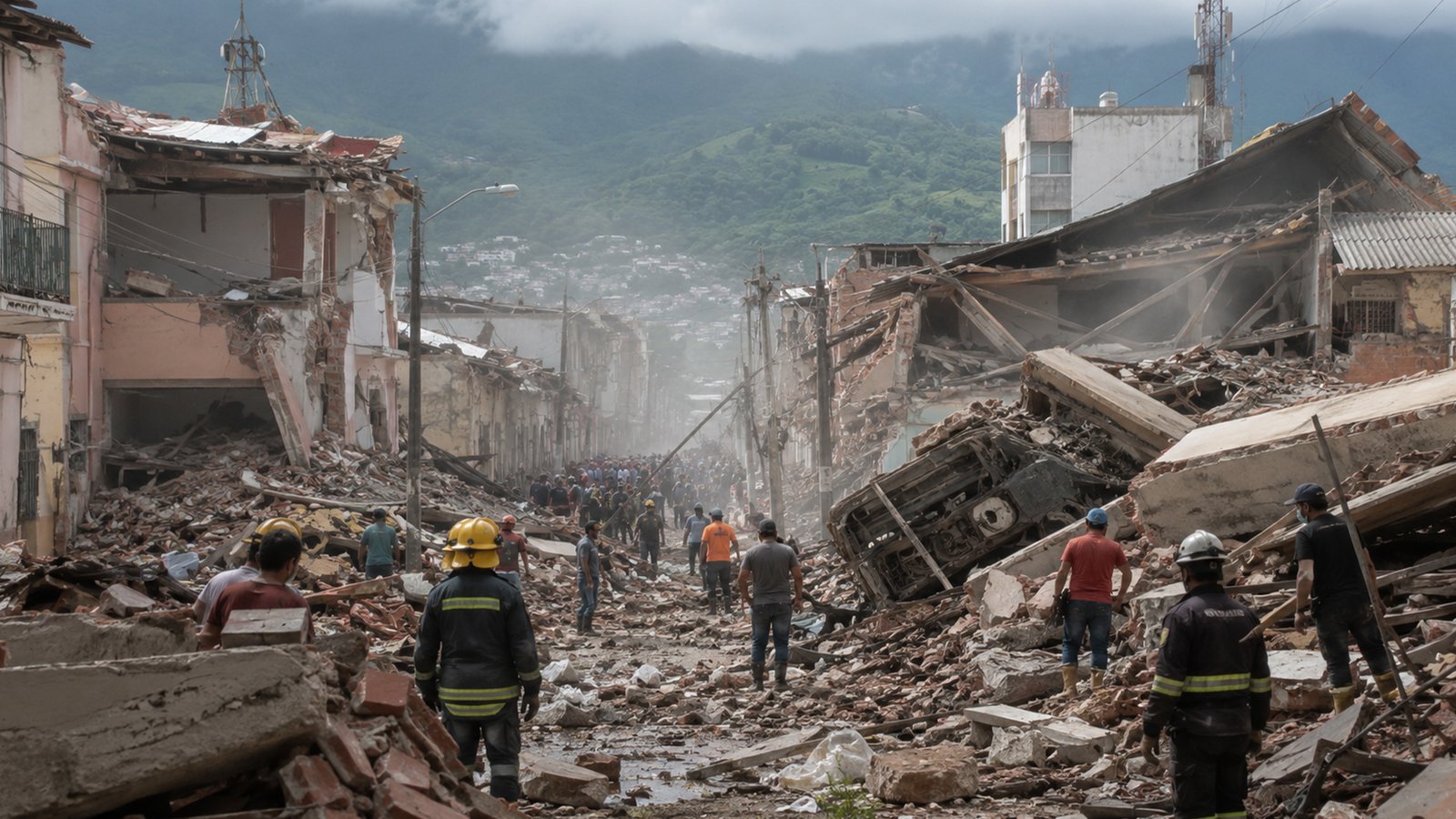
A powerful 7.4-magnitude earthquake has killed at least 164 people in western Colombia, with hundreds injured and rescue teams continuing to search collapsed buildings for survivors. The earthquake struck on Monday and caused extensive damage across several cities, leaving families waiting for news of missing relatives and emergency workers racing to reach people trapped beneath the rubble.
The death toll rose rapidly as rescue teams reached more affected areas. The latest reports put the number of people killed at 164, with the figure expected to increase as authorities assess damage in remote communities. More than 570 people have been injured, while a large number of residents remain unaccounted for in some of the worst-hit areas.
The earthquake was centred near San José del Palmar in the Chocó region of western Colombia, roughly 400 kilometres west of Bogotá. The tremor was relatively deep, but its strength was enough to cause serious structural damage across a wide area. Shaking was felt in several parts of Colombia and neighbouring countries.
Cali, Pereira and Manizales were among the cities that reported significant damage. In Cali, buildings were badly damaged and sections of a hospital were affected, forcing emergency workers to move some patients to safer locations. Pereira also suffered heavy destruction, with buildings collapsing and people feared trapped under debris.
The scenes following the earthquake were chaotic. Residents rushed out of buildings as the ground shook, while emergency crews began moving through affected neighbourhoods. Firefighters, police officers, soldiers and volunteers worked together to clear rubble and search damaged structures. In several locations, residents joined the rescue effort, using their hands and basic tools to remove concrete and debris.
For families waiting for information, the search has become an agonising test of patience. Authorities have reported a significant number of missing people, particularly in Cali. Rescue teams are checking collapsed buildings one by one, hoping to find survivors while also working to identify victims.
The response has been complicated by the geography of western Colombia. Chocó is one of the country’s more remote regions, with difficult terrain and limited road and transport links. Communities close to the epicentre have faced additional challenges in receiving emergency assistance. Damaged infrastructure and communication problems have also made it harder for authorities to establish the full extent of the destruction.
Several buildings and public facilities have been damaged, raising concerns about the safety of structures that remain standing. Authorities have urged residents to stay away from badly damaged buildings, particularly as aftershocks continue to pose a risk. Engineers and emergency teams are inspecting structures before allowing people to return to their homes.
The earthquake has also affected hospitals and other essential services. Medical facilities in the affected cities have been dealing with large numbers of injured people, while some damaged buildings have forced authorities to move patients and staff. Roads and transport facilities have also been affected, making it more difficult to move medical supplies, rescue equipment and emergency personnel.
Air travel in parts of western Colombia was disrupted after authorities temporarily suspended operations at several airports while infrastructure was checked for damage. The disruption added another challenge for rescue agencies attempting to reach communities affected by the earthquake.
Authorities have also introduced additional security measures in some cities. Police and military personnel have been deployed in affected areas, while curfews have been announced in some locations. The measures are aimed at maintaining order and allowing emergency teams to work without disruption.
The Colombian government has declared an emergency and prioritised search-and-rescue operations, medical assistance and support for people who have lost their homes. Temporary shelters are being arranged for residents unable to return to damaged properties.
International assistance has also begun reaching Colombia. The United States has pledged emergency financial support, while several Latin American countries have offered rescue personnel, medical assistance and supplies. The aid is expected to support emergency shelters, food distribution and other immediate relief measures.
The earthquake has drawn attention to Colombia’s exposure to seismic activity. The country lies in a region where several tectonic plates interact, making earthquakes a recurring natural hazard. However, the scale of the latest destruction has made the disaster particularly significant, with authorities describing it as one of the strongest earthquakes to hit the country in recent decades.
For people in Cali, Pereira, Chocó and other affected areas, the statistics offer only a partial picture of what has happened. Families are still searching for relatives, residents are sleeping away from damaged homes and rescue workers are continuing to sift through debris in the hope of finding survivors.
The immediate priority remains locating missing people and treating those injured. Authorities must also provide shelter, food and medical care while assessing thousands of structures for safety.