Cervical cancer is one of medicine’s most frustrating contradictions: we know its central cause, we can detect its precancerous stage, and we have a vaccine that prevents the infections responsible for most cases. Yet the latest World Health Organization estimate records about 604,000 new cases and 280,000 deaths worldwide in 2024. In India, cervical cancer was the second most commonly diagnosed cancer in women, with an estimated 79,360 new cases and 36,319 deaths in 2024. These are not simply statistics. They represent mothers, partners, daughters and colleagues lost to a disease that is, to an extraordinary degree, preventable.
The paradox is sharper still: in 2025, only 33% of eligible girls worldwide received a first HPV-vaccine dose. The vaccine is therefore both a scientific triumph and an unfinished public-health promise.
A common virus; an uncommon opportunity
Human papillomavirus, or HPV, is not a single virus but a large family. It is transmitted through intimate skin-to-skin and sexual contact, and almost every sexually active person will encounter it at some point, usually without symptoms. In most people the immune system clears the infection. The danger arises when a carcinogenic, or high-risk, HPV type persists in the cells of the cervix.
Persistent infection can create precancerous cell changes. Without screening and treatment, a small proportion progress to cancer, often over 15 to 20 years; in people with weakened immunity, progression can be faster. Because HPV is common and silent, a positive test is a medical finding, not a moral diagnosis. The important question is not where blame lies, but whether infection, precancer and cancer can be prevented.
What the vaccine does – and does not do
HPV vaccines are prevention vaccines. They use virus-like particles that resemble the outer shell of HPV but contain neither live biological material nor viral DNA. They cannot cause HPV infection. Instead, they train the immune system to produce antibodies that block future infection by the targeted HPV types.
All currently licensed HPV vaccines protect against types 16 and 18, which account for around 76% of cervical cancers. Depending on the product, protection may extend to additional cancer-causing types and to types 6 and 11, which cause most anogenital warts. The practical message is reassuring: the best vaccine is an approved, age-appropriate product that is available and given on the recommended schedule. Waiting indefinitely for a particular brand can mean missing the age at which protection is greatest.
There is one essential limitation. The vaccine prevents new infections; it does not treat an HPV infection or cervical lesion already present. This is why vaccination is most powerful before exposure, and why screening remains necessary later in life.
The evidence is now visible in cancer rates
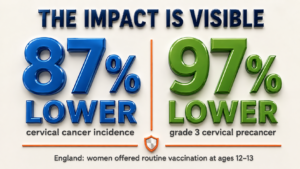
Early trials showed that HPV vaccination was highly effective against vaccine-type persistent infection and high-grade precancer. We now have something even more compelling: real-world cancer outcomes. In England, women offered routine vaccination at age 12 or 13 had an 87% lower incidence of cervical cancer and a 97% lower incidence of grade 3 cervical precancer than comparable unvaccinated cohorts. The benefit was largest when vaccination occurred at the youngest age.
A 2026 population analysis, again from England, found no cervical-cancer deaths among women aged 20-24 during 2020-2024, when vaccination coverage in that cohort was close to 90%. The study was observational, but it is the first robust national-level signal that vaccination is reducing not only disease, but deaths.
Who should be vaccinated?
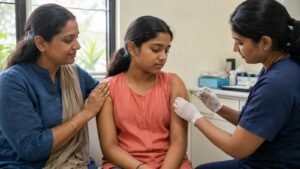
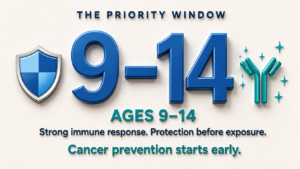
The priority window is early adolescence. WHO recommends vaccination primarily for girls aged 9 to 14 years, before sexual exposure and when the immune response is particularly strong. Vaccination at this age is cancer prevention, not a prediction about when a child will become sexually active. Framing it alongside other routine adolescent vaccines helps remove unnecessary stigma.
Boys also benefit. HPV can cause anal, penile and oropharyngeal cancers as well as genital warts, and vaccinating boys reduces viral circulation while protecting them directly. Whether boys are included in a public program varies by country, but families can discuss individual vaccination with their clinician.
If someone missed vaccination as a child, the opportunity is not automatically gone. A sexually active person may already have encountered one HPV type but not all types covered by a vaccine. However, expected benefit generally falls as prior exposure accumulates. Catch-up age limits differ across countries and product labels; the sensible approach is an individual discussion based on age, immune status, previous doses and future likelihood of new exposure.
How many doses? The answer is changing
Schedules must be read carefully. WHO supports one- or two-dose schedules for adolescents in eligible programs and allows an alternative single-dose schedule from ages 9 to 20 for vaccine products with supporting evidence. A major randomized trial published in 2025 strengthened that position: one dose of either a bivalent or nonavalent vaccine was non-inferior to two doses over five years against persistent HPV16 or HPV18 infection, with effectiveness of at least 97%.
This does not mean every person everywhere should stop after one injection. National programs, regulatory labels and available products are not identical. People who are immunocompromised, including those living with HIV, should receive at least two doses and, where possible, three. Follow the schedule advised locally; if a series is interrupted, it can generally be resumed rather than restarted.
Safety: what patients and parents most often ask
HPV vaccines have been monitored for well over 15 years. The common effects are brief: pain, redness or swelling at the injection site, sometimes headache, fever, dizziness or muscle aches. Fainting can occur after any injection, particularly in adolescents, so sitting or lying down during vaccination and remaining under observation for about 15 minutes is sensible. Large safety reviews continue to find that the benefits far outweigh the risks.
The persistent fertility myth deserves a direct answer: HPV vaccination has not been shown to cause fertility problems. In contrast, treatment for advanced cervical precancer or cancer can affect the cervix, uterus and future pregnancy options. Preventing disease protects reproductive health; it does not threaten it.
Vaccination is not routinely recommended during pregnancy. If a dose is given before pregnancy is recognized, available data are reassuring and there is no reason for alarm; remaining doses are deferred until after pregnancy. Vaccination is compatible with breastfeeding when otherwise indicated. A previous severe allergic reaction to a vaccine component or prior dose is a contraindication and should be discussed with the vaccinating clinician.
Vaccination does not replace screening
This is the point most worth repeating. Vaccines do not cover every cancer-causing HPV type, and they cannot undo infection acquired before vaccination. Precancer usually causes no symptoms. WHO therefore recommends HPV-based screening at intervals determined by national guidance; its 2026 global guidance advises a high-performance test every 5 to 10 years from age 30, or every 3 to 5 years from age 25 for women living with HIV. Screening remains important even after vaccination.
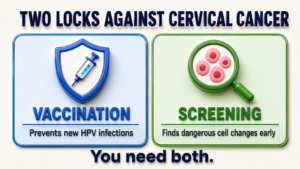
Think of vaccination and screening as two locks on the same door. Vaccination prevents the infection that starts the process; screening identifies the smaller number of dangerous infections or cell changes that still occur. Used together, and followed by timely treatment of precancer, they can make cervical cancer rare.
The bottom line
The HPV vaccine is not a vaccine about sex. It is a vaccine against cancer, given years before the cancer would otherwise appear. Parents should ask about vaccination for children in the 9-to-14-year window. Unvaccinated adolescents and adults should ask whether catch-up vaccination is appropriate. Vaccinated women should still attend cervical screening when invited.
WHO’s elimination goal is fewer than four new cervical-cancer cases per 100,000 women, supported by its 90-70-90 targets for vaccination, screening and treatment.
That goal is ambitious, but no longer fanciful. We have already seen precancer fall, cancer incidence collapse in highly vaccinated cohorts, and the first generation reach young adulthood without a recorded cervical-cancer death. The remaining question is whether access, confidence and timely action can catch up with the science.
This article provides general health information and is not a substitute for individual medical assessment.
(The author is a consultant obstetrician and gynaecologist based in Bengaluru.)