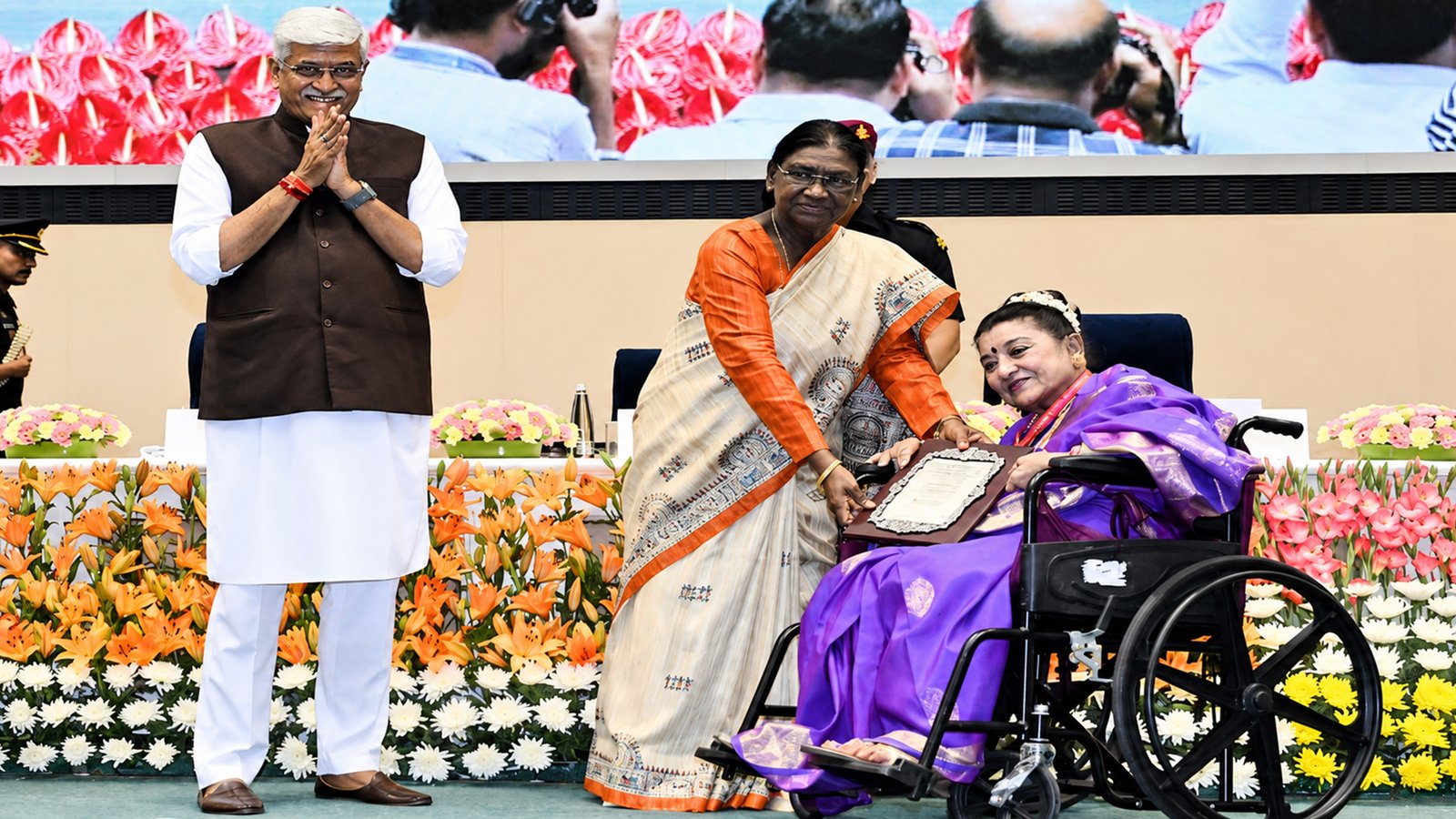
President Droupadi Murmu on Thursday conferred the Sangeet Natak Akademi Fellowships and Awards for 2024 and 2025 on more than 100 artists at a special investiture ceremony in New Delhi. The honours recognised distinguished contributions to India’s performing arts, including music, dance, theatre, puppetry, folk and tribal arts and traditional performance forms.
The ceremony brought together artists representing different regions and traditions of the country, highlighting the breadth of India’s cultural landscape. The combined awards for the two years included seven Sangeet Natak Akademi Fellowships, also known as Akademi Ratna, and 115 Akademi Awards, or Akademi Puraskar. The awards recognised practitioners across classical and traditional art forms, including Hindustani and Carnatic music, Bharatanatyam, Kathak, theatre, puppetry and several regional folk traditions.
Among those receiving the prestigious fellowship were Ramlal Bareth, A V Anand, Rita Ganguly, Puru Dadheech, Chittaranjan Jyotishi, Pasumarthi Rattaiah Sarma and Sudharani Raghupathy. The fellowship is the highest honour given by the Sangeet Natak Akademi and is intended to recognise artists who have made significant and sustained contributions to the performing arts.
The awards ceremony also recognised artists working in less widely known and traditional forms of performance. The list included practitioners associated with folk theatre, regional dance and music traditions, as well as puppetry and other allied forms. By bringing these traditions into a national award framework, the Sangeet Natak Akademi Awards underline the importance of preserving artistic practices that are often rooted in particular communities and regions.
Addressing the gathering, President Murmu described the artists being honoured as representatives of a broad cultural map of India. She said their work carries stories, songs, dances, festivals, languages and dialects that have developed over generations. According to the President, the country’s cultural diversity is reflected not only in its classical traditions but also in its numerous folk and community-based art forms.
The President also drew attention to the close relationship between Indian art and nature. She noted that many musical and dance traditions have evolved from artists’ interaction with their surroundings, with elements of nature finding expression in songs, performances and artistic practices. She described the unity that emerges from this diversity as one of the major strengths of Indian culture.
A key concern raised during the ceremony was the survival of traditional and folk arts. President Murmu pointed out that several folk art forms face the threat of extinction as social and cultural conditions change. She stressed that documenting these traditions alone would not be enough and called for sustained efforts to keep them alive.
She also highlighted the importance of the Guru-Shishya tradition, through which artistic knowledge has traditionally been passed from one generation to another. The President urged senior artists to systematically train and mentor younger practitioners so that valuable knowledge and techniques are not lost. She welcomed the Sangeet Natak Akademi’s Kala-Diksha programme, which focuses on preserving and documenting traditional art forms.
The awards carry both recognition and a material component. Each Sangeet Natak Akademi Fellow receives a purse of ₹3 lakh, a Tamrapatra and an Angavastram, while each Akademi Award recipient receives ₹1 lakh along with a Tamrapatra and Angavastram.
Established in 1953, the Sangeet Natak Akademi serves as India’s national academy for music, dance and drama. Over the decades, its awards have become an important national platform for recognising artists whose work has shaped India’s performing arts. The Akademi’s role extends beyond awards to the preservation, documentation and promotion of traditional cultural practices.
For many of the recipients, the recognition comes after years of sustained work away from the mainstream spotlight. Artists working in folk theatre, regional dance, traditional music and puppetry often rely on intimate community networks and oral transmission to keep their practices alive. National recognition can therefore help bring greater attention to these traditions and encourage younger generations to engage with them.
President Murmu said the artists honoured at the ceremony should be seen as bearers of Indian tradition, guardians of collective memory and creators of the country’s cultural future. She also described the Sangeet Natak Akademi as an important centre of India’s cultural soft power, expressing confidence that it would continue taking Indian artistic traditions to audiences around the world.