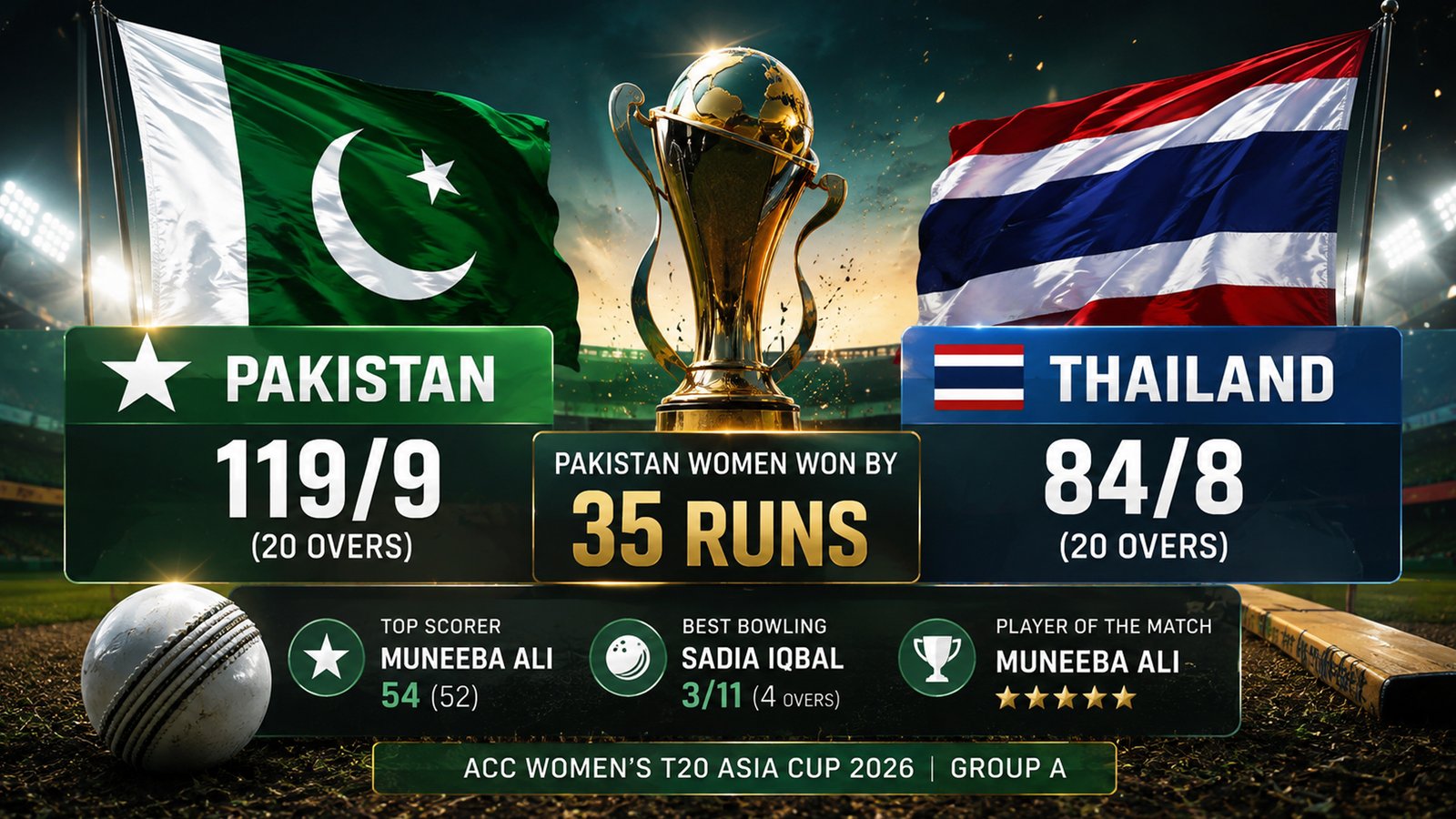
Pakistan Women opened their Women’s Asia Cup 2026 campaign with a 35-run win over Thailand on Wednesday, but the victory was anything but straightforward.
A fighting half-century from opener Muneeba Ali, followed by a disciplined bowling performance led by Sadia Iqbal, helped Pakistan defend a modest total of 119 and begin their tournament with two valuable points.
Asked to bat first in Dubai, Pakistan found it difficult to get going. Thailand’s bowlers kept things tight and made it hard for the Pakistani batters to find their rhythm. Pakistan slipped to 7 for two early, putting the pressure on the middle order.
That was when Muneeba stepped up.
The left-hander played the kind of innings her team needed — patient when the situation demanded it and willing to attack when opportunities appeared. She scored 54 runs, becoming the only Pakistan batter to make a significant contribution as wickets continued to fall around her.
Muneeba’s innings was not about flashy stroke-making. Instead, she concentrated on staying at the crease and ensuring Pakistan had something to defend. Her experience at the top of the order proved crucial as she guided the innings through a difficult phase.
Pakistan eventually reached 119 for nine in their 20 overs. On paper, it was hardly an intimidating total. Thailand had every reason to believe they could chase it down.
But Pakistan’s bowlers had other plans.
Sadia Iqbal quickly emerged as the key figure in the defence. The left-arm spinner claimed three wickets, repeatedly disrupting Thailand’s attempts to build partnerships.
Thailand’s chase never really gathered momentum. Pakistan kept taking wickets just when their opponents appeared ready to settle. The pressure gradually mounted, and the required run rate became increasingly difficult to manage.
Thailand eventually finished at 84 for eight, well short of the target.
It was a victory for Pakistan built more on character than dominance. Their batting had been inconsistent, but when they needed someone to stay calm, Muneeba did. When they needed wickets, Sadia and the rest of the bowling attack delivered.
That combination will give Pakistan confidence, especially with a much bigger challenge waiting.
Their next match is against India on September 5, one of the most eagerly awaited fixtures of the tournament.
The timing could hardly be more interesting. India also began their campaign against Thailand and produced a much more convincing result, winning by 94 runs.
India scored 159 for nine before restricting Thailand to just 65. Shafali Verma led the way with an attacking 64, while the Indian bowling attack maintained complete control during the chase.
Pakistan will therefore know that they cannot afford another slow start with the bat when they face India.
Muneeba’s form could become particularly important. Her half-century against Thailand showed that she can absorb pressure and bat deep into an innings. Against India, Pakistan will need that same composure, but they will also need more support from the other batters.
The bowling unit, meanwhile, will enter the contest with confidence. Defending 119 is not easy in T20 cricket, and Pakistan’s bowlers showed they can make life uncomfortable even when their batting side has not produced a big score.
Sadia’s three wickets will be especially encouraging. Her ability to control the middle overs and break partnerships could prove valuable against India’s strong batting lineup.
The opening victory provides an important foundation, for Pakistan captain Fatima Sana. There are areas to improve, particularly with the bat, but winning a match from a difficult position can sometimes give a team more confidence than a comfortable victory.
Thailand, meanwhile, will rue their inability to make the most of a good bowling effort. Restricting Pakistan to 119 gave them a genuine opportunity, but their batters struggled to deal with Pakistan’s attack and could not build the partnerships needed for a successful chase.
The match also highlighted one of the biggest realities of T20 cricket: a team does not necessarily need a huge total to win if its bowling attack can maintain pressure.
Pakistan now have two points on the board and momentum behind them. But the India game will offer a far tougher examination.
The rivalry between India and Pakistan naturally brings enormous attention, but the contest will also have important implications for the Women’s Asia Cup 2026 standings. Both teams will want to strengthen their position in the group and take an early step towards the knockout stage.
The formula will be simple but demanding. They will need their top order to provide a stronger platform, their middle order to contribute more consistently and their bowlers to maintain the discipline that worked so well against Thailand.
Muneeba has already done her part. Her 54 gave Pakistan a total they could defend when the match appeared to be slipping away from them.
Sadia and the bowling attack then finished the job.
Now, the stakes are higher.
Pakistan will face an India side that has already shown its firepower in the tournament. If Muneeba can provide another solid start and Pakistan’s bowlers can once again find a way to keep the opposition under pressure, the September 5 clash could become a much closer contest than the opening games suggest.
Pakistan can enjoy their win. It was not perfect, but it showed resilience and in a tournament where every point matters, that can be just as valuable as a dominant performance.