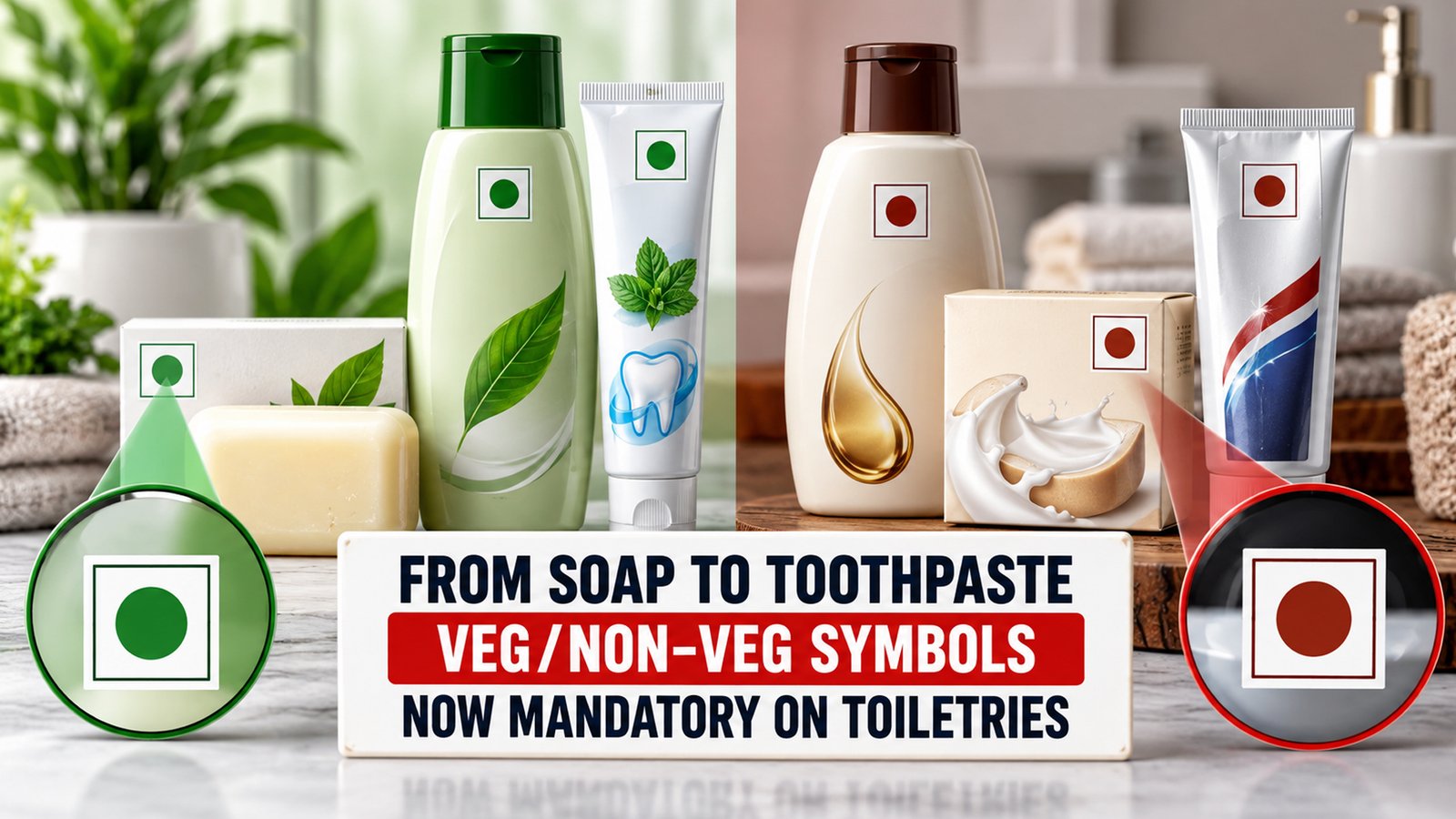
Consumers buying everyday personal-care products such as soaps, shampoos and toothpastes will soon have a clearer way to identify whether a product is of vegetarian or non-vegetarian origin.
The Centre has amended the Legal Metrology (Packaged Commodities) Rules, 2011, making colour-coded vegetarian and non-vegetarian symbols mandatory on packaged cosmetics, toiletries and other personal-care products.
The Legal Metrology (Packaged Commodities) Fourth Amendment Rules, 2026, were notified on September 21 and came into force from the date of their publication in the Official Gazette.
Under the amended rules, products of vegetarian origin must carry a green dot, while products of non-vegetarian origin must display a red or brown dot.
The symbol must be placed at the top of the principal display panel of the package. This is intended to make the information clearly visible to consumers without requiring them to go through the entire label.
The new requirement covers a broad range of packaged personal-care products. It includes soaps, shampoos, toothpastes, cosmetics and other toiletries that fall under the applicable regulations.
The colour-coded system is designed to give consumers a quick indication of the product’s origin.
A green dot will indicate that the product is of vegetarian origin. A red or brown dot will indicate that it is of non-vegetarian origin.
The distinction is particularly relevant for products that may contain ingredients whose source is not immediately obvious from the product name.
For example, consumers may not always be able to determine the origin of every ingredient simply by looking at a shampoo, toothpaste or cosmetic product. The new symbol will provide an additional piece of information at the point of purchase.
The requirement does not mean that manufacturers can stop providing other information about their products. Existing labelling requirements will continue to apply.
Packaged cosmetics and toiletries must carry details such as the name of the product, manufacturer’s name and address, net quantity, batch number, manufacturing information and maximum retail price, wherever applicable.
Imported products must also provide relevant information about the importer or authorised agent.
Manufacturers are required to provide directions for use and safety warnings or precautions where necessary.
Although the latest notification makes the requirement clearer under the amended Legal Metrology rules, the idea of displaying vegetarian and non-vegetarian symbols on personal-care products is not new.
A similar provision was introduced into the Legal Metrology rules in 2014.
The latest amendment changes the regulatory provision under which the requirement operates. It introduces the requirement under Rule 6(4A)(d) and omits the earlier provision under Rule 6(8).
The issue has also been the subject of legal proceedings.
In February 2026, the Delhi High Court considered a challenge relating to the requirement for vegetarian and non-vegetarian symbols on cosmetics and toiletries.
The case brought into focus the roles of different regulators, including the authorities responsible for legal metrology and those overseeing cosmetics.
The court had sought coordination between the Director of Legal Metrology and the Drug Controller General of India to arrive at a comprehensive position on the labelling requirement.
The latest government notification now formally places the requirement under the amended Legal Metrology framework.
For manufacturers and sellers, the amendment means that packaging for products covered by the rules will have to carry the prescribed symbol in the specified location.
Companies may therefore need to review and update their packaging designs and labels to comply with the revised rules.
The change also means that retailers will increasingly see the symbols on a wider range of products beyond packaged food.
The requirement comes at a time when consumers are paying greater attention to the ingredients and composition of products they buy. While information about ingredients is already available on product packaging, such details can sometimes be difficult to interpret.
The colour-coded symbol provides a simpler visual indicator.
However, the symbol should not be treated as a substitute for the ingredient list. Consumers who want detailed information about a product will still need to check the ingredients, directions for use and other declarations on the package.
A green dot at the top of the main display panel will indicate a product of vegetarian origin. A red or brown dot will indicate a product of non-vegetarian origin.
The symbols are expected to be particularly noticeable on products such as soaps, shampoos, toothpastes, creams and other cosmetics.
The move effectively extends a familiar labelling concept from food products to a wider group of consumer goods.
As the new rules take effect, shoppers will have another way to quickly identify the nature of products they are buying, while manufacturers will have to ensure that their packaging meets the updated labelling requirements.