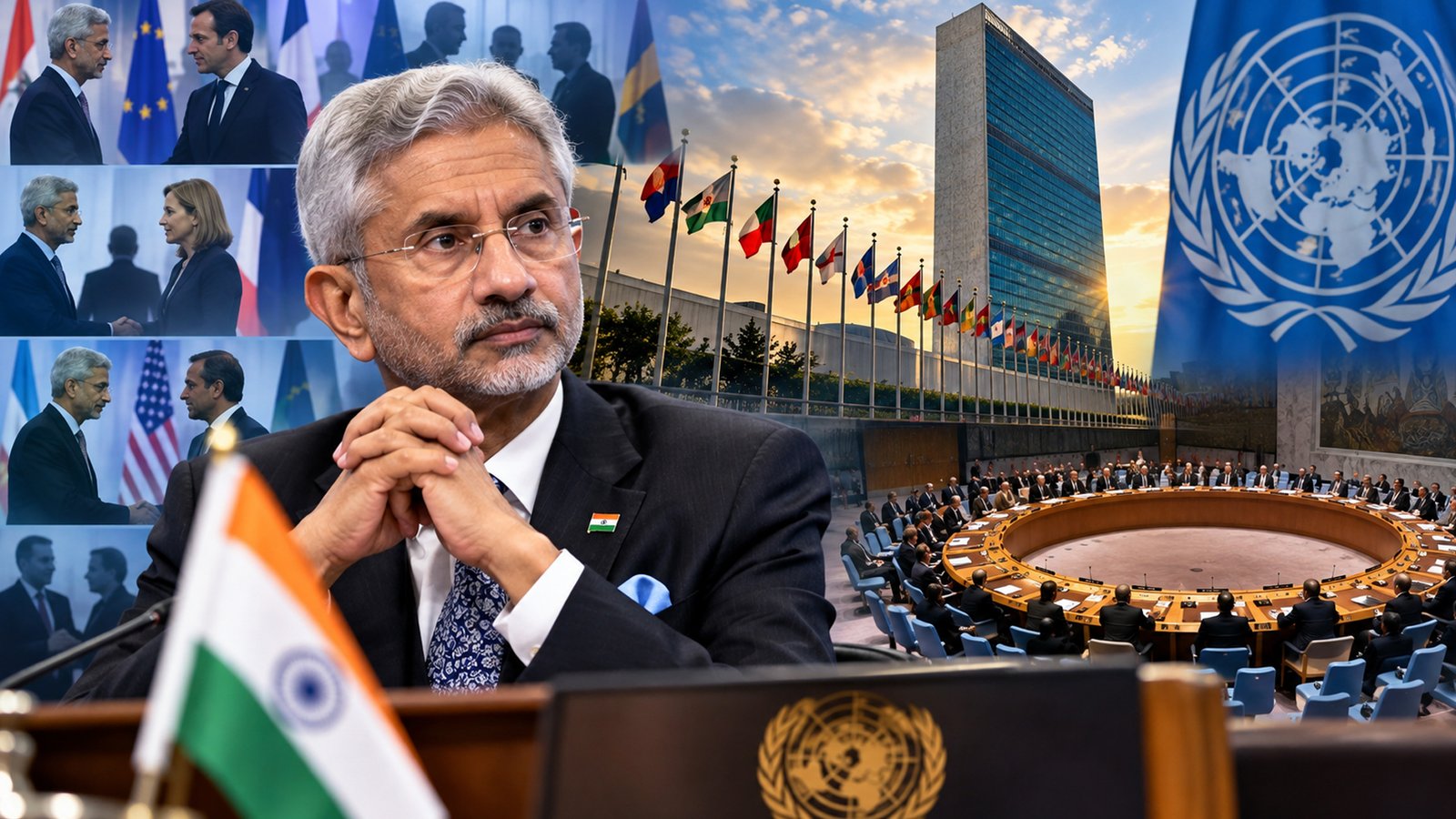
India has stepped up its diplomatic campaign at the United Nations, with External Affairs Minister S Jaishankar holding a series of meetings in New York as the country seeks support for its candidature for a non-permanent seat on the UN Security Council for 2028-29.
The campaign comes alongside a renewed push by India, Brazil, Germany and Japan for changes to the Security Council, which the four countries say no longer reflects today’s geopolitical realities.
The foreign ministers of the G4 countries met on September 22 on the sidelines of the 81st session of the UN General Assembly. In a joint statement issued after the meeting, they called for Security Council reform to move forward at the earliest.
The G4 wants the Council expanded in both its permanent and non-permanent categories. The group also called for greater representation for regions that remain under-represented, including Africa, Asia-Pacific and Latin America and the Caribbean.
The four countries said the increasingly difficult global security environment has made reform more urgent. They argued that the present structure, created around eight decades ago, does not adequately reflect the distribution of political and economic influence in the world today.
The push comes as the UN faces pressure over its ability to respond effectively to conflicts and other international crises. Reform of the Security Council has been discussed for years, but negotiations among member states have yet to produce a substantive restructuring of the body.
The Security Council currently has 15 members. Five countries — the United States, Russia, China, France and the United Kingdom — hold permanent seats and veto power. The remaining 10 members are elected for two-year terms and do not have veto rights.
India has long sought a permanent seat on the Council and has argued that its population, economy, peacekeeping record and role in the developing world should be reflected in the UN’s decision-making structure.
At the same time, India’s immediate campaign is for a non-permanent seat for the 2028-29 term. Jaishankar formally launched India’s campaign in July, presenting it as part of New Delhi’s broader effort to push for what it calls more representative and effective multilateral institutions.
India’s campaign theme centres on “SHANTI”, an acronym for “Securing Holistic Advancement through Norms, Trust and Integrity”. At the campaign launch, Jaishankar said India wanted a Security Council that better represented the Global South and was more responsive to contemporary challenges.
India has also highlighted its long involvement in UN peacekeeping. According to Jaishankar’s campaign statement, the country has contributed nearly 300,000 personnel across about 50 UN missions over the years. India currently has around 4,300 personnel serving across 10 of the 11 active missions.
Jaishankar’s schedule in New York includes a series of bilateral and plurilateral meetings with foreign ministers and other representatives. Discussions have covered regional and global issues as well as reform of the UN Security Council.
The timing is important for India’s campaign because the UN General Assembly brings together representatives from all 193 member states, providing an opportunity for countries seeking elected positions to engage with a wide range of governments.
India has also received recent support from European countries for its longer-term push for permanent membership. On September 22, the four members of the Visegrád Group, Poland, Hungary, Slovakia and Czechia, expressed support for India’s permanent membership during discussions with Jaishankar in New York.
The G4 meeting, however, goes beyond India’s own candidature. Brazil, Germany and Japan are also seeking permanent representation as part of their respective campaigns for a reformed Security Council.
The four countries have worked together for years on Security Council reform. Their latest joint statement said negotiations under the UN’s Intergovernmental Negotiations framework have continued for 18 years without producing the substantive changes they are seeking. The G4 wants member states to move towards text-based negotiations rather than continuing discussions without a concrete negotiating document.
The group has also backed stronger representation for Africa, including permanent representation, reflecting the wider debate over regional balance within the UN system.
The reform question is complicated by differences among UN members over how additional seats should be distributed, whether new permanent members should receive veto powers and which countries should represent particular regions.
India’s campaign therefore has two connected tracks: securing another elected term on the Security Council and continuing its longer-term demand for permanent membership as part of a wider UN reform process.
Jaishankar is scheduled to address the high-level segment of the 81st UN General Assembly on September 26. His visit comes as India seeks to use the gathering to strengthen diplomatic engagement and outline its priorities on international security, multilateralism and the interests of the Global South.
The latest G4 meeting has put Security Council reform back at the centre of India’s UN diplomacy. While the structure of the Council remains unchanged, India and its G4 partners are pressing member states to begin substantive negotiations on a system they believe should better reflect the world as it exists today.