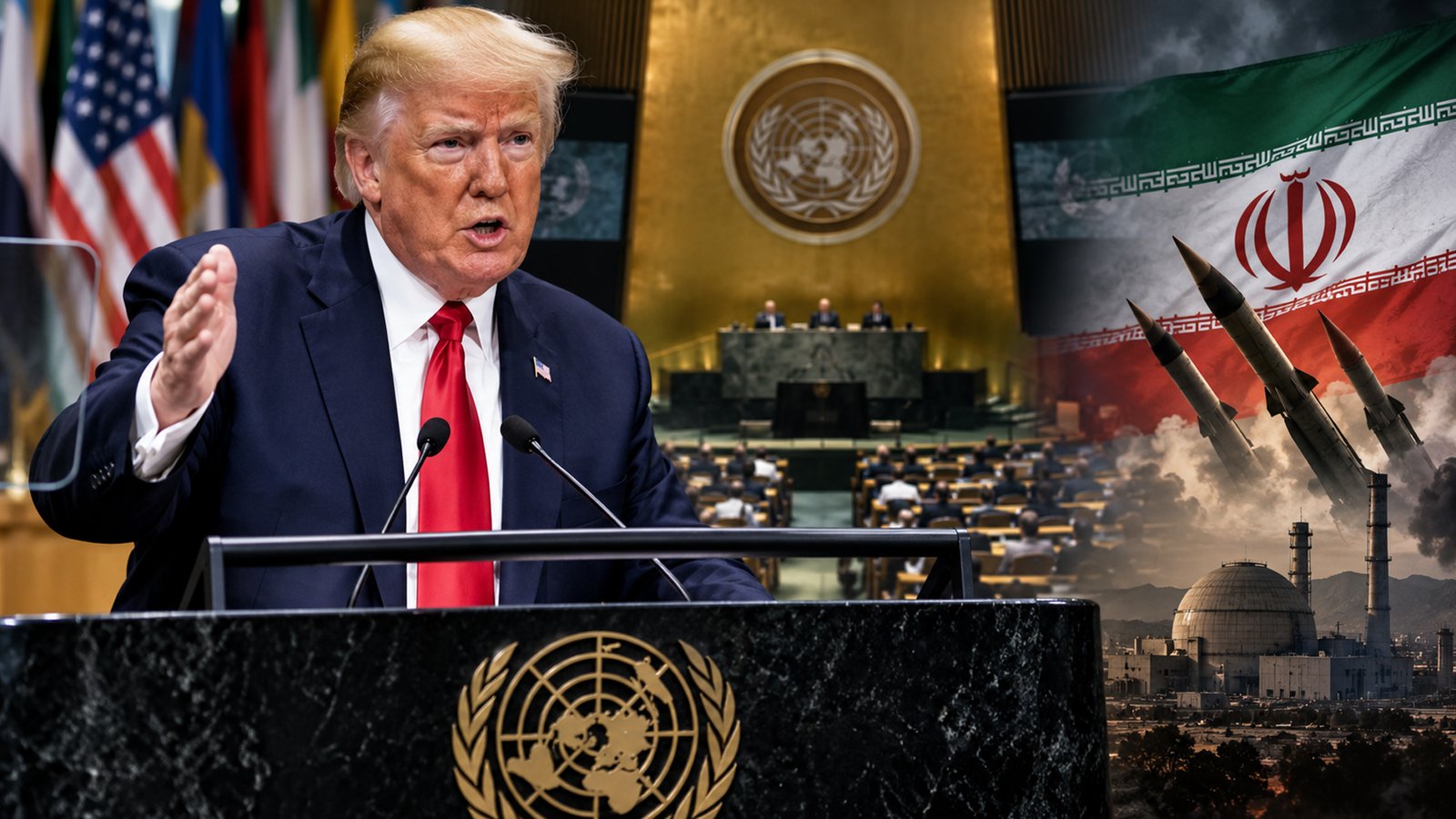
US President Donald Trump used his address to the United Nations General Assembly on September 22 to defend the US military campaign against Iran and call on countries to increase economic pressure on Tehran.
Speaking before world leaders in New York, Trump said the United States had acted after diplomatic efforts failed to prevent Iran from advancing its nuclear programme and expanding its military capabilities. He said Washington would not allow Iran to acquire nuclear weapons.
Trump also called on countries to support what he described as the complete economic isolation of Iran. He linked the demand to Tehran’s actions involving commercial shipping, its nuclear programme and its support for groups that Washington considers terrorist organisations.
The Iran conflict was the central issue in Trump’s speech. He claimed US military action had severely weakened Iran’s military infrastructure, including its naval and air capabilities, radar systems and missile and drone production. These were claims made by Trump in his address and were not independently established by the UN.
Trump also pointed to shipping through the Strait of Hormuz, one of the world’s most important routes for oil supplies. He said the US Navy had escorted more than one billion barrels of oil through the waterway since the conflict began and argued that international cooperation was needed to keep commercial shipping moving.
The president presented Iran with a choice between reaching a negotiated agreement and facing further military action. He said a deal could allow Iran to rebuild its economy and become a stronger country, but warned that the alternative would be a major escalation.
Trump later said US representatives had held a lengthy meeting involving Iranian mediators on the sidelines of the UN gathering. He described the discussions as productive, although he clarified that US officials had met mediators rather than Iranian representatives directly.
The comments highlighted the uncertainty surrounding the next stage of the conflict. Trump continued to defend military pressure while also leaving room for negotiations.
The US president also rejected reports that the Iran campaign was putting pressure on American weapons supplies. He said US stockpiles remained strong and that new defence production facilities were being built. Trump said 18 major ammunition plants were under construction and would eventually increase supplies for both the US and its allies.
Economic pressure was another major element of his Iran policy. Trump argued that wider international sanctions and restrictions could force Tehran back to negotiations. He also said that stronger pressure could eventually help bring oil prices down by restoring stability to global energy markets.
Beyond Iran, Trump used the speech to outline his broader foreign-policy approach. He said his administration was continuing efforts to end the Russia-Ukraine conflict and highlighted developments involving Venezuela, Mexico, Cuba and Greenland.
On Venezuela, Trump referred to a US military operation that resulted in the arrest of President Nicolás Maduro, according to a report from News On AIR. He said Washington was now working with Venezuelan leaders and also announced a major oil agreement between the two countries.
Trump also discussed relations with Mexico, focusing on the fight against drug cartels and transnational crime. He said the United States had designated drug cartels as foreign terrorist organisations and called for stronger action against them.
Cuba also featured in his remarks. Trump said his administration was involved in negotiations aimed at bringing about what he described as a fundamental change in the country.
Greenland was another key part of the speech. Trump highlighted a new agreement involving the United States, Denmark and Greenland and described the Arctic territory as strategically important. He said the arrangement would strengthen US security interests in the Arctic and North Atlantic and expand cooperation with NATO.
Artificial intelligence was another major theme. Trump said the US would continue supporting rapid AI development rather than accept international restrictions that, in his view, could slow innovation. He referred to the technology as “superintelligence” and rejected warnings about uncontrolled AI development.
His remarks also included criticism of international organisations. Trump attacked the International Criminal Court, the UN Human Rights Council, UNESCO and the International Maritime Organization. He argued that international institutions should not expand their authority at the expense of national governments.
The speech came as the UN General Assembly opened against a backdrop of wars, energy-market disruption and growing disagreements over the role of international institutions.
UN Secretary-General António Guterres has urged countries to rely on international cooperation and the rule of law to address conflicts. Trump’s speech, in contrast, placed greater emphasis on US military power, economic pressure and national sovereignty.
Iran remains the most immediate issue. Trump has signalled that negotiations are still possible, but his demand for economic isolation and his warning of further military action leave the path ahead uncertain.
The US-Iran contacts at the UN could provide an opening for diplomacy, but any agreement would depend on the two sides resolving major disputes over Iran’s nuclear programme, sanctions, military activity and regional influence. Meanwhile, the conflict’s impact on commercial shipping, energy supplies and global markets continues to make the issue a concern well beyond the Middle East.