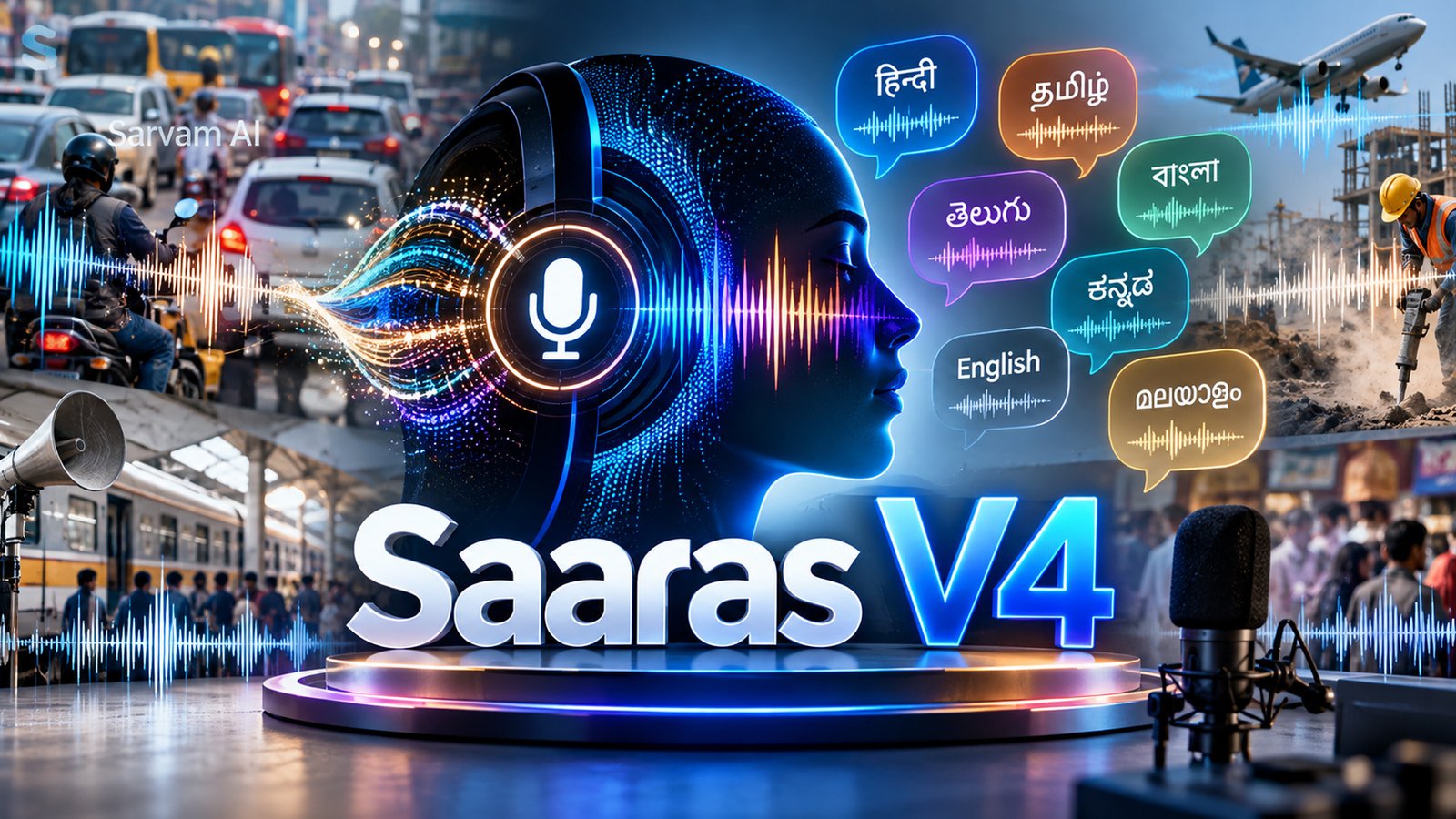
Sarvam AI has launched Saaras V4, its latest automatic speech recognition model, as the Indian artificial intelligence startup expands its focus on voice-based applications. The new model is built to understand speech across 22 Indian languages and English, while handling the kind of noisy, mixed-language audio commonly found in real-world conversations.
The model is designed for applications including voice assistants, customer-service systems, call analytics and other services that rely on speech-to-text technology. Rather than treating transcription, translation and transliteration as separate tasks, Saaras V4 brings several of these capabilities into one model.
It can generate five types of output from the same audio: verbatim transcription, normalised text, code-mixed text, transliteration and translation. This means developers can choose how speech should appear as text depending on the application, without having to build separate post-processing systems for every format.
The model combines an audio encoder with a 3-billion-parameter hybrid state-space language model developed by Sarvam AI. The company has trained the system to deal with challenges that are particularly relevant to Indian speech, including regional accents, dialect differences, background noise and conversations in which speakers switch between languages.
Code-mixed conversations are increasingly common in India, where speakers may move between English and an Indian language within the same sentence. Saaras V4 is designed to recognise such speech and produce code-mixed text when required.
The model also automatically identifies the language being spoken and can transcribe it in the corresponding native script. Sarvam AI reported a language-identification error rate of 5.22% across 22 Indian languages in its IndicVoices evaluation. The error rate fell to 2.9% when the test was limited to the 10 most widely spoken languages.
Sarvam also tested Saaras V4 on Indian-language speech through the Vistaar benchmark, covering 10 languages. The evaluation used both Word Error Rate, or WER, and LLM-WER. While WER measures transcription errors, LLM-WER adds a semantic assessment to distinguish errors that change meaning from differences linked to formatting or spelling conventions.
English performance was tested separately across seven benchmarks covering Indian English, international accents, meetings, financial conversations, media and other speech conditions. Sarvam AI said Saaras V4 recorded the lowest average WER across those datasets. These are company-reported evaluation results.
Another feature aimed at practical business use is keyterm prompting. It allows developers to provide names, brands, places, acronyms or technical terms that the model should pay particular attention to while processing speech.
This can be useful in industries where conversations contain specialised vocabulary or frequently mention company and product names. Sarvam’s evaluation on the IndicContextEval benchmark recorded a WER of 16.03% in the L5 keyword-prompting setting.
Saaras V4 is also built for applications that require near real-time processing. Sarvam says the model has a streaming time to first token of less than 150 milliseconds, allowing transcribed text to begin appearing quickly while a conversation is still taking place.
The system can also process long-form audio and is designed to work with multiple sources of audio. This expands its potential use in areas such as meetings, calls and other situations where more than one person or audio source needs to be understood.
The model is available to developers through Sarvam AI’s application programming interfaces. Python and Node.js support is available, along with integrations for tools and platforms including Vercel AI SDK, LiveKit Agents and Pipecat Agents. Saaras V4 can be accessed through REST, batch and WebSocket-based streaming interfaces.
Sarvam has also continued adding features to the model after its initial release. Its API documentation shows that Saaras V4 supports Global English in addition to Indian English, while retaining coverage of all 22 Indian languages. The company has also added keyterm prompting to streaming WebSocket access, allowing developers to provide up to 50 terms to improve recognition of specific vocabulary.
The launch comes as Indian AI companies increasingly focus on models built around the country’s linguistic diversity. Speech recognition remains a key part of that effort because voice can provide a more accessible interface for users who may not be comfortable interacting with technology primarily through English or text.
With Saaras V4, Sarvam AI is positioning speech recognition as a building block for a wider range of Indian-language AI applications. Its combination of multilingual recognition, code-mixed speech support, translation, transliteration and low-latency streaming is aimed at developers building voice products for both Indian and international users.