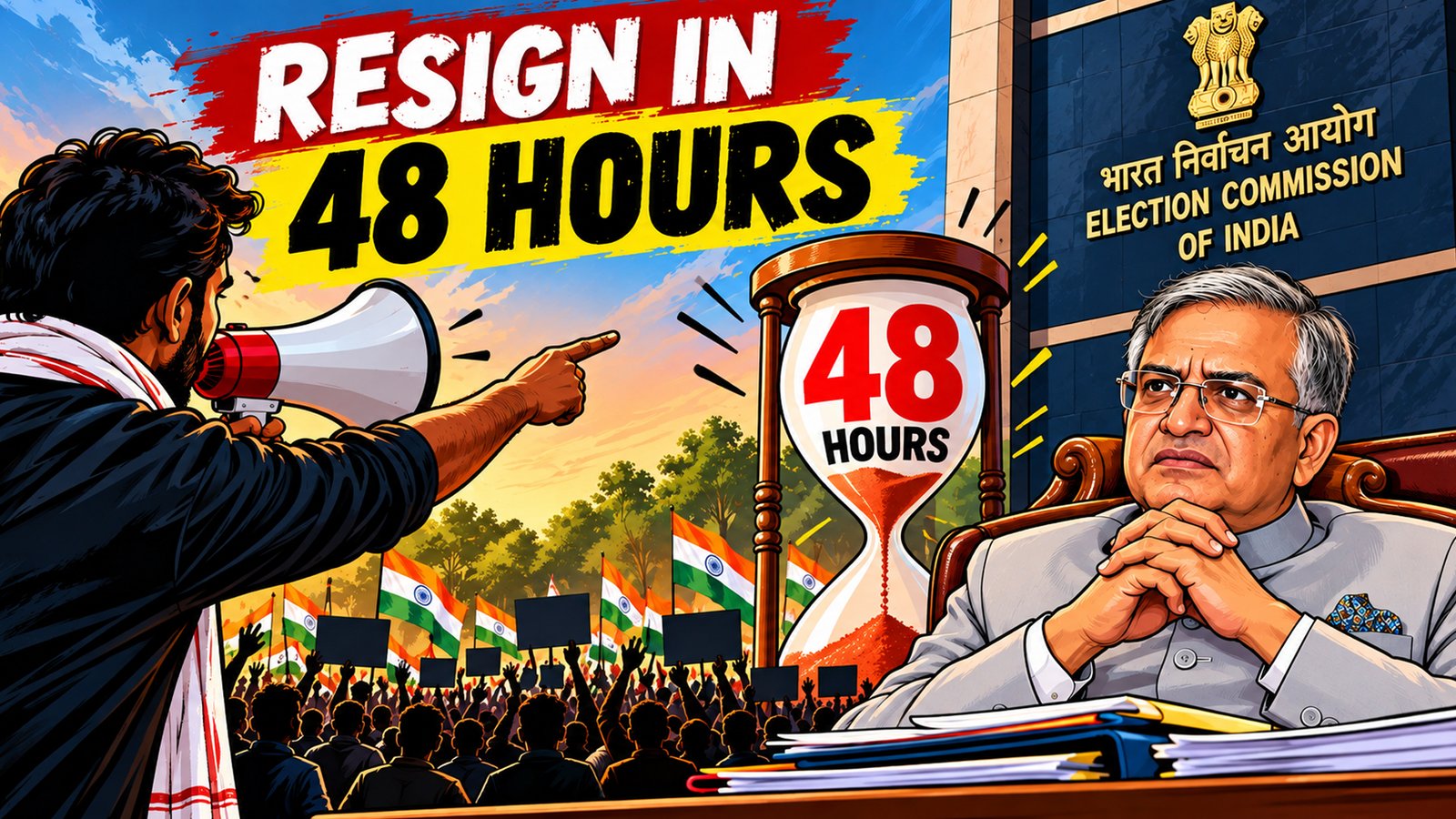
The Cockroach Janta Party (CJP) has given Chief Election Commissioner Gyanesh Kumar 48 hours to resign, warning that it will launch a nationwide protest if he does not step down. The group announced the ultimatum on Thursday amid a wider controversy over the Election Commission’s ongoing Special Intensive Revision (SIR) of electoral rolls.
At a press conference in New Delhi, CJP founder Abhijeet Dipke, along with co-conveners Saurav Das and Ashutosh Ranka, also announced a nationwide “Election Commission Thik Karo” campaign. The group said it would organise protests across the country and hold another large demonstration at Delhi’s Jantar Mantar if its demands were not met.
The latest development comes amid questions over the conduct of the SIR exercise and reports of differences within the three-member Election Commission. The Indian Express reported that Election Commissioners Sukhbir Singh Sandhu and Vivek Joshi had recorded objections on at least 14 occasions over a 10-month period on issues linked to electoral-roll decisions, voter data and the centralisation of the process.
The Election Commission has disputed the characterisation of these differences as a breakdown in decision-making. It has said that discussions and differences are part of deliberations within a multi-member constitutional body and maintained that final decisions, including those related to SIR, were taken unanimously.
CJP lists three demands
The CJP has put forward three principal demands.
First, it wants Gyanesh Kumar to resign and has called for criminal proceedings and an independent investigation into decisions taken during the electoral-roll revision process.
Second, it wants the SIR exercise frozen, upcoming elections halted and the January 2025 electoral rolls restored pending verification. The group has also called for relevant electoral records to be preserved and independently examined.
Third, the CJP wants the 2023 law governing the appointment of the Chief Election Commissioner and other Election Commissioners repealed and replaced with a new framework that, it says, should involve wider institutional and civil-society participation.
The group has also sought the publication of records relating to reported objections within the Election Commission, arguing that the public should be able to examine how decisions concerning electoral rolls and voter data were made.
SIR at centre of dispute
The SIR exercise has become the main focus of the CJP’s campaign. The party has cited large numbers of names excluded from draft electoral rolls in several states and Union territories.
According to figures cited by the CJP, more than two crore names were excluded in both Maharashtra and Uttar Pradesh, around one crore in Karnataka, 97 lakh in Tamil Nadu, 90 lakh in West Bengal, 73 lakh in Telangana, 47 lakh in Delhi and 24 lakh in Kerala.
The reported figures refer to exclusions from draft electoral rolls and do not by themselves establish that all the affected voters were wrongly removed. The electoral-roll revision process includes mechanisms for claims, objections and appeals.
The CJP has nevertheless argued that voters should have clear and accessible ways to challenge exclusions and restore their names.
One issue raised by the group concerns the digital systems used during SIR. It has questioned the centralisation of electoral-roll data and cited reports about difficulties in implementing some decisions taken by Electoral Registration Officers at the constituency level.
The group has called for greater transparency over who authorises changes to voter records and how decisions made at the local level are reflected in the final electoral rolls.
Election Commission faces wider scrutiny
The CJP’s demands come as the Election Commission faces broader political scrutiny over SIR and electoral-roll management.
The reported objections by Election Commissioners Sandhu and Joshi have added to the debate over how decisions are made within the poll panel. According to reports, their concerns included the centralisation of electoral-roll data and aspects of the digital systems used during the revision process. The Election Commission has said the decisions were ultimately unanimous.
The controversy has also drawn responses from political parties and civil-society groups, with demands for greater disclosure of electoral-roll data and the procedures used to remove or restore names.
The CJP has gone further by asking opposition parties to reconsider participation in elections if they believe the electoral process is being manipulated. That position is part of the group’s campaign and does not represent a decision by the Election Commission or a legal determination that elections are invalid.
Nationwide protest plan
The CJP initially said it would begin nationwide protests if Kumar did not resign within the 48-hour deadline. On Friday, Dipke said the group would begin its nationwide agitation from October 2, starting in Mumbai and subsequently taking the protest to other cities, if the CEC did not resign by Saturday.
The proposed agitation follows earlier protests by the group at Jantar Mantar, which the CJP is now referring to as a possible “Jantar Mantar 2.0”.
For the Election Commission, the controversy places renewed attention on the transparency of electoral-roll revisions, the use of technology in voter registration and the safeguards available to people whose names are excluded.
The immediate focus is now on whether the 48-hour deadline set by the CJP will lead to further protests and how the Election Commission responds to the group’s demands. The broader debate is likely to continue around SIR, voter-list verification, institutional decision-making and public confidence in the electoral process.