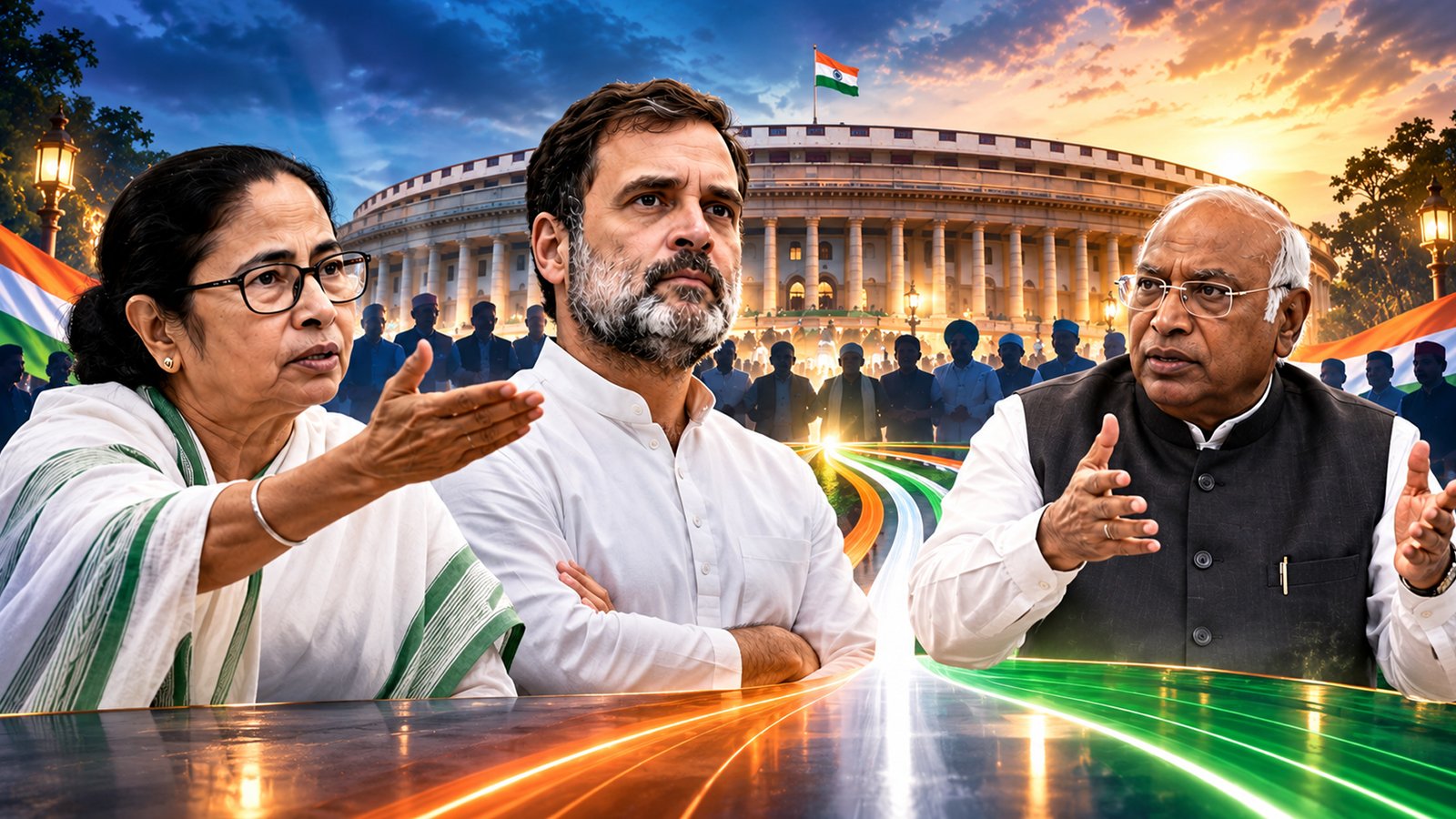
The INDIA bloc on Wednesday moved towards a more coordinated political campaign, with Trinamool Congress chief Mamata Banerjee stressing the need for opposition unity and indicating that she would have no objection to Rahul Gandhi becoming prime minister. Congress president Mallikarjun Kharge, however, said the meeting was focused on joint action rather than deciding the alliance’s leadership.
The issue emerged during a nearly three-and-a-half-hour meeting of INDIA bloc leaders in New Delhi. Banerjee, according to reports on the meeting, told opposition leaders that she had no objection if Rahul Gandhi became Prime Minister. Kharge subsequently emphasised that the immediate priority was to bring opposition parties together and respond collectively to issues concerning the electoral process.
The discussion comes as opposition parties seek to present a more coordinated front ahead of several state elections and the 2029 Lok Sabha election. Banerjee also urged parties to put aside differences and personal considerations, saying the larger objective should be collective action.
The meeting primarily centred on the Special Intensive Revision (SIR) of electoral rolls and the functioning of the Election Commission. Opposition parties have raised concerns over voter-list changes and have demanded greater transparency in the revision process. The Election Commission has maintained that its SIR decisions follow established procedures and have legal backing.
Kharge called for the use of electoral rolls prepared before the SIR exercise in future elections. He also demanded constituency-wise and booth-wise details of additions, deletions and corrections in voter lists, along with prior notice, reasons and an appeal mechanism before eligible voters are removed.
Another major demand was a return to paper ballots instead of electronic voting machines (EVMs). Kharge said the INDIA bloc should seek ballot-based elections, arguing that this would help address concerns about public confidence in the electoral system. Opposition parties at the meeting agreed on the demand, according to Kharge.
The Congress president also called for the removal of Chief Election Commissioner Gyanesh Kumar. He referred to reported differences within the Election Commission over decisions related to the SIR process and argued that the poll panel must be more transparent and institutionally accountable.
The Election Commission has rejected the suggestion that internal differences undermine its decisions. It has said differing views and observations are part of institutional deliberations and that its final orders have full legal sanction and follow statutory procedures.
Mamata Banerjee has separately demanded the resignation of the Chief Election Commissioner and said the opposition would continue its campaign over the electoral-roll issue. She also called for the Prime Minister’s resignation. These are political demands made by the Trinamool Congress chief and INDIA bloc leaders, rather than established findings about the conduct of the Election Commission or government.
Rahul Gandhi, meanwhile, said opposition leaders had a shared responsibility to defend the Constitution and democratic institutions. He called for collective action and said the coming months would be important for the opposition campaign.
The INDIA bloc has now agreed on a nationwide programme of protests. District-level “Save Democracy” marches are scheduled from October 2 to October 8. Opposition MPs will march to the Election Commission on October 6, while opposition leaders are expected to seek a meeting with President Droupadi Murmu in October. The alliance has also planned several major rallies, including a large gathering in Delhi on November 1.
The meeting also highlighted the effort to keep different opposition parties within a common political framework despite their individual priorities and differences. The Samajwadi Party was represented at the meeting, while some other parties did not participate. Shiv Sena (UBT) chief Uddhav Thackeray joined virtually, according to reports.
The leadership question remains separate from the immediate campaign over electoral reforms. While one report said Banerjee expressed openness to Rahul Gandhi becoming Prime Minister, she did not publicly answer a later question on whether Gandhi should be the INDIA bloc’s formal prime ministerial candidate for 2029.
That distinction reflects the broader challenge facing the alliance: maintaining unity among parties with different regional bases, political priorities and leadership interests while building a common campaign.
The immediate focus is now on the SIR controversy, electoral transparency, the Election Commission and the proposed shift back to ballot voting. The coming weeks will show how consistently the INDIA bloc can translate its latest agreement into coordinated political and legal action.