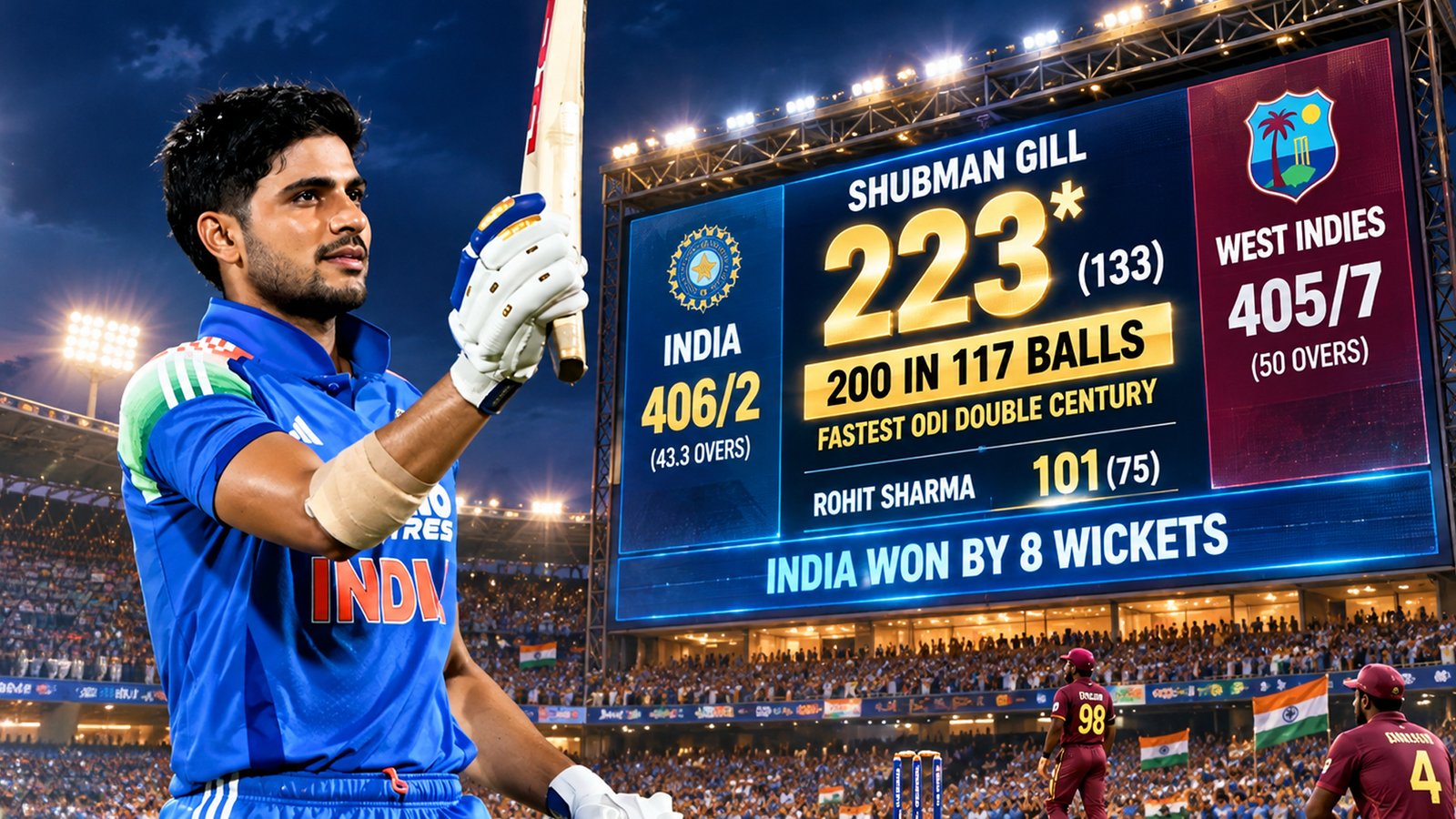
Shubman Gill produced a breathtaking batting display in Guwahati as India chased down West Indies’ massive 406-run target with ease, winning the second ODI by eight wickets and sealing the three-match series 2-0.
Gill remained unbeaten on 223 from 133 balls, hitting 28 fours and eight sixes. His innings was not just about the runs. It rewrote the record books, as the India captain became the fastest batter to score a double century in ODI cricket.
Gill reached his 200 in only 117 balls, breaking Ishan Kishan’s previous record of 126 balls for a double century. His earlier century came in just 62 balls, setting the tone for an innings that kept gathering pace.
The knock also made Gill only the second batter in ODI history to score more than one double century, after Rohit Sharma. Gill had earlier made 208 against New Zealand in Hyderabad in 2023.
What made the performance even more remarkable was the size of the target. West Indies had posted 405 for seven after producing their own extraordinary batting effort.
John Campbell, Shai Hope and Amir Jangoo all scored centuries as West Indies recorded their first 400-plus ODI total. Campbell made 101, Hope scored 104 and Jangoo smashed 114 from 77 balls. It was only the sixth time that three batters had scored centuries in the same ODI innings.
The West Indies innings appeared to put India under serious pressure. But the response from India was almost immediate.
Gill and Rohit Sharma turned the chase into a one-sided contest with a record 255-run opening partnership. Rohit scored a rapid 101 from 75 balls, bringing up his 35th ODI century and also crossing the landmark of 12,000 ODI runs.
The pair attacked from the beginning, ensuring that the required run rate never became a burden. Rohit eventually fell to Jayden Seales, but India were already firmly in control.
Virat Kohli added 29 from 19 balls before being dismissed with India at 320 for two. Ruturaj Gaikwad then contributed an unbeaten 31 from 37 balls, while Gill stayed at the crease to complete the job. India reached 406 in only 43.3 overs, with 39 balls still remaining.
The victory was India’s highest successful run chase in ODI cricket. It was also the second-highest successful chase in the history of the format, underlining the scale of the achievement.
Gill’s innings added several more milestones to an already remarkable night. His 223 is now the highest individual score in an ODI run chase, while his 62-ball century was among the fastest by an Indian batter in the format. He also registered his third successive ODI century on Indian soil.
The match also highlighted the changing nature of modern ODI cricket. A total of 811 runs were scored, with five centuries across the two teams. The Guwahati pitch offered plenty for aggressive batting, but chasing more than 400 still demanded extraordinary consistency and control.
Gill’s performance came after he had scored 110 in the first ODI against West Indies in Thiruvananthapuram. India won that match as well, meaning the captain has now played a central role in both victories of the series.
The West Indies had enough firepower to make the contest difficult, but India’s top order produced an answer that was even more emphatic. Gill combined timing, power and patience, while Rohit’s aggressive start removed much of the pressure from the chase.
The result gives India an unassailable 2-0 lead in the three-match ODI series. More importantly, the Guwahati match will be remembered for a remarkable sequence of records — West Indies’ first 400-plus ODI total, three centuries in their innings, India’s record chase, Rohit’s 12,000-run milestone and Gill’s fastest ODI double century.