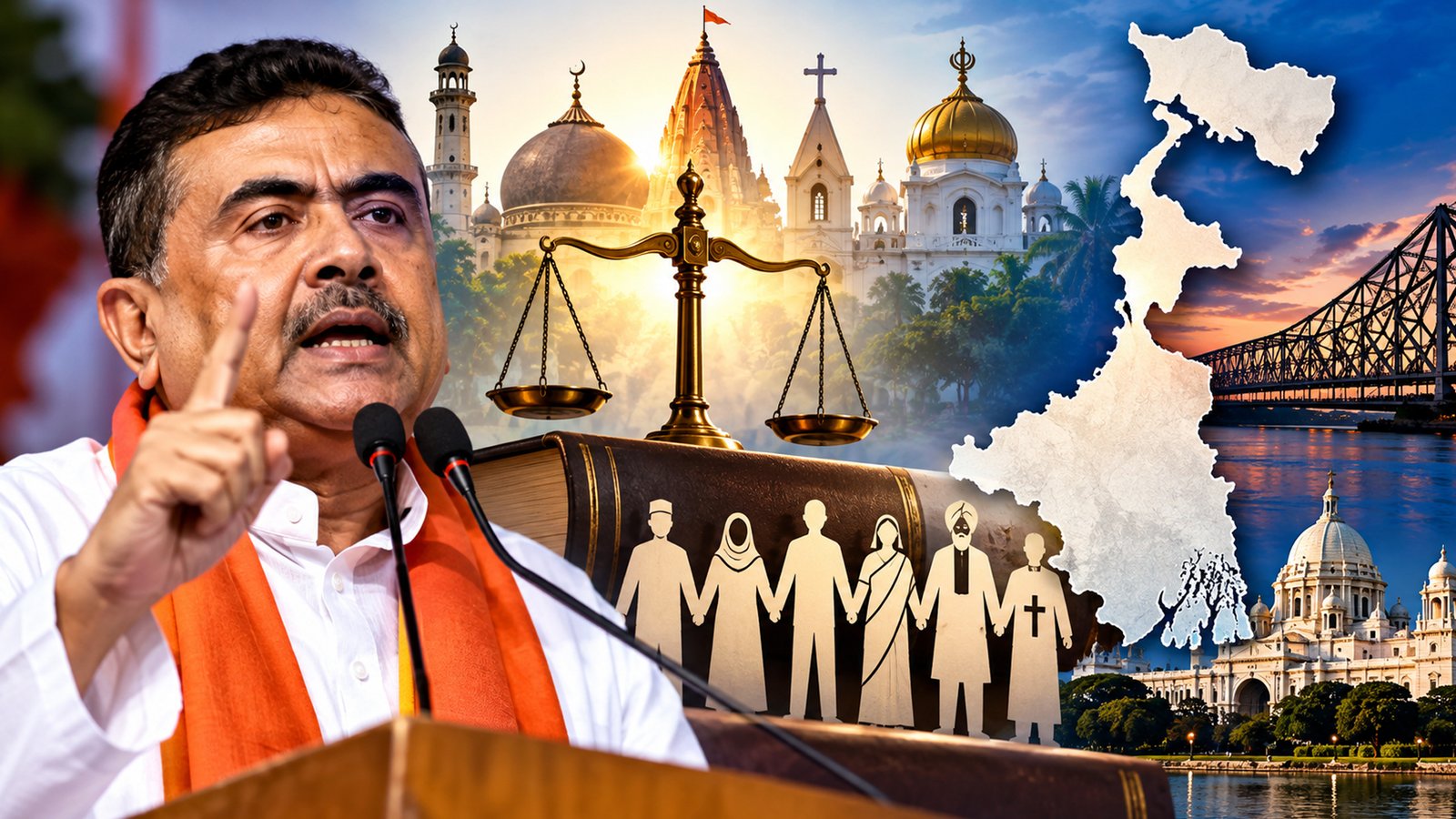
West Bengal Chief Minister Suvendu Adhikari has announced that his government plans to introduce a Uniform Civil Code (UCC) in the state within six months, making it one of the BJP government’s key early policy priorities.
Adhikari said legislation dealing with religious conversion, “love jihad” and “land jihad” would also be brought in after the UCC. The announcements are expected to intensify the political debate over personal laws, religious freedom, minority rights and the BJP’s broader cultural agenda in West Bengal.
Addressing a programme in Kolkata organised to mark the birth centenary of former Vishwa Hindu Parishad president Ashok Singhal, Adhikari asked people to give his government six months to fulfil its UCC commitment.
The Chief Minister said West Bengal would follow the example of other BJP-ruled states that have moved towards a common civil code. He indicated that the government would study existing models before finalising legislation suited to the state.
The Uniform Civil Code seeks to establish common rules for citizens in civil matters such as marriage, divorce, inheritance, adoption and succession, replacing separate religion-based personal laws in these areas. Article 44 of the Constitution directs the state to work towards securing a UCC for citizens.
West Bengal has already taken steps towards drafting the legislation. The state government formed a nine-member committee headed by retired Supreme Court judge Justice Ranjana Prakash Desai to examine the proposed framework. The panel is looking at areas including marriage, divorce, inheritance, adoption and child custody.
The BJP had made the introduction of a UCC one of its election promises in West Bengal. Adhikari’s six-month deadline now gives the government a specific timeframe to turn that promise into legislation.
The Chief Minister said the proposed UCC would be implemented within the constitutional framework. He also linked the policy to his government’s stated objective of protecting cultural traditions, temples, monasteries and other heritage institutions.
The announcement was accompanied by a series of other cultural and religious initiatives. Adhikari spoke about promoting the study of the Vedas and the Bhagavad Gita and announced plans for a religious tourism circuit estimated at ₹1,000 crore. He also said the government would seek to develop the Gangasagar Mela to an international standard.
The proposed laws on “love jihad” and “land jihad” are likely to attract even greater political attention. The BJP uses the term “love jihad” to describe allegations that women are being targeted through relationships for religious conversion. “Land jihad” has been used by BJP leaders to refer to alleged attempts to acquire land through organised or illegal means.
Critics have questioned the legal definitions of both terms and warned that legislation based on such concepts could affect individual freedoms and minority rights. The BJP, however, has argued that such laws are needed to prevent forced conversion, protect vulnerable communities and address alleged organised activities.
The UCC has similarly remained politically contentious. Supporters argue that common civil laws can promote equality, particularly in matters involving women’s rights, inheritance and marriage. Opponents have expressed concerns about the impact of uniform legislation on religious customs and established personal-law practices.
Uttarakhand became the first Indian state to implement a comprehensive UCC, while other BJP-ruled states have also begun examining or drafting similar laws. West Bengal’s proposed legislation would add another major state to the expanding national debate over a common civil code.
The issue is particularly significant in West Bengal because of the state’s religious diversity and the long-running political contest between the BJP and opposition parties over identity, migration, minority rights and governance.
Adhikari also used the occasion to attack the previous Trinamool Congress government, accusing it of encouraging divisions and promising that his administration would pursue policies based on what he described as national and cultural interests.
The government’s immediate task will be to convert the political announcement into a detailed legal framework. The draft will have to undergo legislative scrutiny and could face challenges relating to constitutional rights, personal laws and the powers of the state government.
The six-month deadline has therefore put the UCC at the centre of West Bengal’s political agenda. If the government meets its target, the state could become one of the most significant new battlegrounds in India’s continuing debate over the Uniform Civil Code and the future of personal laws.