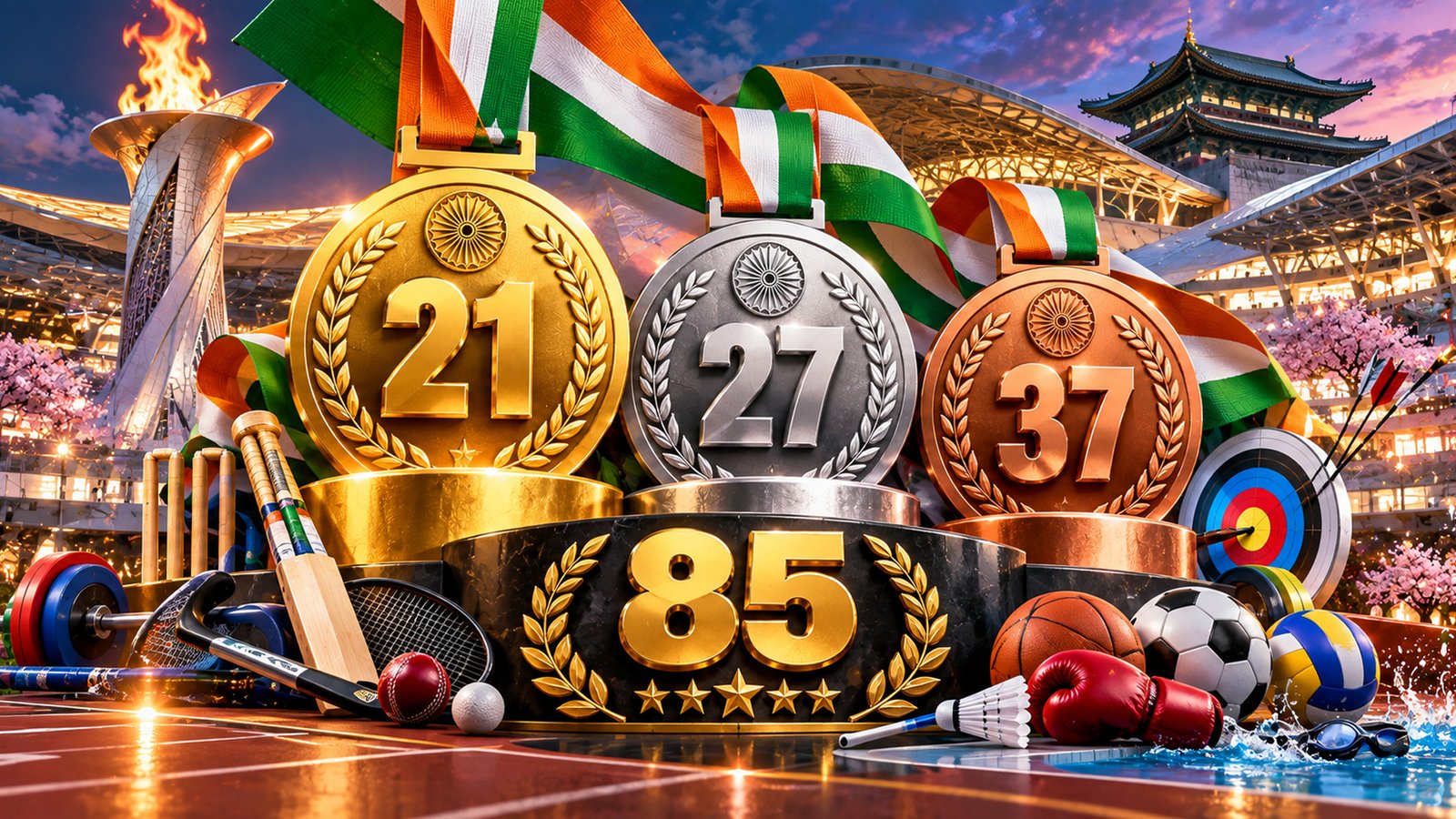
India wrapped up its Asian Games 2026 campaign in fourth place with 85 medals, finishing the Aichi-Nagoya Games with 21 gold, 27 silver and 37 bronze medals.
The final position matched India’s fourth-place finish at the previous Asian Games in Hangzhou, but the overall medal haul was lower. India had won a record 106 medals, including 28 gold, in Hangzhou. This time, a slow start was followed by a powerful finish that helped the contingent move ahead of Uzbekistan and secure a top-four position.
China dominated the medal table with 341 medals, including 169 gold. Japan finished second with 269 medals and 83 gold, while South Korea was third with 150 medals, including 39 gold. India and Uzbekistan both finished with 21 gold medals, but India moved ahead because it collected more silver medals.
India’s campaign looked considerably less promising during its opening stretch. The shooting and athletics contingents, which had produced a large share of India’s medals in Hangzhou, struggled to replicate their previous gold-medal performance. Athletics contributed several medals, including three from Gulveer Singh, but India won only one athletics gold compared with six in the previous edition.
The turnaround came in the final stages of the competition.
India entered the closing stretch outside the top four but produced a series of gold-medal performances in archery, wrestling, golf, cricket and hockey. Five gold medals on the penultimate day helped push the country into fourth place, before the men’s hockey team sealed the position with another gold.
The men’s hockey team defeated Malaysia 5-1 in the final, successfully defending its Asian Games title. Harmanpreet Singh scored twice, while Jugraj Singh, Hardik Singh and Shilanand Lakra also found the net.
The women’s hockey team also created history by beating China 1-0 in the final. Lalremsiami scored the decisive goal as India won its first Asian Games women’s hockey gold since 1982. The victory ended a 44-year wait and also secured Olympic qualification for Los Angeles.
Cricket was equally successful, with India winning gold in both the men’s and women’s T20 competitions. The women defeated Sri Lanka by 147 runs, while the men overcame Pakistan by 19 runs in the final. India also completed a clean sweep in kabaddi, with both the men’s and women’s teams winning gold.
Archery emerged as another major success story. India won nine medals in the sport, including five golds. Seventeen-year-old Kumkum Anil Mohod created history by becoming the first Indian woman to win individual recurve gold at the Asian Games. The Indian women’s recurve team also ended South Korea’s 28-year dominance in the event.
Shooting contributed 15 medals, including three gold, eight silver and four bronze. Neeru Dhanda was among the standout performers. She won individual women’s trap gold, becoming the first Indian woman to win an individual Asian Games shotgun gold. She then teamed up with Kynan Chenai to win mixed-team trap gold, setting an Asian record. Dhanda also won a silver in the women’s team event and was chosen as India’s flag-bearer for the closing ceremony.
Wrestling delivered another late boost. Aman Sehrawat won gold in the men’s 57kg freestyle category after defeating North Korea’s world champion Han Chong Song 11-7. Sujeet Kalkal also won gold, while Antim Panghal and Nitesh Siwach secured silver medals. India finished with six wrestling medals, its strongest Asian Games performance in the discipline since 1962.
Golf produced one of the most significant breakthroughs of the Games. Pranavi Urs became the first Indian woman to win an individual Asian Games golf gold. She finished at 15-under 265 and also helped India take silver in the women’s team event alongside Aditi Ashok and Diksha Dagar.
Boxing also stood out with three gold medals. Lovlina Borgohain won the women’s 75kg title, becoming only the second Indian woman after Mary Kom to win an Asian Games boxing gold. The boxing contingent added three bronze medals to its tally.
Other notable results came in weightlifting, sailing, squash and table tennis. Mirabai Chanu won silver in the women’s 49kg category, while Indian sailors secured three medals. Mixed doubles pair Manush Shah and Diya Chitale won a historic bronze in table tennis.
The campaign also exposed areas where India needs greater consistency. Badminton produced only one bronze, while tennis failed to deliver a medal. Shooting and athletics also fell short of their previous edition’s gold-medal output.
Still, the Aichi-Nagoya Asian Games produced several firsts and important Olympic qualification gains. The performances of younger athletes such as Kumkum Mohod, along with established names such as Lovlina, Neeru Dhanda and Aman Sehrawat, offered reasons for optimism.
India may have fallen short of its record medal haul, but the late gold rush changed the complexion of the campaign. The next challenge will be to convert these breakthroughs into sustained success across more Olympic and Asian Games disciplines as Indian sport looks ahead to Los Angeles 2028 and beyond.