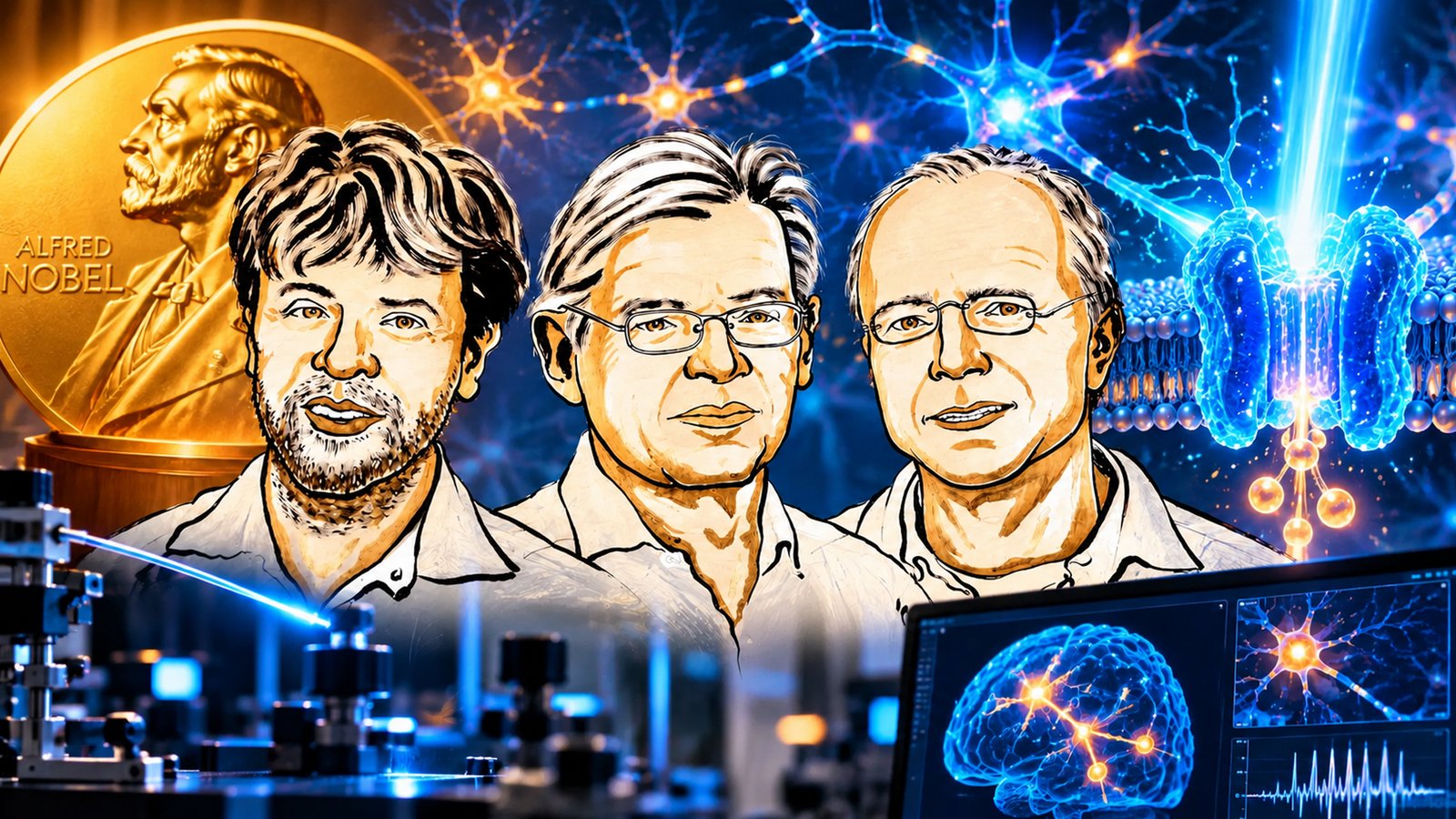
The 2026 Nobel Prize in Physiology or Medicine has been awarded to American scientist Karl Deisseroth and German researchers Peter Hegemann and Georg Nagel for discoveries that transformed the way scientists study the brain.
The trio has been recognised for their work on light-gated ion channels and optogenetics, a technique that allows researchers to switch individual nerve cells on or off using light. The Nobel Assembly at Karolinska Institutet announced the award on October 5, describing the method as a major advance in understanding how the brain controls memories, feelings and behaviour.
The three scientists will share the 12 million Swedish kronor prize, worth roughly $1.2 million. Deisseroth is associated with Stanford University and the Howard Hughes Medical Institute in the United States, while Hegemann works at Humboldt University of Berlin and Nagel is based at the University of Würzburg in Germany.
The core concept of their work is a remarkable protein called channelrhodopsin. The story began with Hegemann’s interest in a single-celled green alga called Chlamydomonas. He wanted to understand how the organism senses light and moves towards it.
His research showed that the organism’s response to light involved a light-sensitive mechanism on the cell surface. Hegemann and Nagel subsequently identified channelrhodopsin, a protein that responds to light by opening a channel through which charged particles can pass.
The discovery created an unexpected possibility. If the light-sensitive protein could make other cells respond to light, scientists might be able to use it as a biological switch.
Nagel’s experiments demonstrated precisely that. When channelrhodopsin was introduced into other types of cells, those cells became sensitive to light. The discovery provided the essential building block for what would later become optogenetics.
Deisseroth took the next major step by introducing the gene responsible for channelrhodopsin into nerve cells. When blue light was directed at those modified neurons, he could trigger a nerve signal.
His breakthrough was published in 2005. Two years later, he demonstrated that the same principle could be used to control nerve cells in the brains of living mice.
That changed neuroscience. Instead of simply observing which parts of the brain became active, researchers could manipulate specific groups of neurons and study what happened when they were switched on or off.
The technique effectively turned light into a tool for probing the brain with extraordinary precision.
Before optogenetics, scientists had struggled to establish direct links between particular groups of neurons and complex functions such as memory, emotion and behaviour. Existing methods could show that areas of the brain were active, but they often could not establish whether those cells were directly responsible for a particular response.
Optogenetics changed that equation. By combining genetic modification with precisely controlled light, researchers could target selected neurons and observe the consequences of activating or silencing them.
The technology has since become an important tool in laboratories around the world. Researchers use optogenetics to study neural circuits linked to memory, emotions, behaviour and neurological and psychiatric disorders.
Its importance extends beyond basic neuroscience. Scientists are investigating whether techniques based on the same principles could eventually help treat neurological and sensory conditions.
One area of research involves restoring vision. Researchers are studying ways to use light-sensitive proteins and related technologies to help patients with certain forms of visual impairment. The approach remains an area of research rather than a broadly available treatment, but it demonstrates the potential medical reach of the original discovery.
The work has also opened new avenues for studying conditions affecting the brain, including disorders involving abnormal neural activity. Researchers are using optogenetics to better understand the circuits involved in diseases and behaviours associated with conditions such as Parkinson’s disease, epilepsy, addiction and psychiatric disorders.
The Nobel recognition comes decades after the scientific journey began, highlighting how fundamental discoveries can take years to reshape medicine. What started with a question about how a tiny organism responds to light eventually became a technique capable of manipulating individual nerve cells in a living brain.
The award also reflects the collaborative nature of modern science. Hegemann and Nagel’s discovery of channelrhodopsin provided the biological foundation, while Deisseroth’s work showed how that discovery could be transformed into a powerful method for controlling neurons.
Their combined work has given scientists a much clearer way to explore one of humanity’s most complicated biological systems.
The Nobel Prize in Medicine 2026 therefore recognises more than a single discovery. It honours a chain of scientific breakthroughs that connected algae, proteins, genetics and light to one of the biggest questions in neuroscience: how the brain creates our memories, emotions and behaviour.
Optogenetics has already changed how researchers investigate the brain. Its future could be even more significant if ongoing studies translate the technology into new treatments for neurological and sensory disorders.
What began as an effort to understand a microscopic organism’s response to light has ultimately provided scientists with something remarkably powerful — a way to use light to explore the living brain, one nerve cell at a time.