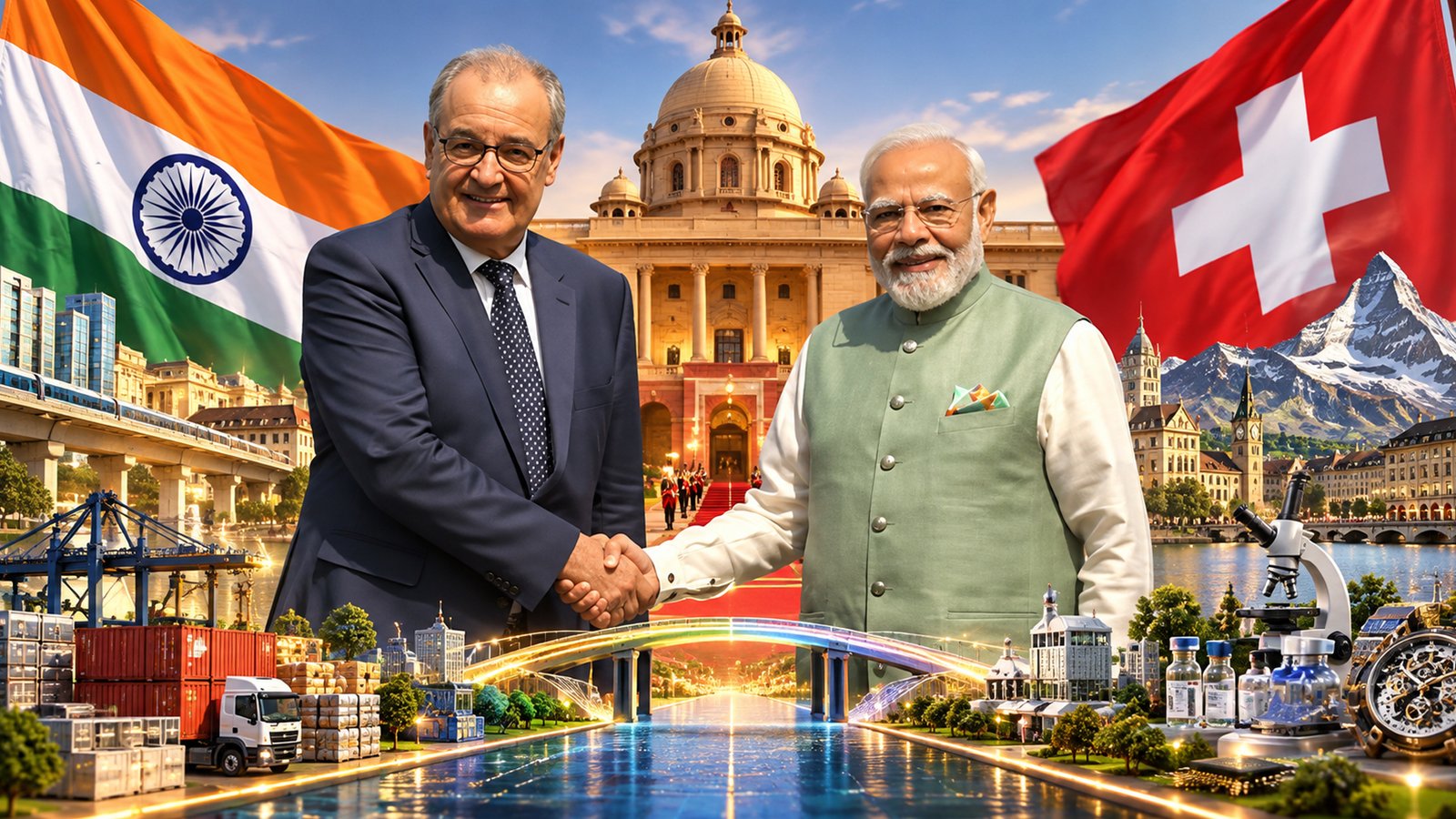
India and Switzerland have agreed to widen their partnership across trade, defence, nuclear energy, infrastructure, technology and people-to-people ties, as Prime Minister Narendra Modi held talks with Swiss President Guy Parmelin in New Delhi.
The two countries signed five agreements during Parmelin’s visit, covering migration and mobility, young professionals, transport and infrastructure, scientific research, and innovation and technology transfer. The agreements are aimed at making the relationship more useful for businesses, professionals, researchers and young people in both countries.
The talks also focused on strengthening economic ties following the implementation of the Trade and Economic Partnership Agreement (TEPA) between India and the European Free Trade Association (EFTA), which includes Switzerland, Norway, Iceland and Liechtenstein.
Switzerland is one of India’s important European economic partners, while Indian companies have steadily increased their presence in the Swiss market. The two sides now want to use the EFTA agreement to encourage more investment and expand trade.
PM Modi said India was looking to attract significant investment from EFTA countries over the coming years. The investment commitment under the agreement is expected to support job creation in India and provide greater opportunities for Swiss companies to participate in the country’s rapidly expanding economy.
Areas such as pharmaceuticals, engineering, textiles, food processing, biotechnology and financial services are expected to benefit from closer economic cooperation.
Defence has also emerged as a new area of interest in the relationship. India and Switzerland discussed expanding cooperation in defence, including exchanges and opportunities for greater engagement between their defence industries.
The development is significant as India continues to strengthen its domestic defence manufacturing capabilities and seeks partnerships involving advanced technology, specialised skills and industrial cooperation.
Nuclear energy was another important part of the discussions. Both countries identified opportunities to strengthen cooperation in the sector as India works to increase the role of nuclear power in its long-term energy plans.
Switzerland has experience in nuclear technology and safety, while India is seeking to expand its nuclear energy capacity as part of its effort to meet growing electricity demand while reducing dependence on fossil fuels.
Infrastructure and transport are also expected to become stronger areas of cooperation. Swiss companies have already been involved in several Indian projects, including ropeway, airport, railway and tunnelling work.
PM Modi invited Swiss companies to participate more actively in India’s infrastructure expansion. The country’s growing urban population and large investments in transport networks, airports, railways and public infrastructure are creating opportunities for companies with expertise in engineering, technology and project management.
The agreements signed during Parmelin’s visit also have a strong human dimension. A mobility partnership between India and Switzerland is expected to make travel and professional movement between the two countries easier while also helping both sides deal with concerns related to illegal migration and human trafficking.
The arrangement includes provisions for multiple-entry visas for eligible travellers, with students and professionals expected to benefit from easier mobility.
A separate agreement for young professionals will provide opportunities for people from both countries to gain work experience abroad. The programme is expected to allow hundreds of young professionals to participate every year, helping them develop professional and language skills while gaining international exposure.
Education and research are another important part of the growing partnership. India and Switzerland agreed to strengthen scientific cooperation, with areas such as healthcare, clean energy and space among the fields that could see greater collaboration.
Technology and innovation are also gaining importance. Both countries are looking to encourage technology transfer, entrepreneurship and cooperation between research institutions and businesses.
Artificial intelligence was part of the wider discussions as well. India and Switzerland share an interest in promoting technological innovation while ensuring that new technologies are developed and used responsibly. Switzerland is scheduled to host a major global AI summit in Geneva, following India’s hosting of the AI Summit earlier this year.
The two leaders also exchanged views on major international developments, including the conflict in Ukraine and the situation in West Asia. India reiterated its support for dialogue and diplomacy as the preferred way of addressing international disputes.
The talks also reflected a shared interest in strengthening multilateral institutions and making global organisations more effective in dealing with new challenges.
Parmelin’s visit comes at a significant time for India-Switzerland relations. The two countries have enjoyed close ties for decades, built around trade, investment, tourism, education, science and cultural exchanges. The latest agreements indicate that the relationship is now moving into newer areas with a stronger focus on strategic and economic cooperation.
The challenge now is to turn the agreements into actual projects, investments and opportunities. Greater Swiss participation in Indian infrastructure, technology and energy projects could bring new expertise and investment, while Indian businesses and professionals could gain wider access to the Swiss and European markets.
The five agreements therefore go beyond diplomatic commitments. They create a broader framework for India and Switzerland to work together on areas that directly affect economic growth, jobs, technology, energy and the movement of people.