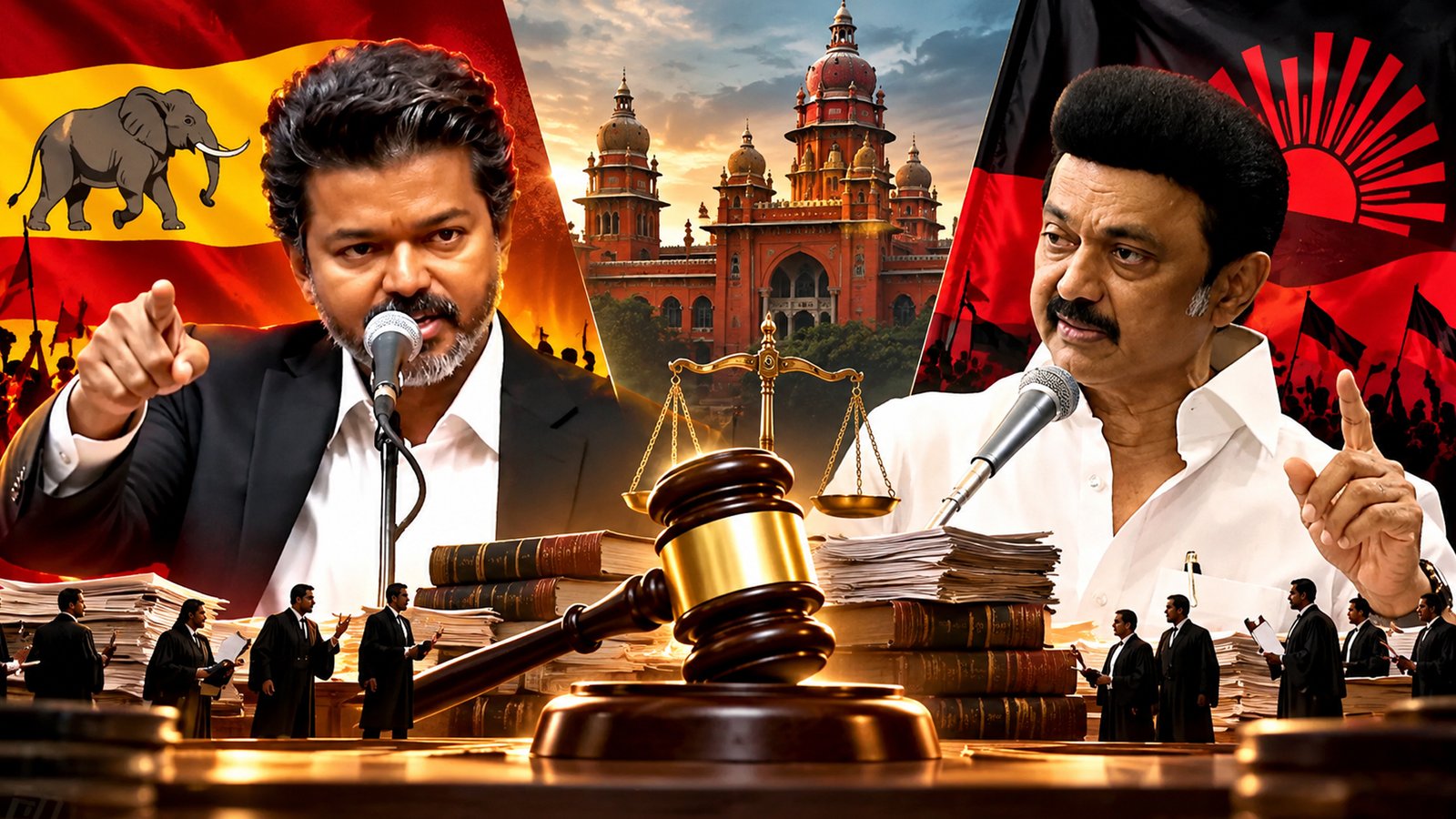
The political confrontation between Tamil Nadu Chief Minister M.K. Stalin’s Dravida Munnetra Kazhagam (DMK) and actor-politician Vijay’s Tamilaga Vettri Kazhagam (TVK) has moved to the courtroom, with the Madras High Court allowing the DMK to pursue a ₹1.01 crore defamation case over allegations linked to the R Veeramani case.
The court’s decision allows the DMK to proceed against TVK leaders C.T.R. Nirmal Kumar and Aadhav Arjuna, along with the party’s IT wing. The proposed lawsuit has been filed by DMK general secretary Duraimurugan, who has alleged that statements made by the TVK side damaged the reputation of the ruling party.
The dispute centres on allegations concerning Veeramani, an industrialist associated with Gem Granites. TVK leaders had accused the previous DMK government of failing to take appropriate action against him and questioned whether the party had protected him during its earlier term in office.
The DMK has rejected the allegations and described them as false and defamatory. It has argued that the statements created a misleading impression that the government had deliberately protected a person facing serious criminal allegations.
The party is seeking ₹1.01 crore in damages and has also sought restrictions on the repetition of the disputed allegations.
The High Court’s latest order does not establish that the TVK leaders are guilty of defamation. It also does not determine whether the allegations against the DMK were true or false. The ruling only allows the proposed civil proceedings to move forward. Questions concerning the merits of the defamation claim will be considered during the next stages of the case.
The TVK side had raised legal objections to the DMK’s proposed action. One of the arguments concerned the requirement of prior notice before legal proceedings are initiated against public officials.
The DMK argued that the defendants were being sued over statements made in their capacity as political leaders and not for actions taken by them as government officials. The party therefore maintained that the requirement did not prevent it from bringing the defamation case.
The High Court allowed the DMK to proceed, while leaving other questions concerning the maintainability of the lawsuit to be examined later.
The legal dispute has emerged from a wider political battle between Stalin and Vijay, whose TVK is seeking to establish itself as a major force in Tamil Nadu politics. Vijay has repeatedly targeted the DMK government on issues of governance and accountability, while the ruling party has responded sharply to his criticism.
The Veeramani case has become one of the latest flashpoints between the two sides. TVK leaders questioned the action taken by the previous DMK government and raised allegations about the handling of the case.
The DMK has pushed back against those claims and accused the TVK of using the matter for political purposes. The party’s decision to seek damages now gives the dispute a formal legal dimension.
Veeramani is facing serious criminal allegations and was arrested in connection with a case involving the alleged sexual abuse of minor girls. Several cases have been registered against him, including cases under the Protection of Children from Sexual Offences (POCSO) Act.
Veeramani and two alleged associates, Shanthi and Mahendra Simhan, were also detained under the Goondas Act. Investigators have been examining other allegations connected with the case, including a suspected abetment-to-suicide charge and financial transactions.
The criminal proceedings and the political allegations are separate matters. The defamation case concerns statements made by TVK leaders about the DMK’s handling of the issue, rather than determining Veeramani’s guilt or innocence.
The timing of the dispute is significant as Tamil Nadu politics enters a more competitive phase. Vijay’s entry into electoral politics has created a new challenge for established parties, particularly the DMK and AIADMK. The TVK has been trying to build its organisation and present itself as an alternative political force.
The DMK, meanwhile, has been defending its record in government while responding to criticism from the emerging party. The exchange between the two sides has increasingly become personal and political, with both questioning each other’s credibility and positions.
The ₹1.01 crore damages claim could now intensify that confrontation. The DMK will have to establish its case during the legal proceedings, while the TVK leaders will have the opportunity to defend the statements that triggered the lawsuit.
The court proceedings could also bring greater focus to the evidence behind the competing claims. While political allegations can often dominate public debate, the defamation case will require the parties to present their positions within a formal legal framework.
The Madras High Court’s decision therefore marks an important development in the DMK-TVK rivalry, but it is not a final verdict on the dispute. The court has only cleared the way for the DMK’s case to proceed.
The political battle between Stalin and Vijay is likely to continue alongside the legal proceedings. What began as an argument over the handling of the Veeramani case has now become a wider test of political credibility, public statements and accountability in Tamil Nadu.