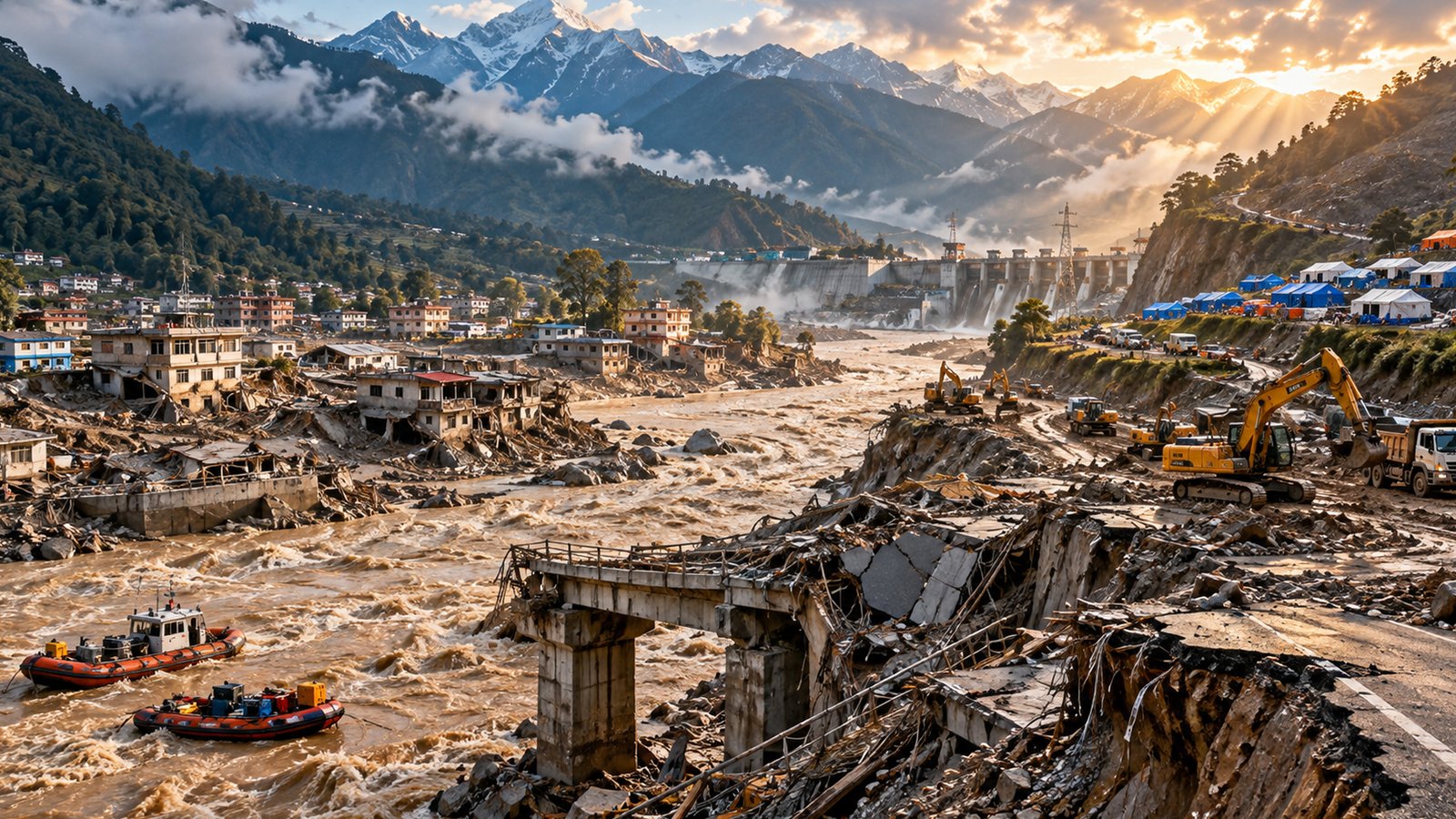
Nepal has ended its 40-day search and rescue operation after devastating floods swept through parts of the country in August, shifting its focus to rehabilitation and reconstruction. The decision comes with 5,285 people still missing, leaving thousands of families facing an agonising wait for news about their loved ones.
The floods began on August 26 and caused widespread destruction across several parts of Nepal. At least 1,455 people have died, while homes, roads, bridges, farms and other infrastructure were damaged or swept away. The disaster has left communities struggling to return to normal life more than a month after the waters receded.
The decision to end the main search operation was taken at a meeting of Nepal’s National Council for Disaster Risk Reduction and Management, chaired by Prime Minister Balendra Shah. The move followed assessments by local disaster management authorities and the National Disaster Risk Reduction and Management Authority.
Officials said the end of the main operation does not mean all rescue-related activity has stopped. Emergency teams will continue responding if new situations arise. Human remains and personal belongings discovered during rehabilitation and reconstruction work will also be recovered and handed over to families wherever possible.
Rescue teams managed to save 13,795 people during the emergency response. Despite that effort, the number of people still missing remains exceptionally high, making the floods one of Nepal’s most serious recent humanitarian disasters.
Indian nationals are among those still unaccounted for. Nepal’s latest figures show that 189 Indians remain missing. Indian officials and the Indian Embassy in Kathmandu have been coordinating with Nepalese authorities to trace missing citizens, identify victims and provide assistance to affected families.
Tamil Nadu has reported the highest number of missing Indians, with 85 people unaccounted for. West Bengal has reported 37, while Gujarat has reported 30. Telangana has reported 25 missing people and Uttar Pradesh 22. Karnataka and Andhra Pradesh have each reported 13 missing people, while Bihar has reported 12. Maharashtra and Odisha have also reported missing persons.
The disaster has also affected foreign tourists. Nepal’s tourism authorities have reported 606 foreign tourists from 36 countries among those missing. Indians form the largest group, followed by Americans, Malaysians, Ukrainians and Chinese nationals. Australians, Latvians, British and Canadian citizens are also among those unaccounted for.
Behind the numbers are families who have spent weeks waiting for a phone call, a confirmed sighting or any information about relatives who disappeared. The end of the large-scale search is likely to be particularly difficult for families who have held on to hope since the floods struck.
Nepalese authorities are now considering the legal process required to declare some missing people dead. Such a step can help families deal with insurance claims, property matters, bank accounts and other legal responsibilities. Officials are expected to follow established procedures before making such declarations.
Attention is now turning to a major rehabilitation and reconstruction programme. The government has proposed around NPR 559 billion, or roughly ₹35,000 crore, for 504 projects aimed at rebuilding damaged areas and supporting communities affected by the floods.
The proposed spending will cover damaged roads, bridges, settlements and other essential infrastructure. Prime Minister Balendra Shah has called for greater coordination between federal, provincial and local governments so that reconstruction can move ahead efficiently.
The scale of the recovery challenge is enormous. Many families have lost homes as well as their sources of income. Farms, businesses and local infrastructure were damaged, meaning rehabilitation will have to go beyond rebuilding physical structures.
Around 1,226 affected people have been provided temporary accommodation at different centres. Others have returned to damaged communities and are attempting to rebuild their homes and restart their livelihoods. Families will need continued support to restore incomes and regain access to essential services.
The floods have also renewed concerns about Nepal’s vulnerability to extreme weather and hazards in the Himalayan region. Authorities are looking at ways to strengthen disaster preparedness, improve early-warning systems and ensure communities receive information quickly when dangerous conditions develop.
Officials are also examining risks posed by potentially dangerous glacial lakes. Proposed measures include improved monitoring, flood forecasting and warning systems. The aim is to give vulnerable communities more time to move to safer locations if water levels rise rapidly.
The disaster has highlighted the importance of cooperation between Nepal and India. Indian authorities are expected to remain in contact with Nepalese officials as efforts continue to identify missing citizens and recover bodies and belongings.
Ending the main search marks an emotional turning point for Nepal. Rescue workers have spent 40 days searching flood-hit areas, while families have waited anxiously for news. The country must now begin the much harder task of rebuilding communities that have lost homes, infrastructure and loved ones.
The shift from rescue to rehabilitation does not bring closure to thousands of families. Many still have no answers about what happened to relatives who disappeared in the floods. The uncertainty is likely to continue even as rebuilding begins.
Nepal’s next phase will therefore be about more than roads and buildings. It will involve helping survivors rebuild their livelihoods, restoring essential services and supporting families dealing with loss and uncertainty.
With 5,285 people still missing, including 189 Indians, the human cost of the August floods remains enormous. Nepal has moved from searching for survivors to rebuilding what the disaster destroyed, beginning a long road towards recovery while many families continue to wait for answers.