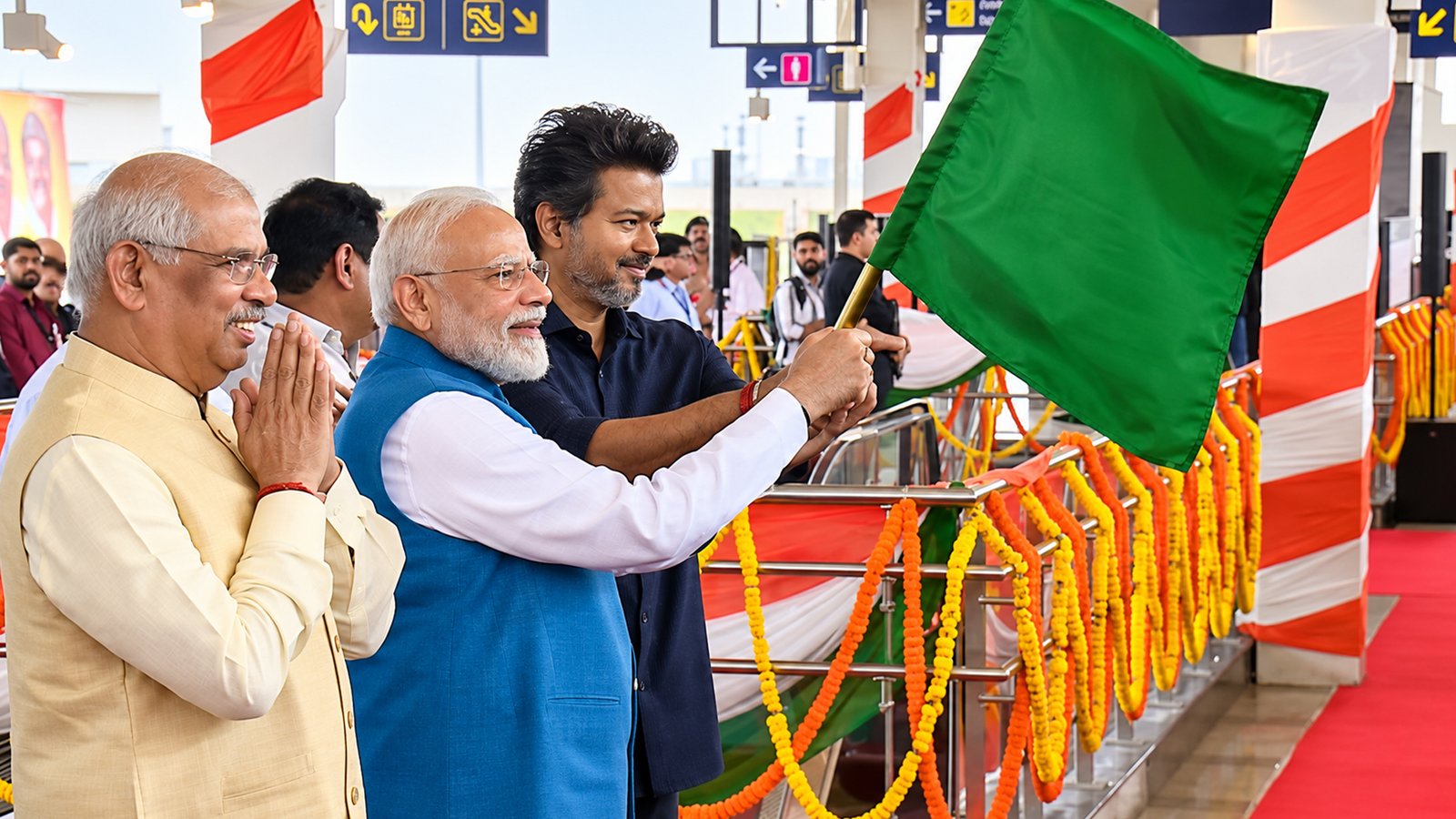
Prime Minister Narendra Modi inaugurated the first operational stretch of Chennai Metro Rail Phase II on October 11, opening a new 15-km corridor between Poonamallee Bypass and Vadapalani. Built at a cost of around ₹4,900 crore, the elevated section is expected to improve public transport connectivity across western Chennai and make daily travel more convenient for thousands of commuters.
Tamil Nadu Chief Minister C Joseph Vijay joined Modi at the inauguration, with Governor Rajendra Vishwanath Arlekar also present. The Prime Minister and the Chief Minister jointly flagged off the new Metro services before travelling on the train together.
The inauguration marks an important step in Chennai Metro’s expansion, as the city continues to invest in mass rapid transit to address growing travel demand and reduce dependence on road transport. The new corridor forms part of Corridor 4 of Phase II and connects developing residential neighbourhoods and commercial areas with the existing Metro network.
During the visit, Modi purchased a paper ticket at the station counter and interacted briefly with an employee before boarding the train with Vijay. The ride highlighted the launch of a major urban transport project, which is expected to offer commuters an alternative to congested roads.
The new Poonamallee–Vadapalani stretch has 11 elevated stations opening to passengers in the initial phase. These are Poonamallee Bypass, Poonamallee Bus Stand, Poonamallee Government Hospital, Karayanchavadi, Kumananchavadi, Kattupakkam, Ayyappanthangal, Thelliyagaram, Porur Bypass, Porur Junction and Vadapalani.
The stations are expected to improve access to residential areas, hospitals, transport hubs and commercial locations across western Chennai. At Vadapalani, passengers can connect with the existing Phase I Metro network, making the new corridor particularly useful for people travelling between the western suburbs and other parts of the city.
One of the project’s key features is a 3.7-km double-decker structure, designed to accommodate different transport requirements within a limited urban space. The corridor also incorporates advanced signalling systems and infrastructure designed to support driverless train operations.
However, the launch of the new line does not mean that passengers will immediately travel on fully driverless services. According to earlier reports citing Chennai Metro Rail Limited (CMRL) officials, trains were expected to operate initially with train operators supervising services, with driverless operations planned for a later stage. The automated system is intended to improve operational efficiency once the necessary arrangements are completed.
Passenger services began on October 11, with regular operations scheduled to run from 7 am to 9 pm from October 12. Trains are expected to operate every 10 minutes during peak hours on weekdays and Saturdays, and every 15 minutes during non-peak periods. On Sundays and public holidays, services are scheduled at 15-minute intervals.
The new line is part of the larger Chennai Metro Phase II project, which envisages 118.9 km of additional Metro corridors and 128 stations. The expansion is designed to strengthen connections between northern and southern Chennai, as well as between eastern and western parts of the metropolitan region. Once the wider Phase II network is completed, Chennai’s Metro system is expected to extend to about 173 km.
The ₹4,900-crore section was among the major infrastructure projects highlighted during Modi’s visit to Tamil Nadu. The Prime Minister also inaugurated and laid foundation stones for development projects worth more than ₹13,000 crore across the state, covering areas such as transport, highways, railways, ports and other infrastructure.
The expansion of urban rail is increasingly important for Chennai, where road congestion and long commuting times affect workers, students and businesses. A reliable Metro network can help passengers plan their journeys more predictably, while reducing pressure on busy roads and supporting better links between residential districts and employment centres.
For commuters in Poonamallee, Porur, Kattupakkam and nearby areas, the new corridor provides a direct connection to Vadapalani and the existing Metro system. Its longer-term impact will depend on passenger uptake, service frequency and the completion of the remaining Phase II corridors.
The inauguration brings a key part of Chennai’s Metro expansion into public use, while signalling the next stage of the city’s effort to build a more connected and accessible transport network.