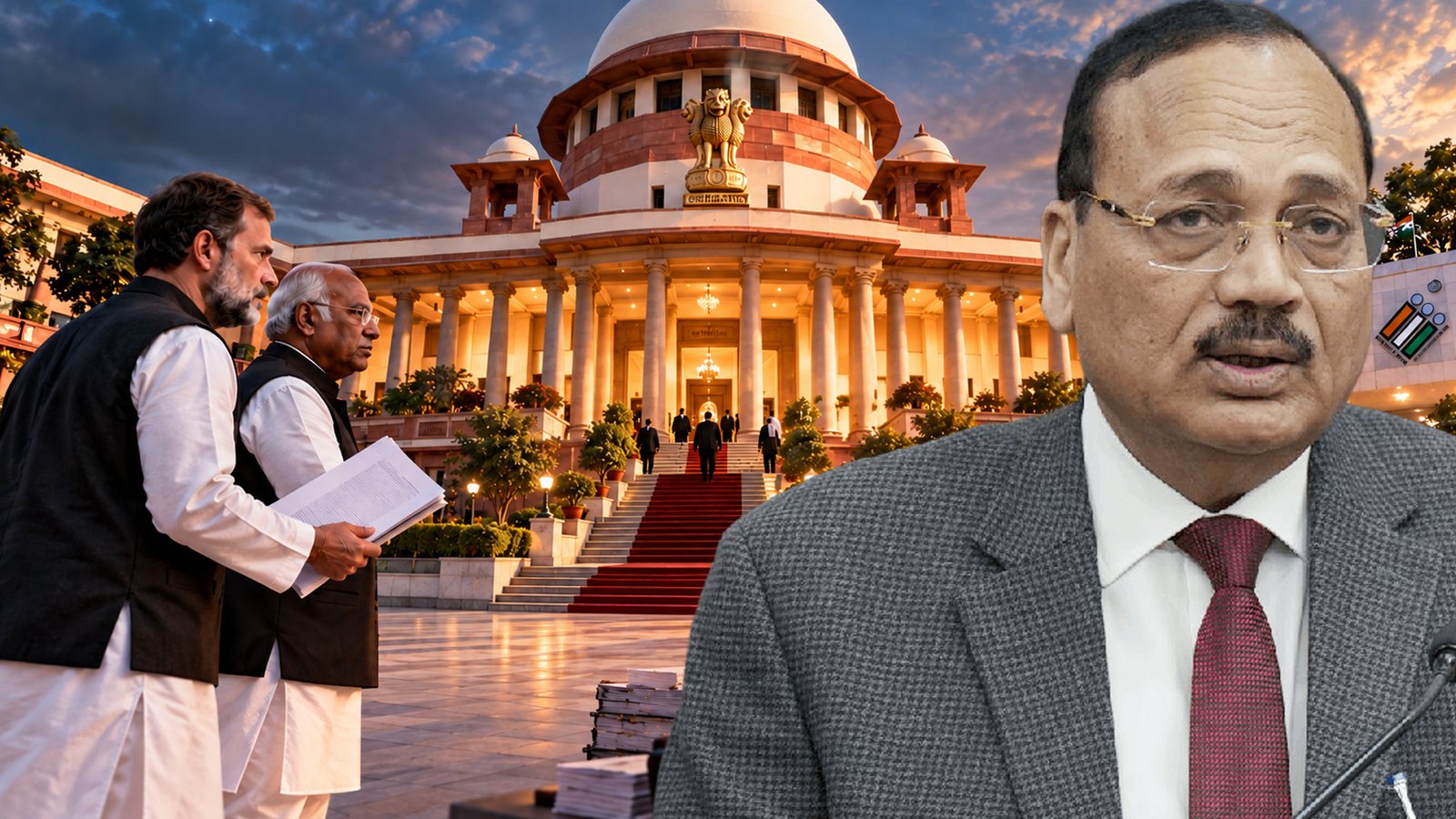
Chief Justice of India (CJI) Surya Kant has declined a request from Congress leaders Rahul Gandhi and Mallikarjun Kharge for a meeting to discuss alleged electoral irregularities, the Special Intensive Revision (SIR) of voter lists and recent police action against protesters in Delhi. The Chief Justice said the issues raised by the Opposition leaders were already pending before the Supreme Court and should be pursued through the judicial process.
Gandhi, the Leader of Opposition in the Lok Sabha, and Kharge, the Leader of Opposition in the Rajya Sabha, had sought an appointment with the CJI between 4 pm and 5 pm on October 12. They intended to submit a memorandum on behalf of the INDIA bloc, raising concerns over what they describe as “vote chori” and demanding action against Chief Election Commissioner Gyanesh Kumar.
In his response, dated October 11, the CJI explained that holding a meeting to discuss matters already before the court would be inconsistent with judicial ethics and propriety. He also referred to the constitutional principle of separation of powers, which distinguishes the responsibilities of the judiciary from those of the executive.
The CJI clarified that the Supreme Court does not have administrative powers to intervene in the functioning of the government or resolve such complaints through an administrative representation. Instead, the leaders were advised to approach the court through a formal petition.
He indicated that a petition could be filed physically or online and that the court could consider it alongside similar matters already scheduled for hearing. Several related cases concerning the SIR process were listed for October 13.
The CJI also stressed that the Supreme Court remained open to citizens and elected representatives seeking legal remedies. Any petition would be considered in accordance with the law, he said.
The Congress shared the CJI’s response as the Opposition prepared to continue its campaign against the Election Commission and the ongoing revision of electoral rolls. The leaders’ request came amid growing political tensions over voter-list changes, allegations of arbitrary arrests and restrictions imposed during protests in the national capital.
The memorandum was expected to raise several concerns, including the functioning of the Chief Election Commissioner and the Election Commission of India, the alleged arbitrary detention of students, the closure of metro stations and the cancellation of trains during the demonstrations.
The Opposition’s principal demands include an end to alleged electoral malpractice, the resignation of Gyanesh Kumar, a halt to the SIR exercise and a return to paper ballots instead of electronic voting machines. These are political allegations and demands; the Election Commission and the BJP have disputed claims that the revision process is intended to influence electoral outcomes.
The controversy has intensified following protests by students and civil society groups, including members of the Cockroach Janta Party (CJP), who have raised objections to the voter-list revision. Opposition leaders have backed the demonstrations and called for accountability over the treatment of protesters.
Gandhi had announced a march to the Supreme Court on October 12, inviting Opposition parties, civil society groups and citizens to join the campaign. The proposed march was intended to press the demands and submit a memorandum to the CJI.
Addressing the issue, Gandhi argued that the protests represented a broader effort to defend democratic rights and electoral integrity, rather than an isolated campaign by one political party. He also alleged that peaceful demonstrators had faced police action and that attempts were being made to restrict their movement. These claims have become part of the wider political dispute surrounding the protests.
Security arrangements were tightened in Delhi as Opposition leaders and demonstrators prepared to march towards the Supreme Court. Authorities imposed restrictions around parts of the capital, with traffic diversions and metro station closures reported amid concerns over crowd movement and public order.
The BJP, meanwhile, has criticised the Congress-led campaign, questioning the Opposition’s motives and rejecting its allegations against the election authorities.
The CJI’s refusal to hold a meeting does not prevent the Opposition from seeking judicial intervention. Instead, his response directs the leaders to use the established legal process, where their claims can be examined through pleadings, evidence and hearings.
The dispute now moves into a crucial phase as related petitions concerning the SIR exercise are due to come before the Supreme Court. The court’s handling of these cases could shape the legal debate over the Election Commission’s authority, the revision of electoral rolls and the safeguards available to voters.
The Opposition has indicated that it will continue its protests, keeping electoral transparency and the conduct of the Election Commission at the centre of its campaign. The government and election authorities maintain that the revision process is intended to improve the accuracy of voter lists, while critics insist that their concerns require scrutiny and accountability.
The central question is whether the Opposition’s allegations can be substantiated through the legal process. The CJI’s response makes clear that such disputes must be addressed through judicial proceedings rather than an administrative meeting with the head of the judiciary.