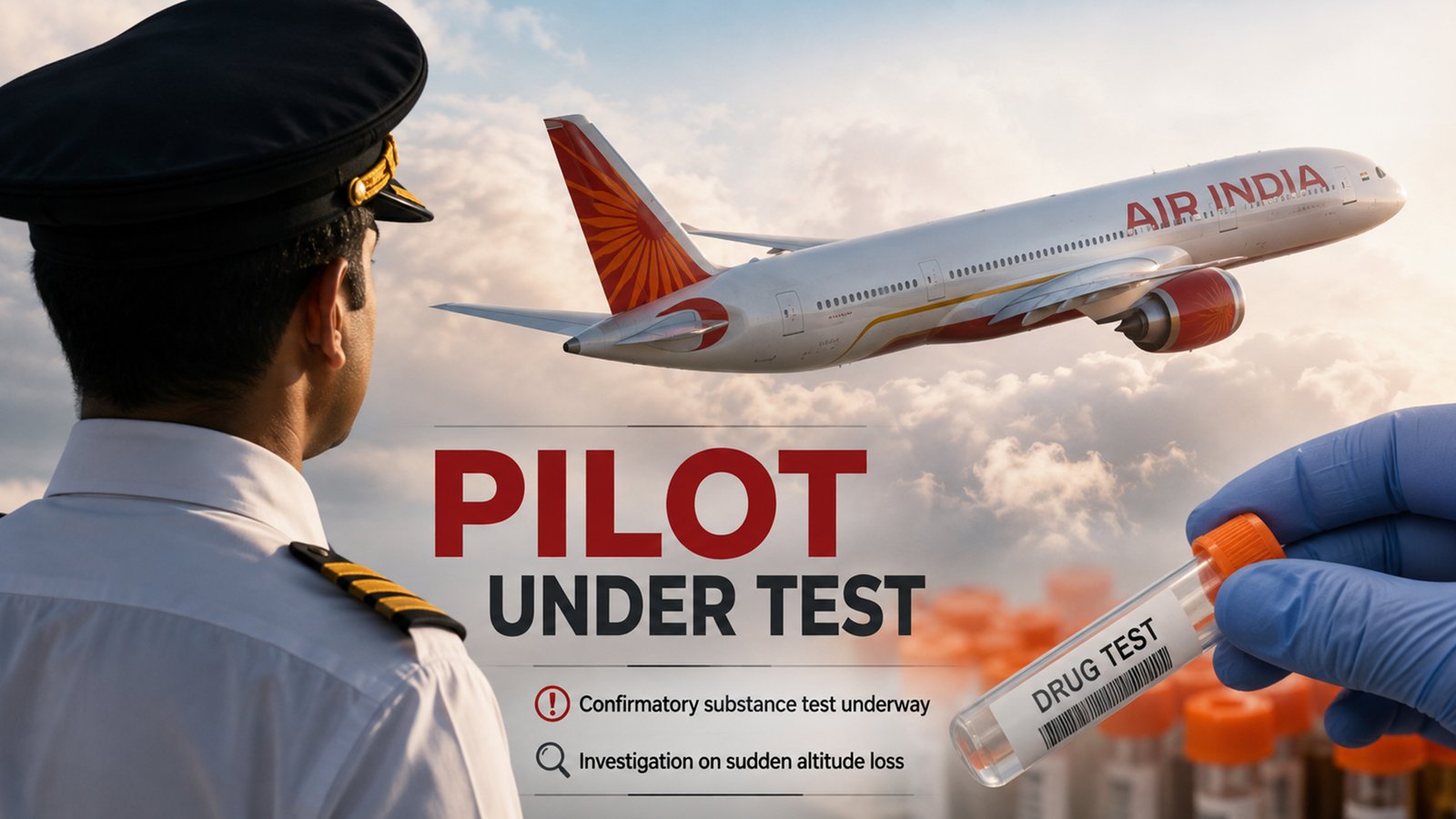
An Air India pilot has been sent for a confirmatory drug test after an initial screening returned a “not negative” result following a flight that suddenly lost around 300 feet in altitude, injuring 17 passengers.
The incident involved an Air India flight from Phuket to Delhi on August 4. The Airbus A320 was carrying 137 passengers and eight crew members when it experienced a sudden altitude drop during the flight. The aircraft later continued its journey and landed safely in Delhi.
The sudden plunge has been classified as a serious aviation incident and is being investigated by the Aircraft Accident Investigation Bureau (AAIB). The Directorate General of Civil Aviation (DGCA) has also taken action by removing the pilots involved from flying duties while the investigation continues.
The drug-test development has added another dimension to the investigation. After the aircraft landed in Delhi, the captain underwent a mandatory screening for psychoactive substances. The initial urine test was described by the government as “not negative”, meaning the result requires further examination and does not by itself establish that the pilot had consumed a prohibited substance.
The sample has therefore been sent for confirmatory testing. Authorities will use the second test to determine whether the initial result was accurate and whether any substance covered under aviation safety regulations was present.
The distinction between an initial screening and a confirmed result is important. A preliminary test can indicate the possible presence of a substance but may require laboratory confirmation before any conclusion is drawn about a pilot’s fitness to operate an aircraft.
The pilot has not been declared guilty of drug use, and the investigation into the incident remains ongoing.
The flight’s sudden loss of altitude occurred while the aircraft was cruising. Passengers were reportedly thrown around inside the cabin during the abrupt movement, leaving 17 people injured. The aircraft was able to recover and continue towards Delhi.
The incident has raised questions about both flight safety and the circumstances that led to the sudden altitude change. Investigators are examining technical and operational factors, including what happened inside the aircraft during the episode and how the crew responded.
The pilots’ actions are also expected to form part of the investigation. Both pilots have been kept off the roster pending the completion of the inquiry, according to aviation authorities.
The drug screening is part of India’s aviation safety framework, under which pilots and other aviation personnel can be tested for psychoactive substances. Such checks are intended to ensure that crew members operating commercial aircraft are fit to perform safety-critical duties.
For commercial aviation, pilot fitness is a particularly sensitive issue because even a temporary impairment can have serious consequences. However, officials have not established a connection between the initial drug-screening result and the altitude loss on the Air India flight.
The AAIB investigation will therefore have to examine the incident from multiple angles rather than relying on the drug-test result alone.
The aircraft involved was an Airbus A320, one of the most widely used commercial aircraft types in the world. The flight was operating from Phuket, Thailand, to Delhi when the altitude change occurred.
The sudden descent reportedly lasted only a short period, but the movement was severe enough to cause injuries among passengers. The aircraft subsequently continued safely and reached its destination.
The incident comes at a time when aviation authorities are facing increased scrutiny over Air India’s operational safety following several high-profile incidents involving the airline. The latest case is being treated separately, and investigators are expected to establish the precise cause based on technical data, crew reports and other available evidence.
The AAIB will examine flight data and other information from the aircraft as part of its investigation. Investigators are also expected to consider weather conditions, aircraft systems and crew actions surrounding the altitude loss.
Meanwhile, the confirmatory drug test could determine whether the initial “not negative” screening result was a false positive or reflected the presence of a regulated psychoactive substance. Until that process is complete, no final conclusion can be drawn about the pilot’s condition at the time of the flight.
The government has emphasised that the pilots have been grounded while the investigation proceeds. This precaution allows authorities to examine the incident without allowing the crew involved to operate commercial flights during the inquiry.
The 17 injured passengers have added urgency to the investigation. Although the aircraft landed safely, the sudden movement highlights how quickly an unexpected event during cruise can affect passengers and crew.
For Air India, the immediate priority will be to cooperate with the aviation authorities and establish what caused the sudden altitude loss. For regulators, the case will also test the effectiveness of existing pilot screening and aviation safety procedures.
The confirmatory drug test is expected to provide a clearer picture of the initial screening result. Until then, the “not negative” finding should be treated as an indication requiring verification rather than proof of drug use.
The investigation into the Phuket-Delhi flight remains underway, with both the cause of the altitude loss and the circumstances surrounding the pilot’s screening still being examined. The final findings will determine whether any regulatory or operational action is required.