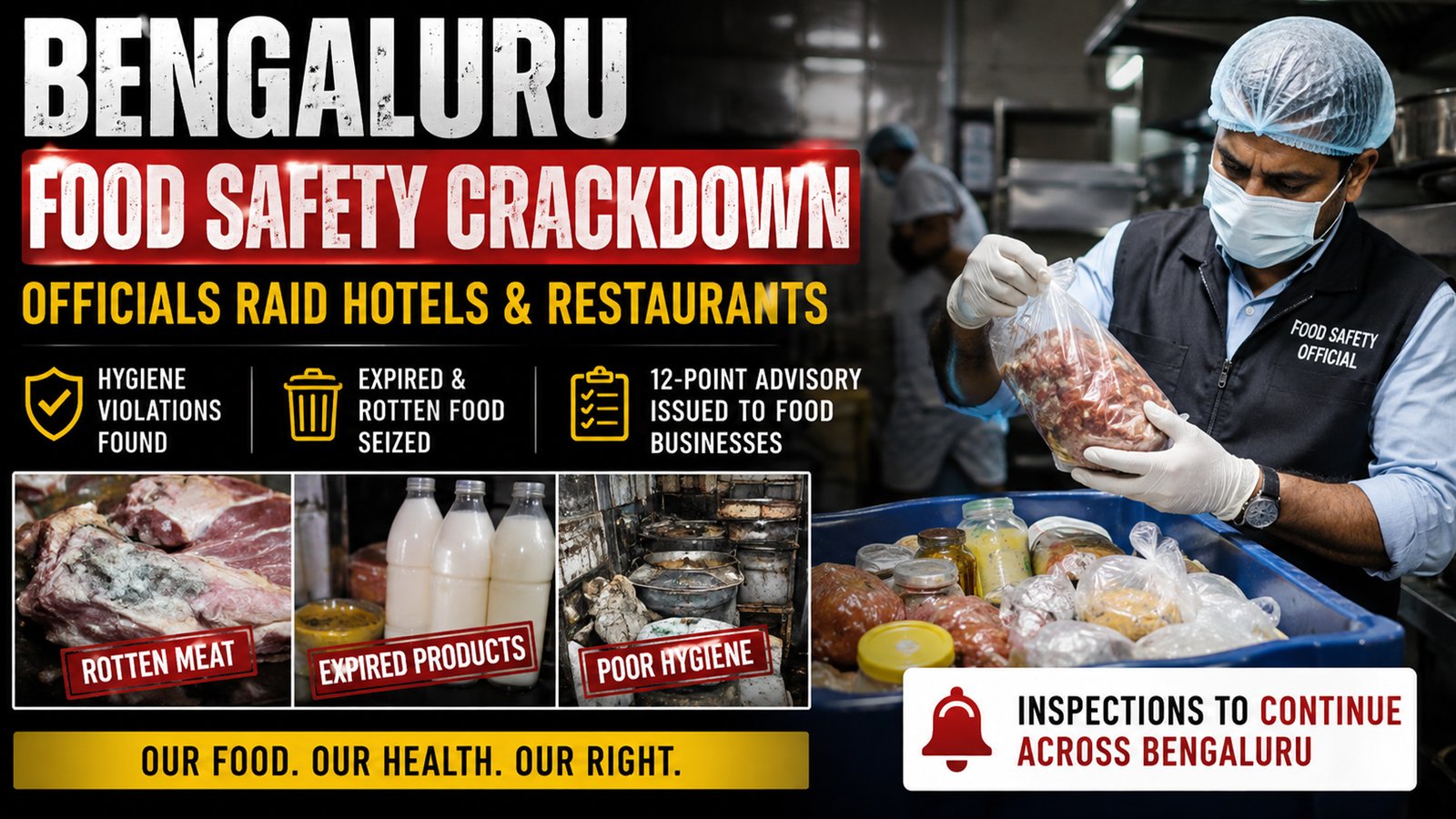
A major food safety crackdown in Bengaluru has uncovered serious hygiene and food-handling violations at restaurants, pubs, hotels and food storage facilities, raising fresh concerns about what reaches consumers’ plates. Authorities seized or discarded around 132 kg of food articles and 15 litres of used cooking oil during inspections carried out across the city.
The inspections found rotten meat, fungus-affected food, expired dairy products, spoiled vegetables and improperly stored ingredients. One of the most striking cases involved Skyye Lounge at UB City, where officials found an unhygienic kitchen and food that was declared unfit for consumption. The pub was subsequently shut following the inspection.
At Skyye Lounge, officials found around 45 kg of rotten chicken and beef, with fungus reportedly growing on the meat. Another 6 kg of vegetable cutlets was also found to be unfit for consumption. The inspection team also discovered milk and curd that had passed their expiry dates by about 10 days. In addition, 15 litres of used cooking oil was disposed of.
The action at the pub was part of a wider food safety inspection drive in Bengaluru rather than an isolated raid. Officials also inspected several other hotels and eateries, where large quantities of food were either seized or discarded after being found unsuitable for consumption.
At Royal Chain Hotel, officials seized 50 kg of duck and 5 kg of fish. Madras Kitchen had 5 kg of green peas seized, while 5 kg of mushrooms was taken from Tescon Hotel. At Senchez Hotel, three kilograms of fish was seized, while another seven kilograms of food, including cake, potatoes and tacos, was discarded.
The findings have brought attention not only to restaurant kitchens but also to the less visible supply chain behind Bengaluru’s booming food industry. Officials inspected food storage and distribution centres operated by Coldman Logistics and Radhakrishna Foodland, which supply products to several hotel establishments and caterers.
At these facilities, inspection teams found around 70 kg of soy sauce and other sauces that were nearing their expiry dates. Officials also confiscated about 10 litres of beverages, including strawberry-flavoured drinks and other products approaching their expiry dates. Five meat samples and 13 other food samples were collected and sent for laboratory analysis.
The inspections were conducted by the Karnataka Food Safety and Drugs Administration Department as part of a special drive covering food storage facilities and food business operators in Bengaluru Urban and BBMP areas. Thirty teams comprising designated officers and food safety officers were deployed for the operation.
The teams were asked to look beyond the appearance of establishments and examine how food was being stored, handled and distributed. This included checking storage conditions, the quality of ingredients, expiry dates and food safety practices followed by operators.
The findings have raised broader questions about how consistently food safety standards are being followed across the hospitality sector. Bengaluru has a large and rapidly expanding restaurant and pub industry, ranging from street-side eateries to luxury hotels and high-end nightlife venues. The latest inspections indicate that food safety risks are not necessarily limited to smaller establishments.
Recent inspections in the city have also revealed problems involving expired products, poor storage practices and contaminated ingredients. The scale of the findings has prompted authorities to widen scrutiny across different categories of food businesses.
The issue is particularly important for consumers because food safety violations can occur at several stages, from procurement and transportation to storage, preparation and serving. Expired dairy products, spoiled meat and poorly stored ingredients can create risks of foodborne illness if they enter the food chain.
The Bengaluru crackdown has therefore shifted attention towards the entire food supply chain, rather than focusing only on the final point of sale. Storage warehouses, distribution centres and suppliers can play an equally important role in determining the quality and safety of food served at restaurants and hotels.
Authorities have said that legal action will be initiated against food business operators found violating requirements under the Food Safety and Standards Act. The samples collected during the inspections will also help determine whether further action is necessary based on laboratory findings.
The enforcement drive comes amid growing concern over food hygiene in India’s restaurant sector. Consumers increasingly depend on restaurants, food delivery services and organised food outlets, making consistent compliance with food safety regulations essential.
The Karnataka government has now indicated that food safety enforcement will become broader. The Food Safety and Drug Administration has issued a 12-point advisory to hotels, restaurants, caterers and other food business operators, covering areas such as hygiene, food handling, storage, temperature control, prevention of cross-contamination and waste disposal.