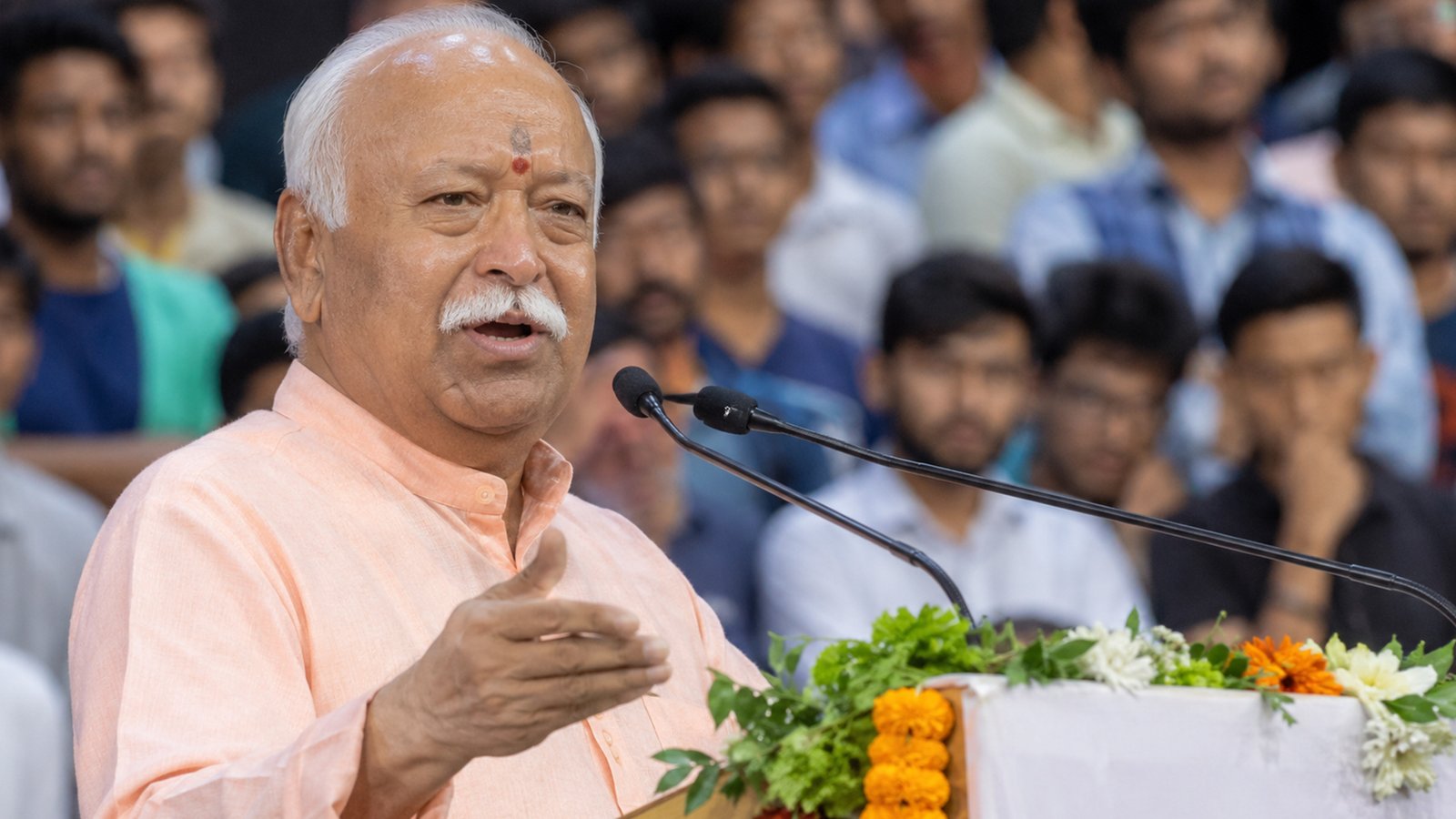
Rashtriya Swayamsevak Sangh (RSS) chief Mohan Bhagwat has said that the grievances raised by Gen Z protesters are genuine, arguing that young people questioning the system should not automatically be labelled anti-national.
Speaking at a youth-focused event in Mumbai, Bhagwat defended protest as a legitimate part of democracy and described it as a form of dialogue that can help society move towards consensus. His comments came amid student protests over alleged irregularities in competitive examinations, including the National Eligibility cum Entrance Test (NEET).
Bhagwat said he would not argue that Gen Z should not protest. Instead, he stressed that protests in a democracy need to be conducted through appropriate channels and with a sense of belonging. He said young protesters are not “anti-national”, but part of the country’s next generation.
His remarks have drawn attention because they offer an unusually direct defence of the right of young people to question authority. Bhagwat said Gen Z and Gen Alpha expect logical answers to the questions they raise rather than simply accepting decisions without explanation.
The RSS chief’s comments also touched on the changing relationship between young people and authority. He observed that today’s youth often interact with authority figures more like equals or friends and that questioning authority is a natural part of adolescence.
For Bhagwat, the challenge is not to silence that questioning but to create a relationship in which disagreements can be discussed. He emphasised dialogue, communication and a sense of belonging as important ways of handling differences between young people, institutions and those in positions of authority.
The comments come against the backdrop of student-led protests over examination-related concerns. Students have raised questions about the fairness and transparency of competitive examinations, with demands for accountability and reforms in the education system.
Bhagwat said education should not be treated simply as a commercial business. He argued that the system should be structured so education remains accessible to all and that society also has a role to play in improving the quality and status of education.
His comments on protests were particularly notable when he was asked about allegations that young demonstrators had faced force during recent agitations. Bhagwat said he did not have complete information about the incidents and therefore did not want to make a definitive judgment about who was right or wrong.
He said the circumstances and reasons behind such incidents need to be examined before reaching a conclusion. At the same time, when asked whom he would trust if forced to choose, he said he would place his faith in Gen Z.
The RSS chief’s broader message was that disagreement should not automatically be treated as hostility towards the country. In a democracy, people can raise concerns, organise protests and demand answers while remaining committed to the nation.
That distinction is particularly relevant for India’s younger population, which increasingly uses social media to organise, communicate and express dissatisfaction. For many young people, digital platforms have become an important space for discussing education, employment, public policy and other issues affecting their future.
Bhagwat also called for greater responsibility from parents and older generations. In another interaction, he said adults should lead by example rather than simply blaming younger people for social problems. He stressed the importance of teamwork and open communication within families instead of confrontation.
His remarks reflect a broader attempt to understand the mindset of a generation that is often described as more willing to question established institutions. Gen Z has grown up in an environment shaped by smartphones, social media, rapid access to information and changing expectations around education and employment.
That has also changed the way young Indians respond to institutions. When they believe their concerns are not being addressed through conventional channels, protests and online campaigns can become powerful tools for demanding attention.
Bhagwat’s argument was not that every protest or every demand should automatically be accepted. Rather, he presented protest as one of the ways democratic societies negotiate differences and eventually work towards consensus.
That approach places dialogue at the centre of the debate. For institutions, it means listening to grievances before they become larger conflicts. For protesters, it means ensuring that dissent remains focused on issues and seeks solutions rather than simply creating confrontation.
The comments are also significant in the context of the ongoing debate over youth participation in Indian democracy. India’s young population represents a large share of its future voters, workers, entrepreneurs and citizens. Their expectations around education, jobs, governance and accountability are therefore likely to shape the country’s political and social conversation in the years ahead.
Bhagwat’s remarks suggest that engaging with young people may require more than asking them to follow existing systems. It may also require institutions to explain decisions, respond to questions and recognise the legitimacy of peaceful dissent.