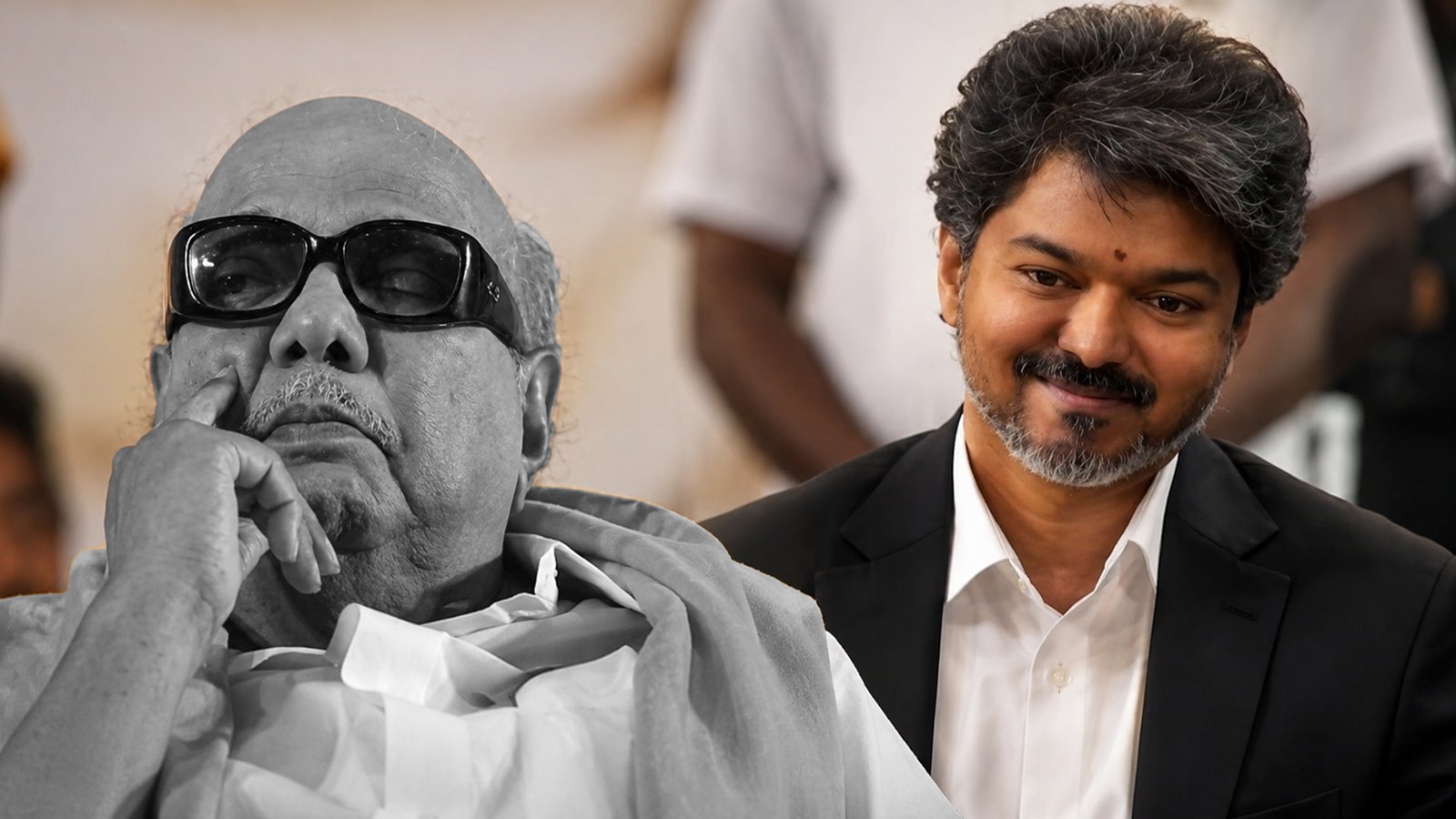
Tamil Nadu Chief Minister C Joseph Vijay apologised in the Assembly on Monday after Forest Minister R V Ranjith Kumar referred to former chief minister and DMK patriarch M Karunanidhi directly by name without using the customary honorifics.
The remark triggered an immediate protest from DMK legislators, who objected to what they described as a breach of established Assembly decorum. Vijay intervened to calm the situation and offered an apology on behalf of the minister.
“I apologise on his behalf,” Vijay said in the Assembly, acknowledging that the manner in which Karunanidhi had been referred to was inappropriate. His intervention brought the immediate confrontation between the ruling benches and the Opposition to an end.
The controversy arose during a debate on the demands for grants for the Health and Revenue departments. While speaking in the House, Ranjith Kumar referred to Karunanidhi simply by his name instead of using terms such as “Kalaignar” or “former Chief Minister”, which are commonly used in Tamil Nadu’s political discourse to refer to the late leader.
For the DMK, the issue was not merely about a choice of words. Karunanidhi, who served as Tamil Nadu chief minister multiple times and led the DMK for decades, remains one of the most influential figures in the state’s political history. The party viewed the omission of the customary respectful reference as a breach of the conventions followed in the Assembly.
The incident also highlighted the political sensitivity surrounding the legacies of former Tamil Nadu chief ministers. An unwritten convention in the Assembly has been to refer to former chief ministers, including Karunanidhi and former AIADMK leader J Jayalalithaa, with appropriate respect rather than simply by their names.
The minister’s comments came during a broader political attack on the previous system of alleged cash-for-votes practices. Ranjith Kumar referred to the controversial “Thirumangalam formula” and claimed that voters in his Kancheepuram constituency had received as much as ₹1,500 per vote during earlier elections.
He contrasted those elections with the present administration, arguing that the government led by Vijay had come to power without distributing money to voters. It was during this portion of his speech that he referred to Karunanidhi without the customary title.
The reference quickly shifted attention away from the minister’s criticism of electoral practices and towards the question of Assembly protocol and political respect.
DMK members protested strongly and demanded that the remark be addressed. The Opposition’s reaction reflected the continuing sensitivity around Karunanidhi, who died in 2018 but continues to occupy a central place in the DMK’s political identity.
Vijay’s decision to apologise was notable because it came despite the fact that the remark had been made by a member of his own Cabinet. Rather than allowing the dispute to disrupt the proceedings, the chief minister accepted responsibility for resolving the issue and apologised on the minister’s behalf.
The episode comes at a politically significant time for Vijay and his Tamilaga Vettri Kazhagam (TVK) government. Vijay, who entered electoral politics after a successful career in Tamil cinema, became chief minister after the 2026 Tamil Nadu Assembly election. His administration has completed its first 100 days in office, with the government highlighting welfare measures, investment commitments and initiatives in areas including women’s safety, agriculture and employment.
The government is also operating in an increasingly competitive political environment, with the DMK serving as the principal Opposition. The exchange over Karunanidhi’s name therefore carries a broader political context as the new TVK administration seeks to establish itself in a state where the DMK and AIADMK have dominated electoral politics for decades. The development is part of the wider national political developments across India involving state governments, opposition parties and legislative proceedings.
The DMK has already been sharply critical of the new government on several issues. Leader of the Opposition Udhayanidhi Stalin recently accused the TVK government of rebranding schemes introduced by the previous administration, while describing Vijay as a “dummy CM”.
Against this backdrop, the Assembly incident offered a brief moment of de-escalation. Instead of allowing the dispute to develop into a larger political confrontation, Vijay’s apology acknowledged the Opposition’s objection and restored proceedings.
The controversy also underlined the importance of political language in Tamil Nadu, where references to leaders such as Karunanidhi and Jayalalithaa often carry considerable emotional and political weight. Even seemingly minor deviations from established forms of address can quickly become contentious inside the Assembly.
For the TVK government, the incident is also a reminder of the scrutiny faced by ministers as the new administration settles into office. Statements made inside the Assembly can have consequences beyond the immediate debate, particularly when they involve figures who remain central to the political identity of the Opposition.
Ranjith Kumar’s comments were ultimately overshadowed by the apology that followed. Vijay‘s intervention prevented the dispute from escalating further and allowed the Assembly to move on with its proceedings.
The episode may have lasted only a short time, but it offered a glimpse of the political sensitivities surrounding Tamil Nadu’s past leadership. For Vijay, the decision to apologise was an attempt to preserve Assembly decorum while managing a confrontation with the DMK, whose objections were rooted in the longstanding respect attached to Karunanidhi’s legacy.