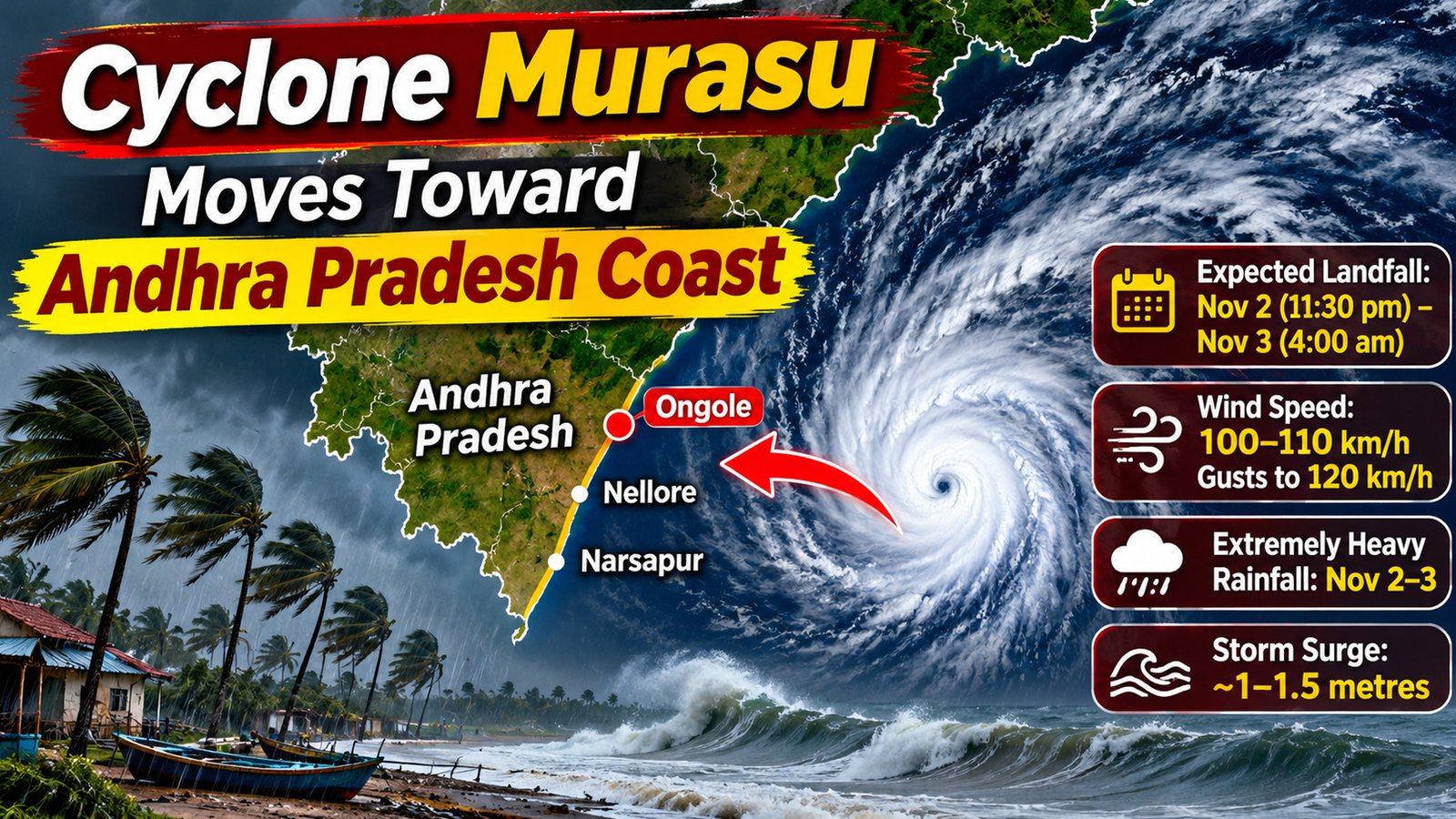
Cyclone Murasu moved closer to the Andhra Pradesh coast on Monday, November 2, prompting authorities in Andhra Pradesh and Odisha to intensify precautionary measures. With the severe cyclonic storm expected to make landfall around midnight, administrations have started evacuating residents from vulnerable areas, suspended educational activities in affected districts and deployed disaster response teams to handle emergencies.
The approaching weather system has raised concerns over heavy rainfall, strong winds, waterlogging and possible flooding across coastal districts. Authorities have urged residents to avoid unnecessary travel, stay away from the sea and follow instructions issued by local administrations as preparations continue.
According to the India Meteorological Department (IMD), Cyclone Murasu is expected to cross the south Andhra Pradesh coast between Nellore and Narsapur, near Ongole, around midnight on November 2 or during the early hours of November 3. The storm is likely to bring sustained wind speeds of 100-110 kmph, with gusts reaching 120 kmph during landfall.
In its Monday morning bulletin, the weather department said the severe cyclonic storm was moving west-northwestwards at approximately 25 kmph. At 5.30 am, it was centred over the west-central and adjoining southwest Bay of Bengal, around 200 km east-northeast of Chennai and 210 km east-southeast of Nellore.
The IMD has warned that several parts of coastal Andhra Pradesh could experience heavy to extremely heavy rainfall over the next three days. Krishna, Guntur, Bapatla, Prakasam, Markapuram and Nellore are among the districts expected to receive intense rainfall on Monday. Isolated locations could experience extremely heavy showers, increasing the possibility of flooding in low-lying areas.
The Andhra Pradesh government has directed district administrations to identify vulnerable settlements and shift residents to safer locations. Special attention is being given to people living in low-lying areas, weak houses and locations exposed to flooding.
Home Minister Vangalapudi Anitha reviewed the state’s cyclone preparedness arrangements with officials and instructed departments to ensure that emergency services remain operational. Six National Disaster Response Force (NDRF) teams and seven State Disaster Response Force (SDRF) teams have been deployed across vulnerable districts.
The teams have been positioned in areas including Krishna, Bapatla, Guntur, Nellore, Prakasam, Markapuram, Palnadu and Tirupati. Police, fire services, revenue officials and electricity department personnel have also been placed on alert to respond to emergencies, clear fallen trees and restore essential services.
Emergency control rooms have been instructed to function round the clock. District officials are also monitoring weather conditions and coordinating evacuation arrangements to ensure that people receive assistance without delay.
Educational institutions have been among the first establishments affected by the cyclone warning. In Andhra Pradesh’s Palnadu district, the collector declared November 2 a holiday for government and private schools, colleges and Anganwadi centres. The decision was taken as a precaution against heavy rainfall and possible disruptions caused by the storm.
Odisha has also stepped up its preparations, even though the cyclone is expected to make landfall along the Andhra Pradesh coast. The state government has directed district collectors and emergency departments to remain prepared for heavy rainfall, localised flooding and possible landslides.
Special Relief Commissioner Rajesh Prabhakar Patil instructed officials to strengthen disaster management arrangements and prioritise the safety of people living in vulnerable locations.
Evacuation operations have begun in Gajapati district, where authorities have identified around 150 landslide-prone locations. Residents of settlements in vulnerable hilly areas are being moved temporarily to safer places. Officials have also been asked to identify families living in kutcha houses and other structures that may not withstand strong winds and heavy rainfall.
The Water Resources Department has directed officials to lower water levels in dams in potentially affected regions to create additional storage capacity for rainwater. District administrations have also been instructed to take preventive measures to protect standing crops, plantations and horticultural produce.
Cyclone shelters and district emergency operation centres have been asked to remain functional. Authorities are arranging adequate stocks of food, drinking water, medicines and other essential supplies. Special arrangements are being made to assist elderly residents, pregnant women, children and persons with disabilities.
In Malkangiri district, schools and Anganwadi centres will remain closed from November 2 to 4. These buildings will also be used as temporary shelters if evacuation becomes necessary. Fire services, police personnel, forest officials, paramedics and mobile medical teams have been placed on alert.
The cyclone’s impact is also being felt in neighbouring Tamil Nadu, where Chennai, Chengalpattu and Tiruvallur have experienced heavy rainfall. The IMD issued an orange alert for Chennai, warning of very heavy showers.
Madhavaram recorded 11 cm of rainfall in the 24 hours preceding Monday morning, while Ennore Port and Nungambakkam received around 10 cm each. Waterlogging was reported in some parts of Chennai, although municipal authorities said there was no major flooding.
Schools and colleges in Chennai and Tiruvallur remained closed on November 2 as a precaution. Flight operations were also affected at Chennai Airport, with some services cancelled because of adverse weather conditions. Passengers have been advised to check with airlines for updated departure and arrival information.
The IMD has warned that the cyclone’s influence could extend to other southern states, including Kerala, with rainfall expected in parts of the region over the coming days.
Meanwhile, ports along the Odisha coast have been advised to keep Local Cautionary Signal No. III hoisted. Fishermen have been warned against venturing into the sea, while residents in vulnerable coastal and hilly areas have been asked to remain alert.
With Cyclone Murasu nearing landfall, authorities across Andhra Pradesh, Odisha and neighbouring states are focusing on evacuation, emergency response and the uninterrupted supply of essential services. Residents have been urged to follow official weather updates and avoid taking risks as the storm approaches the coast.