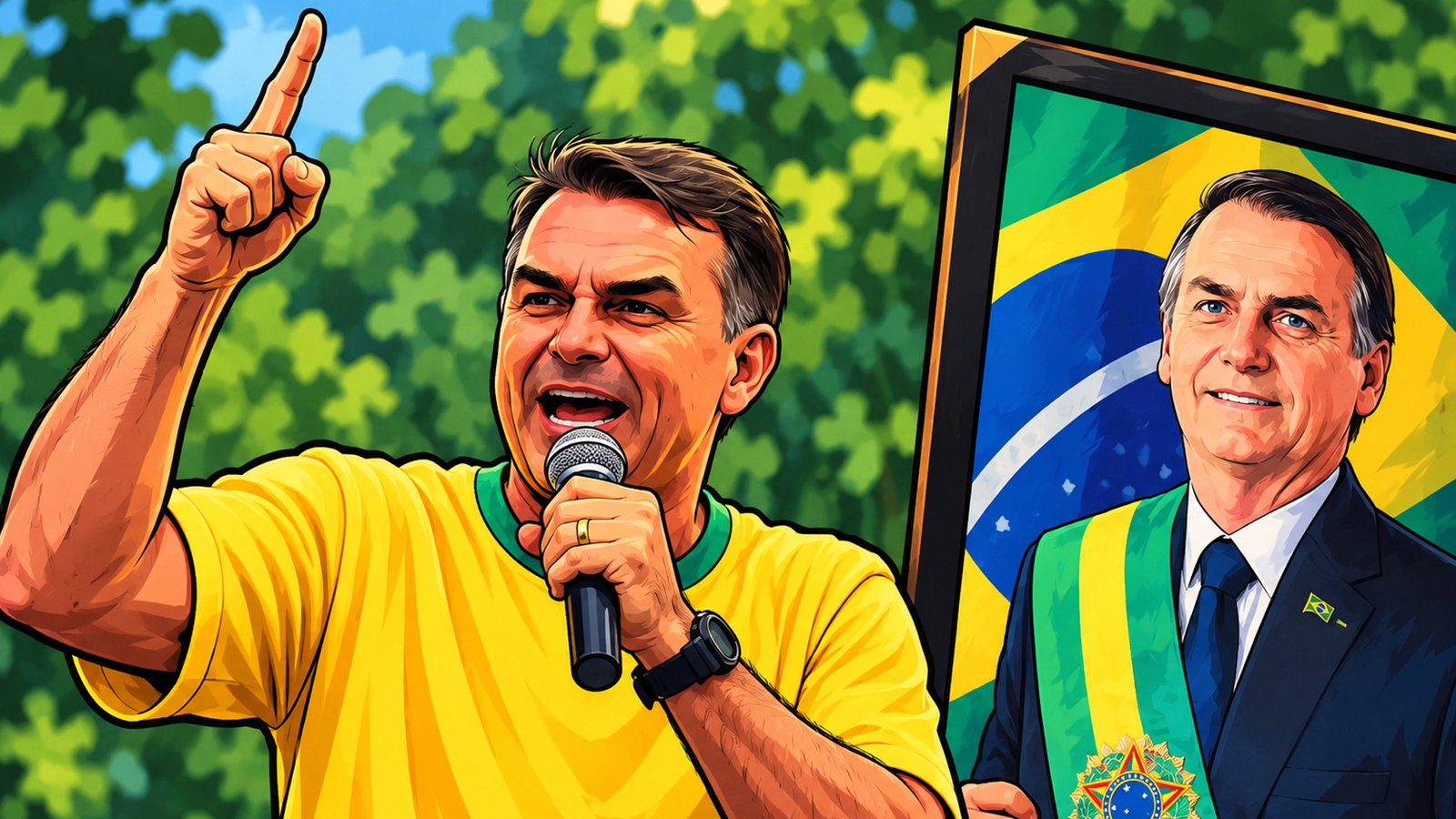
Former Brazilian presidential candidate Flavio Bolsonaro has claimed that political persecution forced him to leave Brazil and move to the United States, days after losing the country’s presidential election to incumbent Luiz Inacio Lula da Silva. In a video shared on social media, the 45-year-old senator described his departure as an urgent decision, alleging that authorities had begun targeting him sooner than he expected.
“The persecution began even sooner than I imagined,” Bolsonaro said during an Instagram livestream on Friday. He used the video to explain why he secretly left Brazil with his wife and two daughters, travelling through Argentina and Ecuador before reaching Miami, Florida, aboard a private aircraft on Wednesday.
His departure has triggered a diplomatic controversy between Brazil and Argentina, with the government of President Lula seeking explanations about the circumstances surrounding his journey. The incident has also brought renewed attention to the political divisions in Brazil following the closely contested presidential election.
Bolsonaro lost Sunday’s presidential runoff to Lula, who secured 51.8% of the vote. The senator reportedly finished more than four million votes behind the incumbent. However, he has refused to concede defeat and has questioned the election process, making allegations of irregularities without presenting supporting evidence.
In his social media video, Bolsonaro recalled receiving information from police that his Brazilian passports were being revoked on Monday, October 26. The development came shortly after he visited his father, former Brazilian president Jair Bolsonaro, who is currently under house arrest.
Recounting the emotional conversation with his father, Flavio said Jair had tears in his eyes when they discussed the possibility of further legal action against the family. According to Flavio, his father warned him that he understood where the situation was heading.
The senator said he responded that he understood the circumstances and knew what he needed to do. He also claimed that the decision to leave Brazil was made secretly, with very few people aware of his plans. However, he did not explain the complete arrangements behind the journey and urged people not to blame anyone for his departure.
Why did Flavio Bolsonaro leave Brazil?
Bolsonaro’s departure came amid an ongoing investigation into alleged money laundering involving Banco Master, a financial institution whose former head, Daniel Vorcaro, is being investigated over a multimillion-dollar payment reportedly made to Bolsonaro.
Investigators are examining allegations that the money was intended to finance a film about his father, Jair Bolsonaro. Flavio has denied wrongdoing and described the investigation as politically motivated.
Authorities had ordered him to surrender his passports and remain in Brazil as part of the legal proceedings. His departure, shortly after the restrictions were imposed, has raised questions about whether the conditions of the court order were followed.
The senator has accused Supreme Court Justice Alexandre de Moraes of making false allegations against him. He has repeatedly portrayed the legal proceedings as an attempt to silence the political opposition.
Bolsonaro also questioned aspects of the recent election, suggesting that voting irregularities had affected the outcome. However, he did not provide evidence to support his claims. Both Lula’s campaign and Bolsonaro’s political movement had sought extensions to voting hours on election day, citing different concerns.
Brazil seeks explanation from Argentina
The controversy has now developed into a diplomatic issue between Brazil and Argentina. Brazil’s Foreign Ministry summoned Argentina’s chargé d’affaires, Maria Emilia Cortes, on Thursday to seek clarification about the circumstances surrounding Bolsonaro’s passage through the neighbouring country.
According to reports, Bolsonaro and his family crossed into Argentina through the northern border on Tuesday evening before boarding a chartered aircraft at Puerto Iguazu. They subsequently travelled through Ecuador before arriving in Florida.
Argentina’s Foreign Minister Pablo Quirno denied that his government had received a formal request for explanations from Brazil. He disputed reports about the diplomatic move in a social media post.
The incident has further strained relations between Lula and Argentine President Javier Milei, who openly supported Bolsonaro during the presidential campaign. Milei has not acknowledged Lula’s election victory, adding to the tensions between the neighbouring countries.
An Argentine presidential spokesperson described Bolsonaro’s journey as a rescue from what he called the threat of communism and the imprisonment of opposition figures. Bolsonaro had also thanked Milei for his assistance in a letter released after arriving in the United States, although he did not explain what help he received.
Trump administration also faces questions
The United States has also come under scrutiny over Bolsonaro’s arrival in Florida. US President Donald Trump has previously criticised the legal proceedings against Jair Bolsonaro and questioned Brazil’s election results.
The Trump administration approved US visas for Flavio Bolsonaro and his family. Trump also indicated that he had no objection to the senator coming to the country.
Meanwhile, Jair Bolsonaro remains under house arrest after receiving a 27-year prison sentence for his role in an attempt to overturn the results of Brazil’s 2022 presidential election.
Despite leaving Brazil, Flavio Bolsonaro has indicated that he intends to remain politically active. He has described himself as Brazil’s legitimate political leader and suggested that he could seek the presidency again before the next scheduled national election in 2030.
He also predicted economic difficulties under Lula’s administration and continued to criticise the country’s judicial system.
His departure has therefore become more than a personal decision to relocate abroad. It has opened another chapter in Brazil’s political confrontation, while placing additional pressure on the country’s already strained diplomatic relationship with Argentina. Whether Bolsonaro will continue leading the opposition from the United States remains an important question for Brazil’s political future.