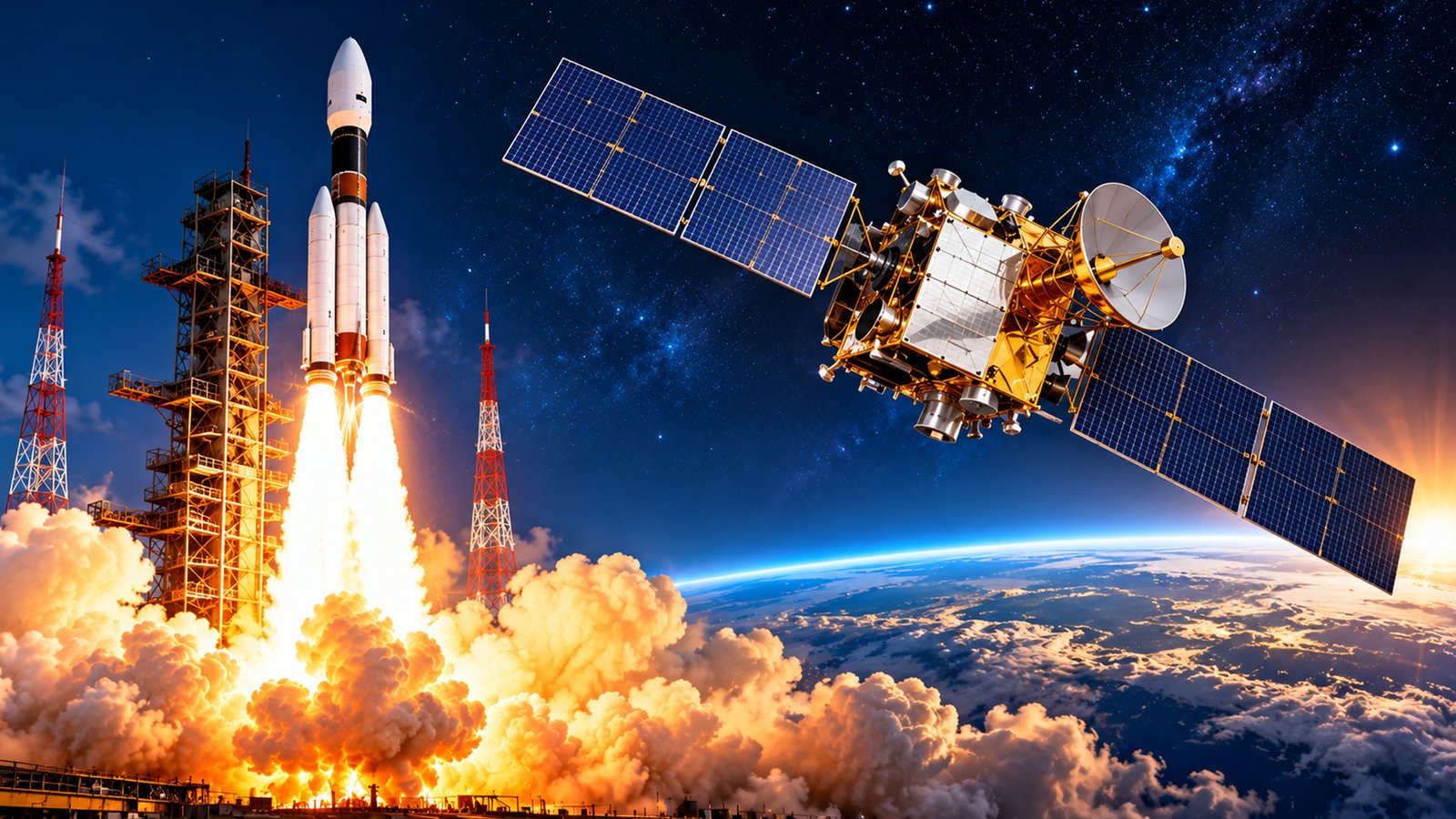
The Indian Space Research Organisation (ISRO) has successfully launched its next-generation navigation satellite, NVS-03, aboard the GSLV-F18 rocket, strengthening the country’s indigenous satellite navigation system, NavIC. The mission took place at 11.51 pm on Friday, October 30, from the Second Launch Pad at the Satish Dhawan Space Centre in Sriharikota, Andhra Pradesh.
The launch marks the 20th flight of India’s Geosynchronous Satellite Launch Vehicle (GSLV) and is an important step towards improving NavIC, which had fewer satellites than required for independent positioning services. ISRO confirmed that the rocket placed NVS-03 in its intended geosynchronous transfer orbit.
Weighing around 2,250 kg, NVS-03 is the third satellite in ISRO’s second-generation navigation series. It is designed to ensure continuity of services under the Indian Regional Navigation Satellite System (IRNSS), now known as Navigation with Indian Constellation, or NavIC. The satellite will strengthen coverage across India and approximately 1,500 km beyond its borders.
Around 18 minutes after liftoff, the satellite separated from the launch vehicle and entered transfer orbit. The mission was completed 56 days after the previous GSLV-F17 launch, highlighting a faster turnaround.
A key feature of NVS-03 is its indigenous atomic clock. The satellite carries an Indian-made clock alongside procured atomic clocks. These devices provide precise time measurements. Navigation systems use the time taken by signals to travel between satellites and receivers to calculate a user’s location. Even tiny timing errors can affect accuracy.
Developing this technology domestically can reduce dependence on foreign suppliers for a critical component and strengthen India’s ability to maintain its navigation infrastructure. Earlier NavIC satellites faced atomic clock problems, making reliable timing technology a priority for the newer generation.
NVS-03 also carries the L1 navigation signal, alongside the existing L5 and S-band signals. L1 is expected to improve NavIC’s compatibility with other global navigation systems and expand its use in civilian devices. It is widely used by consumer navigation equipment, including smartphones and other location-enabled products, potentially making NavIC more accessible to technology manufacturers and everyday users.
NavIC provides positioning, navigation and timing services. Applications include road and maritime navigation, vehicle tracking, aviation, emergency response, precision agriculture and location-based services. It also has a restricted service for authorised users, making it relevant to defence. NavIC is designed to cover India and up to 1,500 km beyond its borders, unlike the worldwide US-operated Global Positioning System (GPS).
The launch is important because NavIC’s operational strength had been affected by ageing satellites and the failure of NVS-02. Launched in January 2025, NVS-02 could not complete its orbit-raising manoeuvre after an electrical signal failed to reach a pyro valve in its propulsion system. It could not reach its intended orbit. The setback left NavIC with three satellites providing positioning, navigation and timing services, while at least four are required for basic standalone positioning.
The timing service remained functional, and users continued relying on multi-constellation navigation. However, the shortage limited NavIC’s ability to independently provide positioning information. ISRO said corrective measures identified after the NVS-02 anomaly were incorporated into subsequent preparations.
With NVS-03 placed in transfer orbit, the constellation has gained a fourth satellite. ISRO Chairman V Narayanan said the launch had restored the constellation’s operation for positioning, navigation and timing services. The spacecraft was reported healthy, with its solar panel deployed. It must still complete orbital manoeuvres and commissioning before services become fully available.
For defence users, an indigenous navigation system can offer strategic autonomy. Armed forces use satellite navigation for positioning and coordinating aircraft, ships and troop movements. Depending on foreign systems can create risks if access is restricted during conflict. NavIC’s restricted services are intended to provide secure support to authorised strategic users.
The case for independent navigation became clear after the 1999 Kargil conflict, when India faced limitations in accessing foreign satellite navigation information. The experience strengthened the case for a domestic system under Indian control. NavIC emerged from that effort and is now part of India’s space and security infrastructure.
NVS-03 is part of a plan to deploy five second-generation satellites, NVS-01 to NVS-05, to improve continuity and reliability. NVS-01, launched in May 2023, was the first in the series and carried an indigenous atomic clock. ISRO is preparing NVS-04 and NVS-05 as further additions.
The successful GSLV-F18 mission marks progress in strengthening India’s launch capability and rebuilding its independent navigation network. NVS-03’s performance in orbit and commissioning will determine when the improvements reach users. The satellite brings India closer to a dependable NavIC system and greater self-reliance in technology supporting everyday navigation and critical national operations.