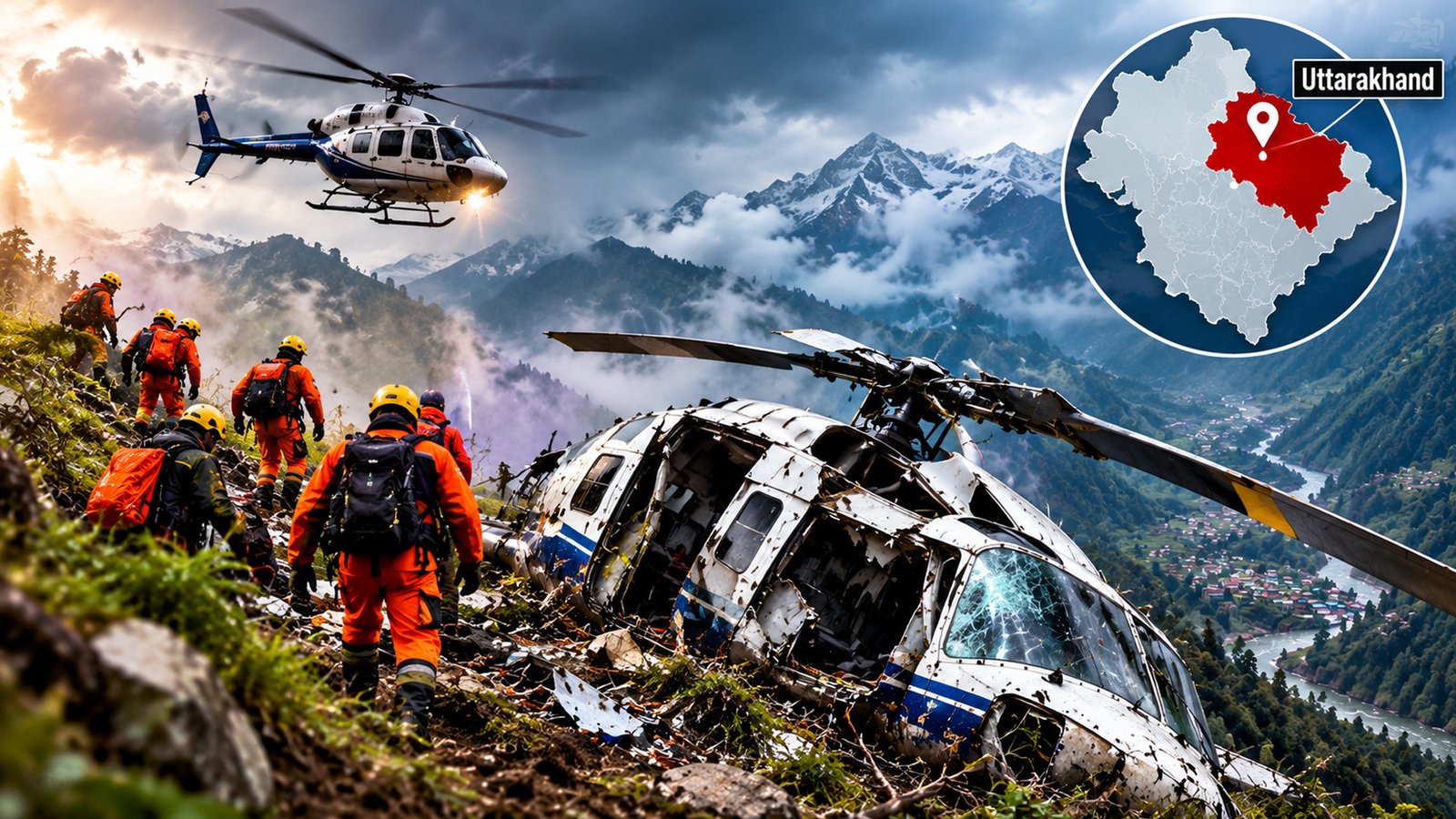
A helicopter crash near Joshimath in Uttarakhand’s Chamoli district has killed six people, including five pilgrims and the pilot, raising fresh concerns about aviation safety on India’s Himalayan pilgrimage routes. The privately operated helicopter crashed on Friday, October 30, while returning from Badrinath to Dehradun.
The accident occurred in a mountainous area near Chhai village, close to Joshimath. The helicopter was operated by Trans Bharat Aviation and was carrying five passengers and the pilot. All six people on board died in the crash, according to officials.
The aircraft had departed from Badrinath at around 1.14 pm and was heading towards the Sahastradhara helipad in Dehradun. It reportedly lost contact with the tracking system while crossing the Joshimath valley. Officials said the wreckage was located near the JP Power House, close to Marwari Bridge, in the Chamoli district.
The passengers were identified as Prathapa, Arun, Shankar Gowda, Sudheer K and H S Natraja. They were from Karnataka and had undertaken the Char Dham pilgrimage together. The pilot was identified as Captain Himanshu.
The crash has once again drawn attention to the challenges of operating helicopters in the Himalayan region, where unpredictable weather, steep mountain slopes, narrow valleys and rapidly changing visibility can make flying particularly difficult.
According to initial information, adverse weather conditions may have contributed to the accident. The India Meteorological Department had issued an orange alert for Chamoli on October 30, warning of thunderstorms, lightning, hail and strong winds. Rain and poor visibility also affected rescue operations.
However, the exact cause of the crash has not yet been established. Investigators will examine whether weather conditions, a technical malfunction or other operational factors played a role.
The Aircraft Accident Investigation Bureau (AAIB) is expected to investigate the incident. The investigation will examine the helicopter wreckage, flight records and cockpit voice recorder, if available. Officials are also expected to review the pilot’s flying history, aircraft maintenance records and the operator’s compliance with aviation safety regulations.
The Directorate General of Civil Aviation (DGCA) is responsible for regulating civil aviation operations in India, including helicopter services. Compliance with its safety requirements will be an important part of the investigation.
As a precautionary measure, the Uttarakhand government grounded the entire helicopter fleet operated by Trans Bharat Aviation following the accident. This decision is intended to ensure that the operator’s aircraft and operational procedures can be examined before further services are permitted.
The incident also raises questions about the reliability of flight tracking systems in mountainous regions. According to Uttarakhand Civil Aviation Development Authority chief executive officer Prateek Jain, the helicopter disappeared from the tracking system as it crossed the Joshimath valley.
Aircraft tracking technology plays an important role in monitoring flights, particularly in remote areas where ground-based communication infrastructure may be limited. However, mountainous terrain can create challenges for communication and tracking signals. When an aircraft disappears from monitoring systems, locating its last known position becomes critical for emergency response teams.
The use of satellite-based tracking, reliable communication equipment and improved monitoring systems can help aviation authorities identify aircraft in distress and coordinate rescue operations more efficiently. Weather monitoring technology is equally important because conditions in high-altitude regions can change rapidly.
The rescue operation involved the district administration, police, State Disaster Response Force (SDRF), Army and Indo-Tibetan Border Police (ITBP). The remote crash location and difficult terrain made access challenging. An Army team also helped locate the wreckage and the victims.
The accident has renewed concerns about helicopter services used during the Char Dham Yatra. Thousands of pilgrims travel to Uttarakhand every year to visit Badrinath, Kedarnath, Gangotri and Yamunotri. Helicopter services have become increasingly popular because they reduce travel time and provide access to difficult-to-reach religious destinations.
However, the growing use of helicopters has also brought greater attention to flight safety. These operations involve flying through narrow valleys and landing at high-altitude locations, where weather conditions and geographical limitations can increase operational risks.
Uttarakhand has witnessed several helicopter accidents in recent years. In June 2025, seven people were killed when a helicopter carrying pilgrims crashed near Kedarnath. Another helicopter accident on the Kedarnath route in October 2022 claimed seven lives.
Official figures cited in recent reporting indicate that the state recorded 12 helicopter crashes between 2016 and 2026, resulting in 21 deaths. The latest accident adds to the concerns surrounding aviation operations in the region.
For the aviation industry, the incident highlights the need to strengthen safety procedures through better aircraft maintenance, pilot training, weather assessment and real-time flight monitoring. Operators must also ensure that flights are conducted only when weather and visibility conditions are suitable.
Technology can improve aviation safety, but it cannot completely eliminate the risks associated with flying in challenging geographical conditions. Reliable communication systems, accurate weather forecasts, regular technical inspections and strict adherence to flight restrictions remain essential.
The investigation into the Joshimath helicopter crash is expected to provide more clarity about what went wrong. Until then, the tragedy serves as another reminder that passenger safety must remain the highest priority when operating helicopter services across India’s mountainous pilgrimage routes.