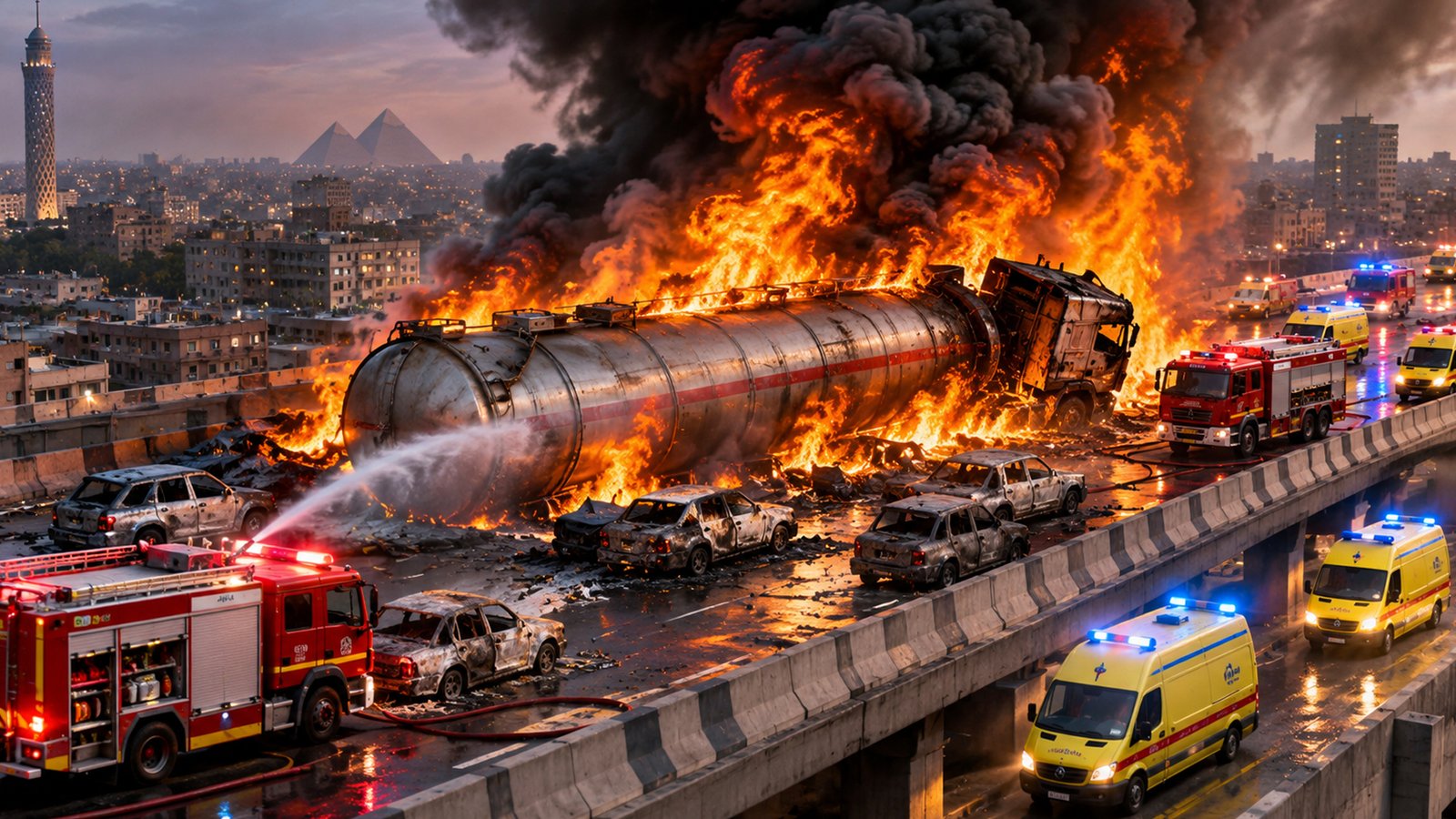
A devastating fuel tanker accident on a major highway in Cairo has killed 31 people and injured 26 others, triggering public outrage and renewed questions over road safety in Egypt. The tanker overturned and burst into flames during evening rush hour on November 25, engulfing nearby vehicles and leaving a trail of destruction along the capital’s busy Ring Road.
Egyptian authorities have detained a 21-year-old driver suspected of causing the crash. Prosecutors have ordered his detention pending an investigation and sent him for forensic tests to establish whether he was under the influence of drugs at the time of the accident.
The incident occurred at around 6.30 pm in the Al-Waraq neighbourhood of Giza, on the western outskirts of Cairo. The tanker, which was carrying petroleum products, overturned after a collision, spilling fuel that quickly caught fire. The flames spread to surrounding traffic, destroying 27 vehicles, including cars and motorcycles.
The fire was so intense that motorists abandoned their vehicles and ran for safety. Thick smoke and towering flames rose above the highway, while several explosions added to the panic among commuters and residents living nearby.
According to the Public Prosecution’s preliminary findings, the accident began when a car struck the rear of the tanker as it travelled along the highway. The driver reportedly told investigators that he was travelling at around 110 kmph and attempting to overtake other vehicles by changing lanes when his car hit the tanker’s rear-right side.
He subsequently lost control of his vehicle. One of the tanker’s tyres burst before the truck struck a concrete barrier and overturned. The petroleum products spilled onto the road and caught fire, triggering the massive blaze.
Investigators identified the driver after examining the accident site and questioning witnesses. Authorities are also examining whether speeding, reckless driving or other factors contributed to the tragedy.
Emergency services rushed to the scene as the fire spread across the highway. Authorities deployed 39 ambulances to transport the injured to nearby hospitals. Three buildings close to the accident site were also evacuated as the flames threatened surrounding residential areas.
The Ministry of Health confirmed that 31 people had died and 26 were injured. Five of the injured were subsequently discharged, while the remaining 21 continued receiving treatment. Eight patients were transferred to other hospitals for further medical care.
The identification of some victims has proved difficult because of the severity of the fire. Forensic teams have begun collecting DNA samples from relatives to establish the identities of the deceased.
Families of missing commuters have also turned to social media, posting appeals for information about relatives who had been travelling along the Ring Road when the accident occurred.
Residents described scenes of panic and helplessness as the fire engulfed vehicles. Some said the intensity of the flames and repeated explosions made it almost impossible to approach the victims and offer assistance.
Traffic gradually resumed after emergency crews cleared much of the wreckage. However, the charred remains of vehicles, damaged road infrastructure and debris highlighted the scale of the disaster.
Egyptian President Abdel Fattah el-Sisi directed authorities to provide full medical care to the injured and extend assistance to the families of those killed.
Prime Minister Mostafa Madbouly visited injured victims in hospitals along with senior ministers and assured families that the government would provide financial and other support.
The government has also proposed investment certificates to generate a regular income for bereaved families, while owners of vehicles destroyed in the fire are expected to receive replacement vehicles.
Madbouly acknowledged that financial assistance could not compensate families for their loss but said the authorities would work to support those affected.
The Ministry of Social Solidarity has opened channels for public donations, while the cabinet announced that seven charitable organisations had contributed 24 million Egyptian pounds towards relief efforts. Businesses and members of the public have also been encouraged to contribute.
The tragedy has reignited debate over Egypt’s road safety standards, traffic enforcement and the regulation of heavy vehicles. The Cairo Ring Road is one of the country’s busiest transport corridors, connecting the capital with surrounding towns and expanding suburban communities.
A 2018 government decision reportedly prohibited trucks weighing more than four tonnes from using the Ring Road between 6 am and midnight. However, authorities have yet to explain why the petroleum tanker was travelling on the highway during evening rush hour.
The incident has also raised questions about the enforcement of traffic rules, speeding and the safety of transporting hazardous materials through densely populated areas.
According to Egypt’s official statistics agency, 5,829 people died in road accidents in 2025, an increase of 10.8 per cent compared with the previous year. Around 84,000 people were injured in road accidents during the same period.
The tanker fire comes less than three weeks after a train collision in Giza killed seven people and injured more than 125, adding to public frustration over recurring transport accidents.
Lawmakers and public figures have demanded accountability, arguing that investments in highways and transport infrastructure must be accompanied by stronger safety management and enforcement.
Former foreign minister Amr Moussa criticised what he described as a deterioration in government oversight, warning that avoiding responsibility could lead to further tragedies.
As the investigation continues, the focus remains on establishing the circumstances that led to the tanker overturning, determining the driver’s responsibility and examining whether lapses in transport regulation contributed to the disaster. For the families who lost loved ones, the immediate challenge is coping with an unimaginable loss while seeking answers and accountability.