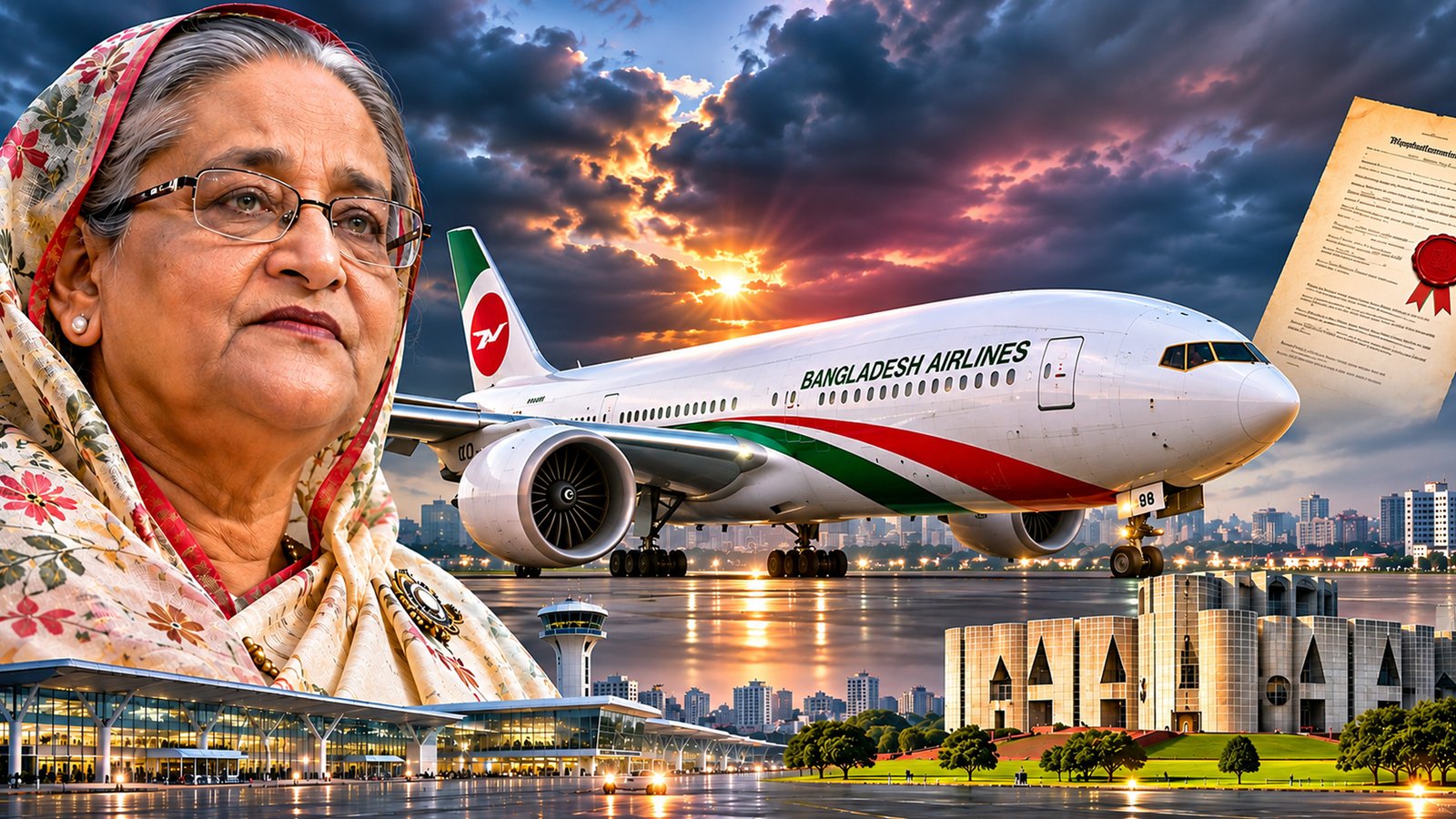
Former Bangladesh prime minister Sheikh Hasina has announced plans to return to her country on December 16, choosing the politically significant occasion of Victory Day for her proposed homecoming after more than two years in exile in India. However, her announcement has been met with a strong response from Bangladesh’s government, which has made it clear that she faces arrest if she enters the country.
Hasina has also asked the government in Dhaka to arrange her return from Delhi aboard Biman Bangladesh Airlines, the country’s national carrier. Her spokesperson, Syed Mozammel Ali, confirmed the request in a statement, saying that Bangladesh should facilitate her journey home.
The development marks the first time Hasina has publicly identified a specific date for her return since fleeing Bangladesh in August 2024. It could further complicate relations between the former prime minister and the administration led by Tarique Rahman, while adding another dimension to the already sensitive political situation in the country.
December 16 holds particular importance in Bangladesh’s history. Celebrated as Victory Day, it marks the country’s victory over Pakistan in the 1971 Liberation War and the emergence of Bangladesh as an independent nation. The date also carries personal and political significance for Hasina, whose father, Sheikh Mujibur Rahman, was the central figure in the country’s independence movement and its founding leader.
Hasina’s aide Abu Obaidha Arin described the proposed return as deeply symbolic, expressing confidence that she would spend Victory Day among the people of Bangladesh. The announcement reflects the former leader’s determination to re-enter the country’s political landscape despite the serious legal challenges awaiting her.
The Bangladesh government, however, has rejected the suggestion that it should arrange a special flight for Hasina. The response from Dhaka has been particularly firm, underlining the gap between her stated intention to return and the legal circumstances surrounding her departure.
State Minister for Foreign Affairs Humaiun Kobir said Hasina could return only through the extradition process and would face arrest under strict surveillance. Speaking to reporters in Dhaka on Tuesday, he ruled out an unconditional return and said the government would not entertain her request for transport on the national carrier.
The minister’s remarks followed the statement from Hasina’s spokesperson. He also maintained that her return would have to be governed by the extradition treaty between Bangladesh and India. Bangladesh has already sought her extradition, and the current administration has reiterated that it intends to pursue the matter.
Hasina’s legal position remains the biggest obstacle to her proposed homecoming. In November 2025, Bangladesh’s International Crimes Tribunal sentenced her to death in absentia after finding her guilty of crimes against humanity in connection with the crackdown on the 2024 student-led uprising. The tribunal held her responsible for ordering a deadly response to the protests that eventually brought her government down.
Hasina has rejected the charges and the court proceedings, describing the cases against her as politically motivated. She has maintained that she wants to return and contest the allegations. However, a prosecutor has said that she missed the deadline to appeal against the verdict and that there is no legal basis to suspend the execution. Bangladesh’s legal system does provide for presidential clemency, although Hasina has not sought it and has rejected the verdict.
The scale of the violence that preceded her departure remains a major issue in Bangladesh. The United Nations estimated that up to 1,400 people were killed during the unrest. What began as student protests against a controversial government job quota system developed into a nationwide movement demanding Hasina’s resignation.
On August 5, 2024, Hasina left Bangladesh and travelled to India as the protests intensified, bringing an end to her 15-year rule. Her departure marked a major turning point in Bangladesh’s political history. Three days later, Nobel Peace Prize laureate Muhammad Yunus took charge of an interim administration.
The interim government subsequently banned political activities of Hasina’s Awami League, which had governed Bangladesh for much of the preceding 15 years. The party was also barred from contesting the February 2026 general election. The Bangladesh Nationalist Party (BNP), led by Tarique Rahman, won the election and returned to power, with Rahman taking office as prime minister.
The political environment has remained unsettled since the change of government. Hasina’s recent efforts to secure new travel documents have added to the tensions, with reports of increased violence following her attempts to obtain a passport and other papers earlier this month.
The question of her return also has implications for India-Bangladesh relations. Hasina has been living in India since August 2024, and Dhaka has repeatedly sought her extradition. In April, India’s Ministry of External Affairs said it was examining the request and expressed its willingness to engage constructively with Bangladesh’s new government. New Delhi has not yet publicly responded to the latest developments.
There has also been no official discussion between the two governments about arranging a Biman Bangladesh Airlines flight to bring Hasina back to Dhaka. Bangladesh has made it clear that it expects the matter to be handled through the extradition process rather than through a government-arranged journey.