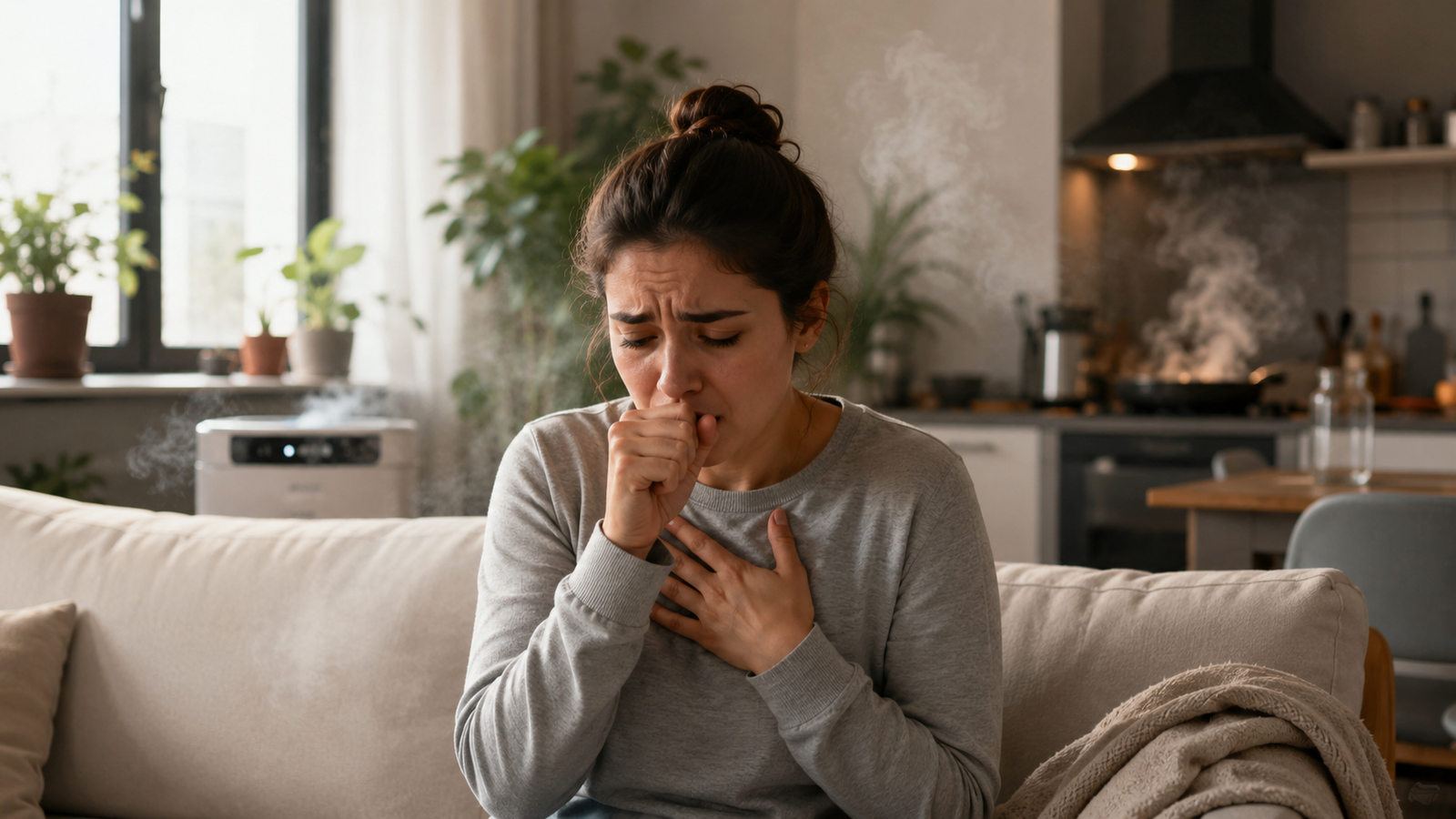
We tend to imagine air pollution as something visible, like traffic haze, factory smoke or a grey skyline. Home, by contrast, feels like the place where we shut pollution out.
Yet a closed door does not create clean air. It can also trap what is produced by a frying pan, a gas flame, a cigarette, an incense stick, a damp wall, a new coat of paint or a poorly vented heater.
The first question to ask is not: “Does my home smell clean?”
It is: “What is entering the air here, and where does it go?”
That matters because exposure is a combination of concentration and time. People in the United States spend about 90% of their lives indoors, and concentrations of some pollutants are commonly two to five times higher indoors than outdoors. A home need not look dirty or smell unpleasant to contain a lung hazard.
What the lungs encounter in a closed room
Indoor air pollution is not one substance. It is a shifting mixture of particles, gases, allergens and microbes. The mix changes when we cook, clean, burn fuel, renovate, shower, smoke or simply open a window on a polluted day.
Among the most important components is PM2.5: particulate matter no more than 2.5 micrometres across. Roughly 60 particles of that diameter placed side by side would span the width of a human hair. Their size allows them to travel deep into the lungs; some can cross into the bloodstream, which helps explain why particle pollution is associated with both respiratory and cardiovascular harm.
Gases behave differently. Nitrogen dioxide (NO2), for example, irritates the airways and can aggravate asthma, causing cough, wheeze and difficulty breathing, especially at higher concentrations
The global scale is sobering. The World Health Organization’s latest fact sheet says about 2.1 billion people still cook over open fires or inefficient stoves using kerosene, wood, charcoal, coal, crop waste or dung. Pollution from those fuels was responsible for an estimated 2.9 million deaths in 2021, including more than 309,000 deaths in children under five.
These figures refer specifically to household pollution from solid fuels and kerosene and they should not be casually applied to every modern kitchen. But they demonstrate what repeated inhalation of combustion products can do.
The ordinary sources we underestimate
- Cooking can be a major short-lived particle event in a home.
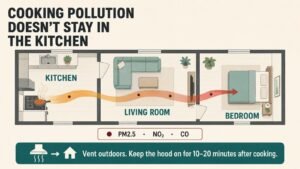
Frying, grilling, toasting and charring can generate PM2.5 regardless of whether the appliance is gas or electric (US EPA). Gas and propane add combustion pollutants, particularly NO2 and carbon monoxide (CO). In a 2024 study of more than 100 US homes, stove-related NO2 travelled well beyond the kitchen and could remain elevated after cooking had ended.
Here, scientific precision matters. The emission and exposure are established; the exact amount of chronic disease caused independently by gas cooking is less certain.
A major systematic review comparing gas with electricity found no statistically significant association with childhood asthma, including in a correction published in August 2026. Observational studies can be confounded by housing, smoking, outdoor pollution and income. This uncertainty is not a reason to ignore NO2, whose adverse respiratory effects are well supported, but it is a reason to avoid sensational claims.
- Smoke does not respect rooms.
There is no safe level of second-hand tobacco smoke exposure, and ventilation or air cleaning may reduce but cannot eliminate it. The only reliable protection is to keep smoking and vaping outside and away from doors, windows and air intakes. Candles, incense, fireplaces and wood-burning stoves also add particles and combustion gases; “natural” does not mean lung-neutral.
- Dampness is a respiratory problem, not merely a decorating problem.
Damp buildings are associated with cough, wheeze, respiratory infections, allergic rhinitis, hypersensitivity pneumonitis, and the development or worsening of asthma (CDC/NIOSH). The colour of visible mould is less useful than the underlying fact that water is present. Painting over it treats the evidence, not the cause.
- Invisible gases may be the most deceptive.
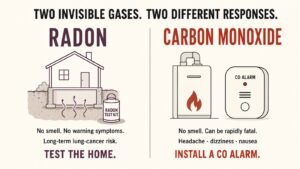
Radon is colourless and odourless. Its radioactive decay products settle on airway cells, damage DNA and can cause lung cancer. Depending on a country’s radon levels and smoking prevalence, radon is estimated to account for 3% to 14% of lung cancers. No symptom or smart air purifier can reveal it; testing is the only way to know the level in an individual home.
Carbon monoxide is a different emergency. Produced by incomplete combustion, it is colourless, odourless and potentially fatal. Headache, dizziness, nausea, weakness, chest pain and confusion can resemble flu or food poisoning, particularly when several people in the home become ill together.
Finally, those “fresh” fragrances can conceal chemical exposure. Paints, varnishes, adhesives, new furniture, cleaning agents, disinfectants, pesticides and personal-care products can release volatile organic compounds, or VOCs. Some cause eye, nose and throat irritation; health effects vary greatly by chemical, dose and duration. A pleasant smell is not a safety certificate.
A practical lung-health audit for your home
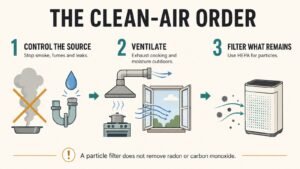
The most effective strategy is usually source control first, ventilation second and filtration third. Begin with the actions that remove a source rather than trying to capture pollution after it has spread. Protecting respiratory health at home usually starts with source control first, ventilation second and filtration third. Begin with the actions that remove a source rather than trying to capture pollution after it has spread.
- Make the home smoke- and vape-free. Reduce avoidable burning, including incense and candles, especially around children or anyone with lung disease.
- While cooking, use a range hood that exhausts outdoors, not one that merely recirculates air. Turn it on every time, favour the back burners and leave it running for 10–20 minutes afterwards. If there is no outdoor-vented hood, use cross-ventilation when outdoor air quality is acceptable. Where practical, induction avoids combustion pollutants at the stove, though cooking particles still require extraction.
- Have fuel-burning heaters, boilers, chimneys and stoves installed and serviced correctly. Never use a charcoal grill, camping stove or portable generator indoors or near an open window. Install certified CO alarms according to local guidance.
- Treat moisture as urgent maintenance. Repair leaks, use bathroom and kitchen exhaust, aim for roughly 30%–50% relative humidity, and dry water-damaged material within 24–48 hours to limit mould growth. Large or recurrent mould problems need competent remediation, not repeated bleaching.
- Test for radon using an approved kit or accredited service, then follow the prescribed action level. A neighbour’s result cannot predict yours; adjacent homes can differ.
- For particles, choose a portable HEPA cleaner with a clean-air delivery rate suited to the room, or use a MERV-13 HVAC filter if the system can accommodate it. Filtration can supplement source control and ventilation, but no cleaner removes every pollutant, and a particle filter does not solve radon or CO. Avoid devices that intentionally generate ozone: ozone itself is a lung irritant, and some ionising devices can produce harmful levels.
- Use the least aggressive cleaning product that will do the job, follow the label and ventilate. Never mix bleach with ammonia, acids or other cleaners since dangerous gases can be released.
A low-cost PM2.5 monitor can reveal a spectacular spike when toast burns or oil smokes, but it measures only what its sensors detect. It is a clue, not a medical instrument and not a complete score for the air.
The central lesson is simple: clean indoor air rarely comes from one expensive device. It comes from preventing smoke and fumes, exhausting pollution at its source, controlling moisture, testing for hazards that cannot be sensed and filtering what remains.
Your lungs do not know whether pollution came through the front door or was made behind it. They only know what arrives with the next breath.
This article provides general health information and is not a substitute for individual medical assessment.
(The author is an interventional pulmonologist and respiratory medicine consultant in Bengaluru.)