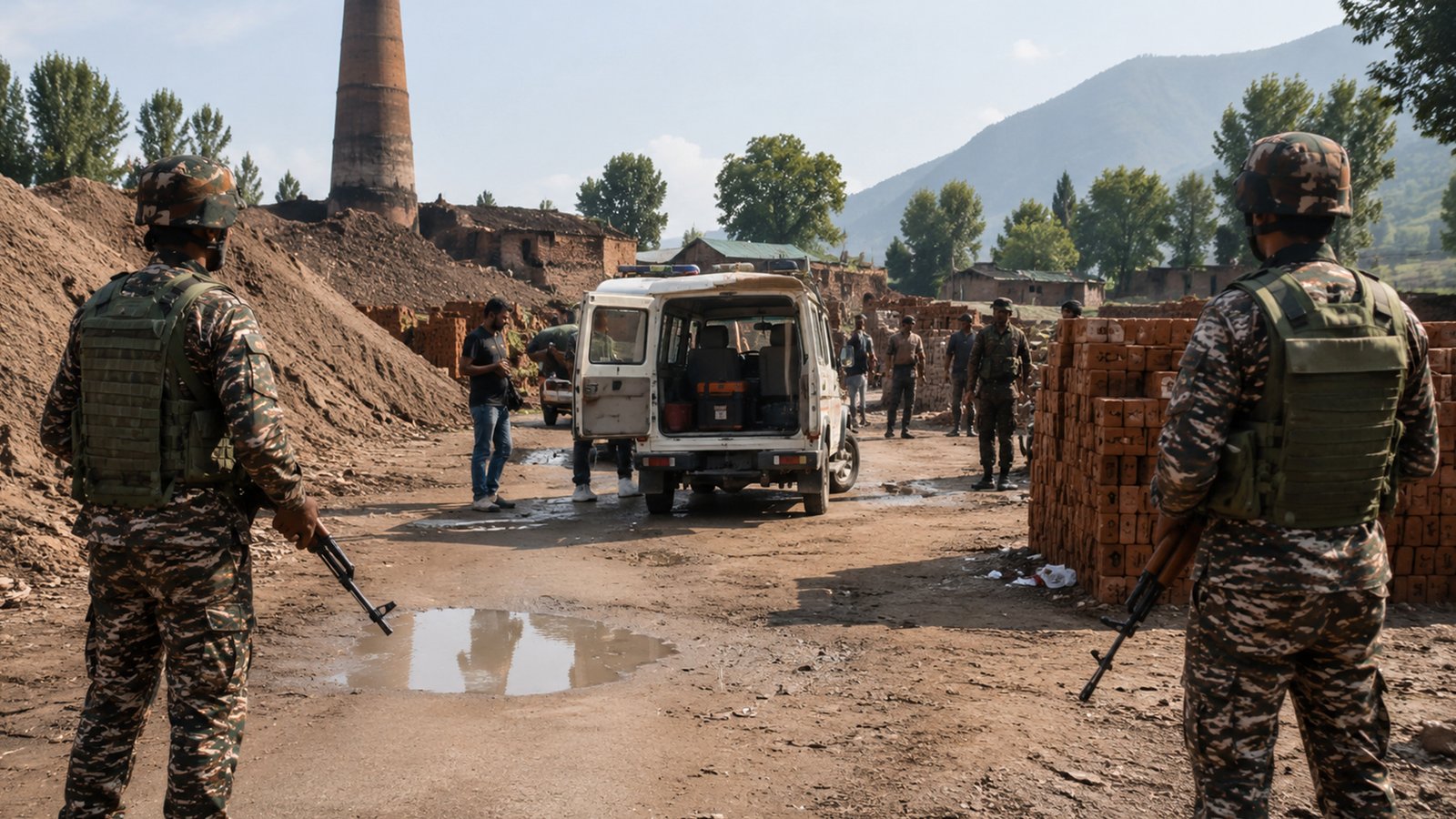
A migrant labourer from Chhattisgarh was killed and another was critically injured after terrorists opened fire at workers in Jammu and Kashmir’s Kulgam district on Friday evening, triggering a major security operation in south Kashmir. The attack took place in the Kelam area of Kulgam, where the victims were working at a brick kiln. The incident has raised fresh concerns over the security of migrant workers in the Valley.
According to officials, the terrorists opened fire on the workers before fleeing the area. The injured labourer was immediately shifted to a nearby hospital for treatment. His condition was reported to be serious. The deceased worker was also from Chhattisgarh. Later reports identified the two victims as Deepak Ratray and Bopinder, both in their twenties.
The attack occurred at a time when security agencies have maintained heightened vigilance across Jammu and Kashmir following a series of terror-related incidents. The latest incident has once again brought migrant workers into focus, as they have been targeted by militants in the past. Security officials have been particularly watchful over non-local workers, who are often employed in construction, brick kilns, agriculture and other seasonal jobs across the Valley.
Soon after the shooting, Jammu and Kashmir Police and other security forces cordoned off the area and launched a search operation to track down the attackers. Security personnel are conducting searches in nearby areas and checking possible escape routes used by the terrorists. The operation is aimed at identifying and locating those responsible for the attack.
Jammu and Kashmir Lieutenant Governor Manoj Sinha strongly condemned the attack and expressed his condolences to the family of the worker who was killed. He said the security forces had intensified operations against the terrorists involved in the incident. The administration has also assured that every effort will be made to bring the attackers to justice.
The latest Kulgam terror attack comes just days after another security incident in Jammu and Kashmir. On July 22, an IRP head constable, Aashiq Hussain Qureshi, was shot dead in Anantnag while he was deployed for security duties connected with the Amarnath Yatra. The two incidents within a short span have prompted renewed attention to the security situation in south Kashmir.
The targeting of migrant workers is particularly sensitive in Jammu and Kashmir. Non-local labourers have faced threats from militant groups in previous years, with attacks often aimed at creating fear and disrupting normal economic activity. In 2019, several migrant workers were killed in Kulgam in an attack that triggered an exodus of workers from the Valley. The latest incident has therefore revived concerns about whether terrorists are again attempting to intimidate migrant communities working in the region.
For workers from states such as Chhattisgarh, Bihar, Uttar Pradesh and other parts of India, employment in Jammu and Kashmir provides an important source of livelihood. Many work for months away from their families in construction sites, farms, brick kilns and other labour-intensive sectors. Attacks on such workers can have consequences beyond the immediate loss of life, creating fear among other workers and their families.
Authorities are now expected to examine the circumstances surrounding the attack and determine whether the victims were specifically targeted or whether the terrorists fired at workers after identifying them as non-locals. Investigators are also likely to examine local intelligence inputs and possible links to militant networks operating in south Kashmir.
The incident has also drawn condemnation from political and social leaders in Jammu and Kashmir. Former Chief Minister and National Conference president Farooq Abdullah and prominent religious leader Mirwaiz Umar Farooq were among those who condemned the killing of migrant workers and called for an end to violence.
The latest violence comes against the backdrop of continued security operations across Jammu and Kashmir, where security forces have been conducting counter-terror operations to dismantle militant networks and prevent attacks. The authorities have repeatedly stressed the need for strong intelligence gathering and coordinated operations between the police, Army and central armed forces.
For the people living and working in Kulgam, however, the immediate priority is restoring a sense of safety. The attack on workers at a brick kiln shows how vulnerable civilians can remain even as security forces maintain a heavy presence in the Valley. The investigation and search operation will now determine whether the attackers can be identified and neutralised.
The Kulgam terror attack has once again highlighted the continuing challenge of protecting civilians and migrant workers in Jammu and Kashmir. With security forces intensifying the search for the perpetrators, attention will now remain on the ongoing operation and whether authorities can prevent similar attacks in the days ahead.