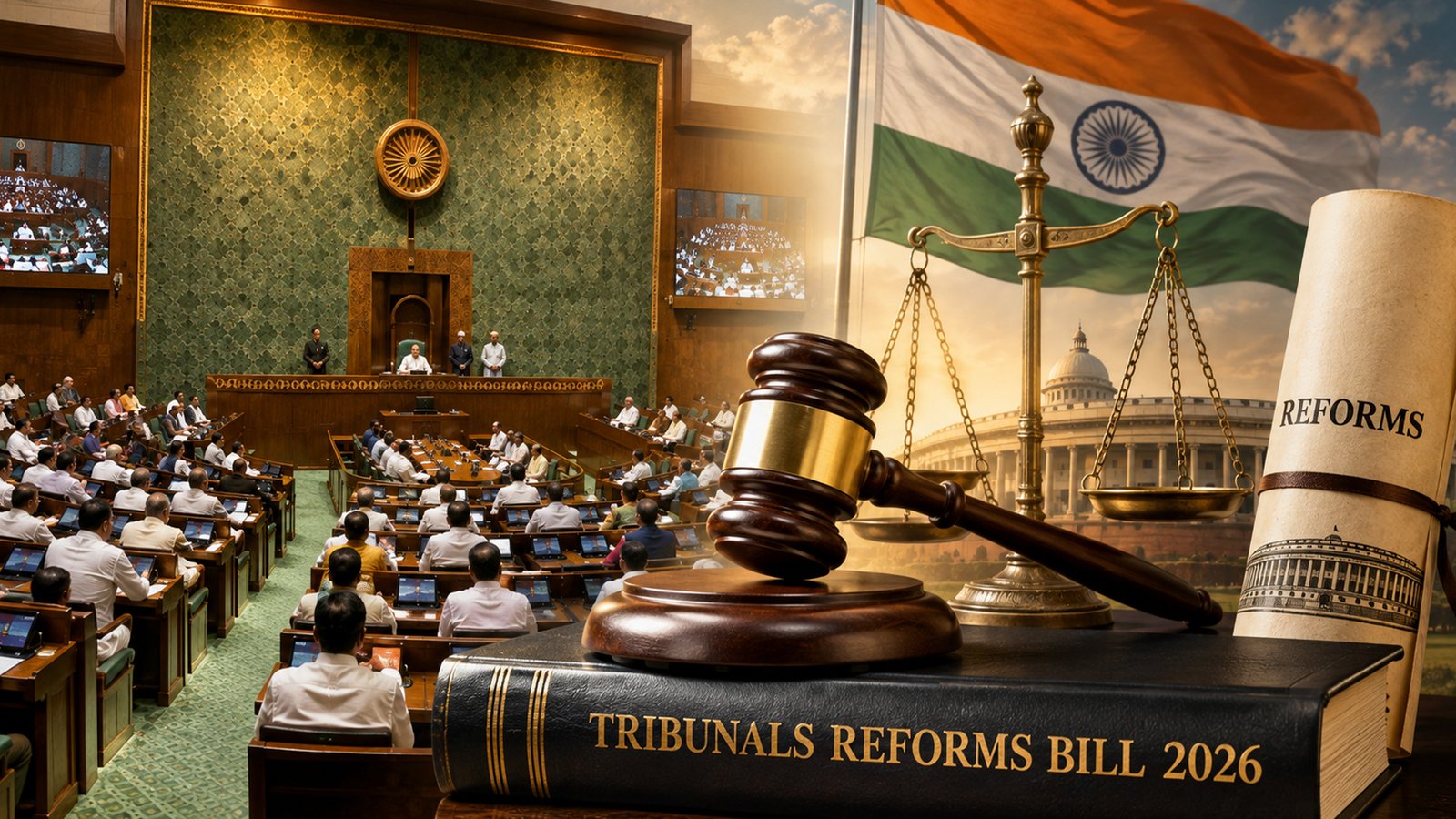
The Lok Sabha on Monday passed the Tribunals Reforms Bill, 2026, seeking to overhaul the way tribunals are administered and their senior officials appointed. The legislation was passed without a debate amid strong Opposition protests, with MPs raising slogans in the House. The Bill now moves to the Rajya Sabha for consideration.
The legislation proposes the creation of a National Tribunals Commission (NTC), a central body that will oversee the appointment, administration and functioning of several tribunals across India. The government says the proposed framework is intended to improve efficiency, transparency, institutional independence and uniformity in the tribunal system.
Union Minister of State for Law and Justice Arjun Ram Meghwal moved the Bill in the Lok Sabha amid the Opposition uproar. He said tribunals are designed to complement the regular court system rather than replace it. Tribunals deal with specialised areas such as taxation, company law, environmental disputes, securities, telecommunications, consumer matters and other regulatory issues.
Under the proposed framework, the National Tribunals Commission will have a Chairperson, two Judicial Members and two Technical Members. The Chairperson would be a former Supreme Court judge or a former Chief Justice of a High Court. The Bill also provides for consultation with the Chief Justice of India in the appointment of the Commission’s Chairperson and Judicial Members.
One of the key changes concerns the appointment of tribunal Chairpersons and Members. The NTC will conduct the selection process through Search-cum-Selection Committees. These committees will assess candidates before making recommendations to the Central Government.
The proposed system is intended to bring greater uniformity to tribunal appointments, which have been governed by different laws and procedures. The Bill lays down common provisions relating to qualifications, selection, appointment, salaries, allowances, resignation, removal and reappointment.
The Central Government would be required to make appointments within three months of receiving recommendations from the Search-cum-Selection Committee. The Bill also provides for domain experts to assist in assessing candidates for specialised tribunal positions.
The proposed National Tribunals Commission would have responsibilities extending beyond appointments. It would review the performance of tribunals, oversee inquiries into complaints against Chairpersons and Members, and maintain a National Tribunals Data Grid containing case-related information. The data system is intended to provide a central repository of information and help improve monitoring of tribunal performance.
The legislation covers 16 tribunals and appellate bodies, including the Central Administrative Tribunal, State Administrative Tribunals, Securities Appellate Tribunal, Debts Recovery Tribunals, Telecom Disputes Settlement and Appellate Tribunal, National Green Tribunal, National Company Law Appellate Tribunal, National Consumer Disputes Redressal Commission and Income Tax Appellate Tribunal. The Armed Forces Tribunal is also among the institutions covered by the framework.
The Bill proposes a five-year tenure for tribunal Chairpersons, subject to an upper age limit of 70 years. Members would also have a five-year term, subject to an age limit of 67 years, and could be considered for reappointment under the proposed rules.
The legislation comes against the backdrop of a continuing legal debate over the independence and administration of tribunals. The government’s Statement of Objects and Reasons refers to the Supreme Court’s judgment in Madras Bar Association v. Union of India, in which provisions of the Tribunals Reforms Act, 2021 were struck down on grounds linked to separation of powers and judicial independence. The court also called for an independent National Tribunals Commission with professional expertise and transparent oversight mechanisms.
The 2026 Bill seeks to repeal the Tribunals Reforms Act, 2021 and establish a new statutory framework. Existing appointments, proceedings and certain actions taken under the earlier system are protected through saving provisions, ensuring that the transition does not automatically disrupt ongoing tribunal functioning.
The government has estimated that establishing and running the National Tribunals Commission and its secretariat will involve an annual expenditure of about ₹27.14 crore. This includes ₹24.79 crore in recurring expenditure and ₹2.35 crore in non-recurring expenditure.
The Bill was passed at a time when proceedings in the Lok Sabha have been repeatedly disrupted by Opposition protests. News On AIR reported that the legislation was cleared without discussion amid the uproar, after which the House was adjourned for the day.
For the government, the proposed reforms are aimed at creating a more predictable and transparent tribunal system, particularly in the appointment and monitoring of members. For the legal system, the larger question will be whether the new National Tribunals Commission can balance administrative efficiency with the judicial independence that the Supreme Court has repeatedly emphasised.
The Bill’s passage therefore marks an important step in the Centre’s attempt to restructure tribunal governance in India, but its final shape and implementation will depend on parliamentary scrutiny in the Rajya Sabha and the subsequent rules and institutional arrangements.