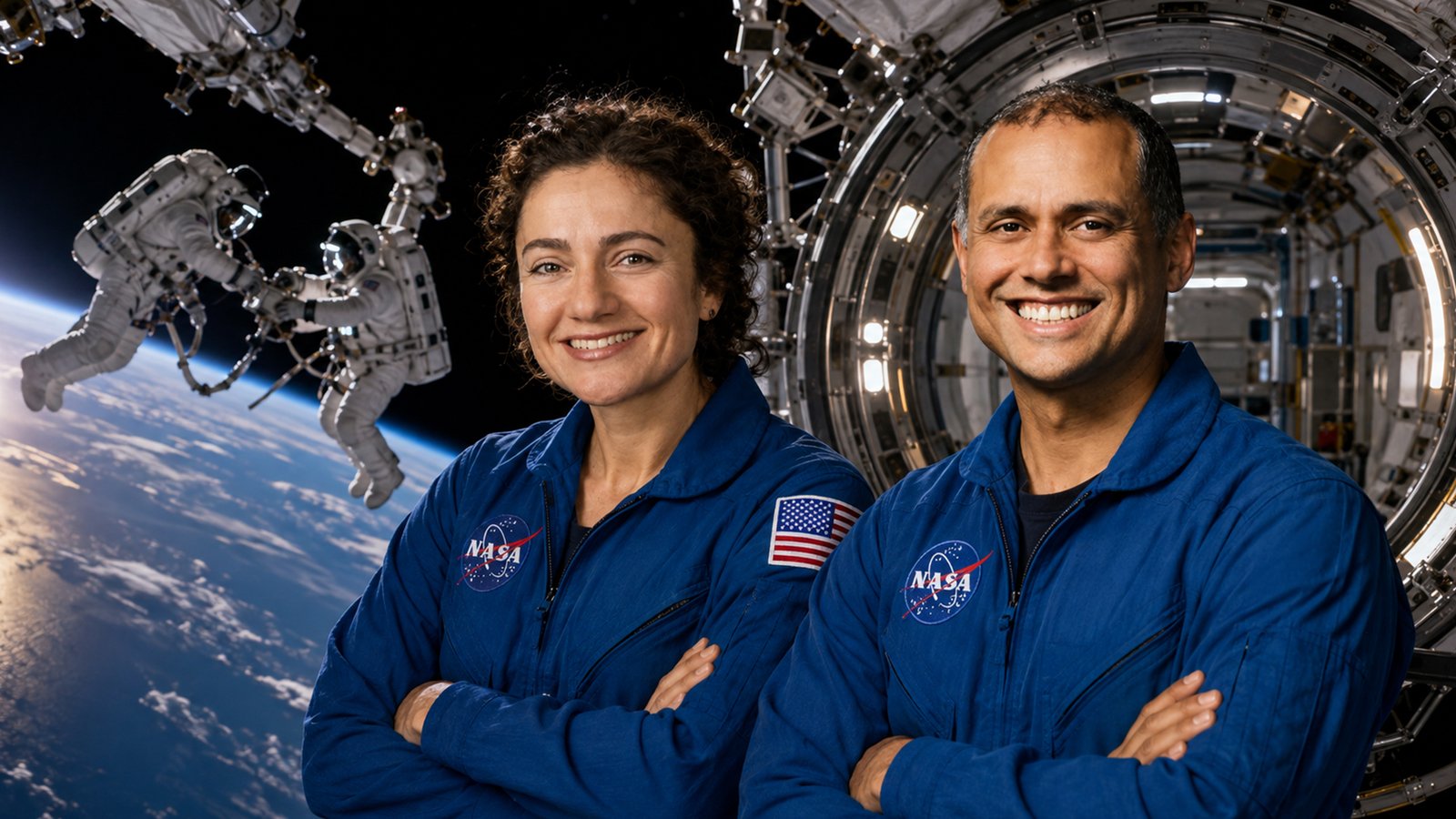
Two NASA astronauts have completed a major spacewalk outside the International Space Station (ISS), taking another important step toward upgrading the orbiting laboratory’s power system.
Jessica Meir and Anil Menon spent 6 hours and 27 minutes outside the station on Thursday, August 6, installing the final set of mounting hardware needed for a new roll-out solar array. The spacewalk began at 8:33 a.m. EDT and ended at 3 p.m. EDT.
The work may have looked routine from the ground, but it involved careful construction and electrical work in the harsh environment of space.
For Menon, the mission carried an additional personal significance. It was his first-ever spacewalk. Meir, meanwhile, completed her sixth spacewalk, bringing her total time working outside the International Space Station to 42 hours and 33 minutes.
The astronauts’ main task was to prepare the station’s 3B power channel for a new ISS Roll-Out Solar Array, or iROSA. They assembled and secured a set of triangular mounting brackets on the station’s S6 truss segment before routing cables that will eventually carry electricity from the new solar array into the station’s power system.
They then covered parts of the structure with multi-layer insulation, helping protect the equipment from micrometeoroids and the extreme conditions of space.
The importance of this work goes beyond simply adding another set of solar panels.
The International Space Station has eight original solar arrays, but those systems have been operating for more than 15 years and their power output has gradually declined. The new iROSA panels are designed to work alongside the older arrays rather than replace them.
Once the upgrades are complete, the additional solar arrays are expected to increase the station’s available electrical power by about 20% to 30%. That extra capacity will help support scientific research, station operations and other activities as the ISS continues its mission in low Earth orbit.
NASA began deploying the new iROSA system in 2021. Astronauts have already installed six of the new solar-array assemblies. The latest spacewalk completed the mounting work for the seventh, while two more arrays are expected to be delivered to the space station later this year. Another power channel, known as 2A on the station’s port side, is still waiting for an iROSA installation.
The latest mission was also notable because it was the first spacewalk for the ISS Expedition 75 crew.
During the operation, the astronauts had a brief reminder that their workplace is unlike any other. Meir pointed out the Moon to Menon while they were working outside the station. Menon responded that he could see a future lunar base from their position.
That small exchange captured the wider significance of the work being done aboard the ISS. The station is not only a laboratory and engineering platform; it has also become an important testing ground for technologies, procedures and human experience that could support future missions to the Moon and Mars.
The International Space Station has now been continuously supporting human activity and scientific research for almost 26 years. Its aging systems require regular maintenance and upgrades, making spacewalks an essential part of keeping the facility operational.
Thursday’s mission was the 96th US extravehicular activity, or EVA, and the 281st spacewalk conducted in support of ISS assembly, maintenance and upgrades.
But the work is far from finished.
NASA has scheduled two more US spacewalks during August. The next, planned for August 13, will focus on replacing a space-to-ground antenna. Another EVA, scheduled for August 25, will involve connecting power-channel cables and data-relay systems while also replacing a navigation aid used by spacecraft docking with the station. The work is part of broader efforts to maintain the ISS and prepare for its eventual controlled deorbit.
For now, however, Meir and Menon’s successful spacewalk marks another milestone in the long effort to keep the world’s orbital laboratory productive.
The new solar arrays will provide more power at a time when the station’s original systems are showing their age. More importantly, the upgrade demonstrates how astronauts can continue to repair, expand and adapt a spacecraft that has spent decades circling Earth.
High above the planet, what may appear to be a simple installation is actually part of a much bigger effort: keeping the International Space Station running today while using its experience to prepare humanity for the next era of space exploration.