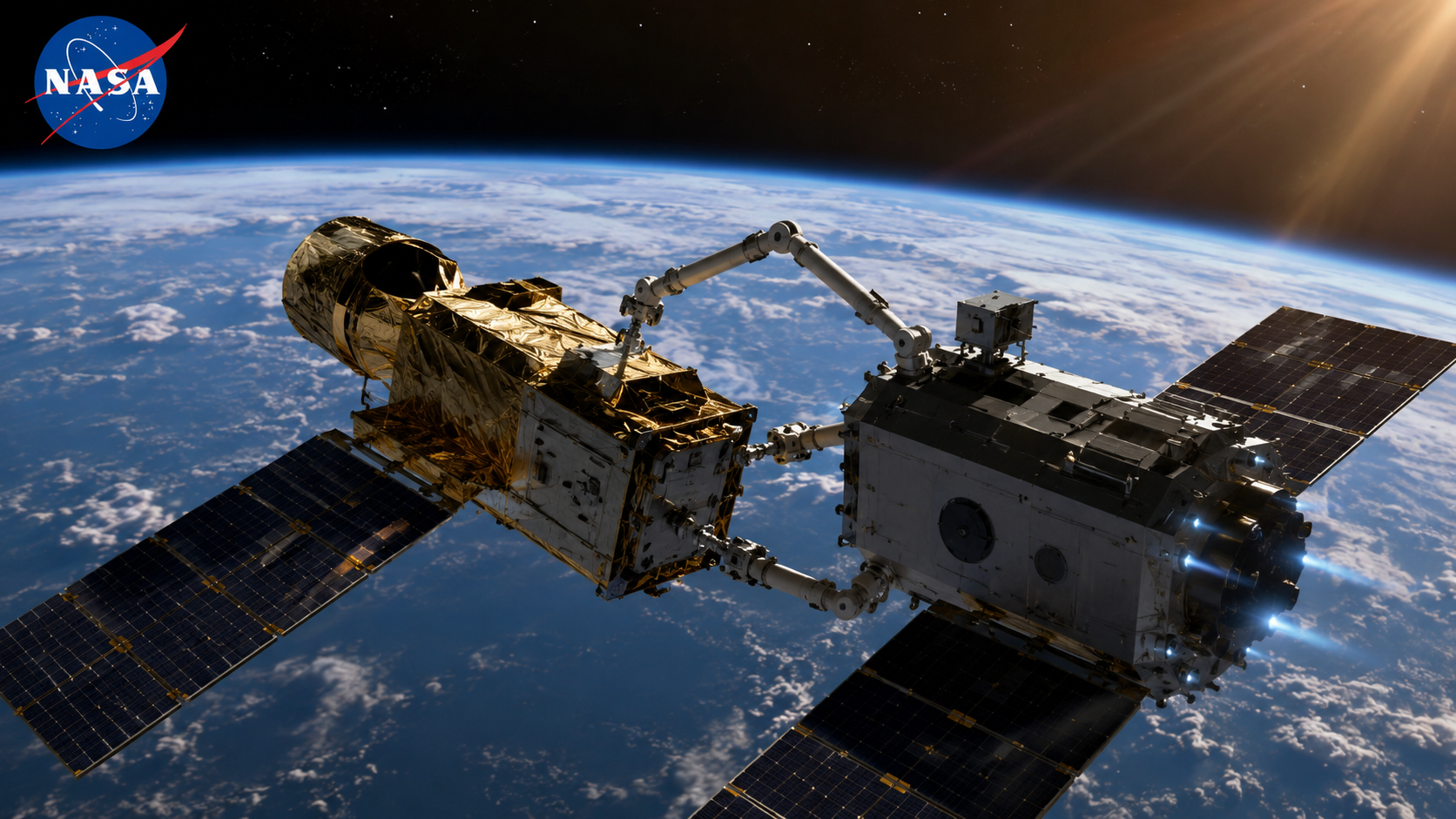
NASA is preparing to launch a pioneering mission to save its ageing Neil Gehrels Swift Observatory, a space telescope that has spent more than two decades studying some of the universe’s most powerful cosmic explosions.
The Swift Boost mission will send a robotic spacecraft to rendezvous with the observatory, attach itself to the telescope and raise it into a higher orbit. The operation is designed to prevent Swift from gradually losing altitude and eventually burning up in Earth’s atmosphere.
Launched in 2004, Swift was built for a two-year mission but has remained operational far beyond expectations. It has played a key role in observing gamma-ray bursts, black holes, neutron stars and other high-energy events, making it one of NASA’s most productive space observatories. Swift’s long scientific life also highlights the growing importance of space telescopes and satellite missions in studying distant cosmic events that cannot be observed as effectively from Earth.
Over the years, increased solar activity has caused Earth’s upper atmosphere to expand, creating more drag on satellites in low-Earth orbit. As a result, Swift’s orbit has slowly declined, prompting NASA to look for a way to extend its life instead of retiring the telescope.
If successful, the mission will not only keep Swift operational for several more years but also demonstrate a new way of maintaining spacecraft already in orbit. Scientists believe robotic servicing could reduce space debris, lower mission costs and help extend the life of expensive satellites.
The rescue mission will use advanced navigation and docking technology to safely connect with the telescope before lifting it into a safer orbit. NASA says the demonstration could pave the way for future missions that repair, refuel or reposition satellites rather than replacing them.
Also Read: 19 northern US states brace for auroras