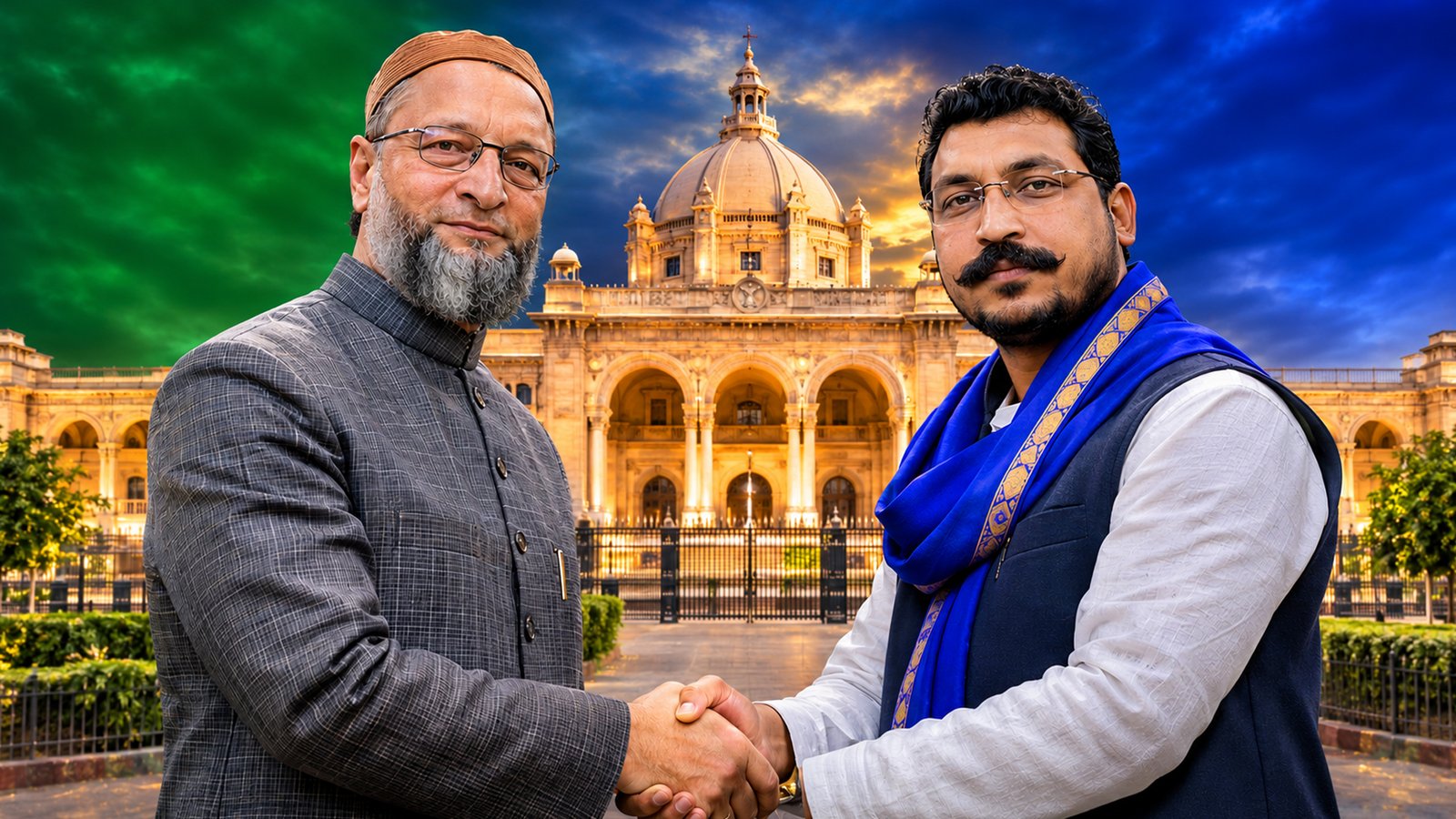
The political battle for Uttar Pradesh has gained a new dimension ahead of the 2027 Assembly elections, with AIMIM chief Asaduddin Owaisi and Azad Samaj Party (Kanshi Ram) president Chandrashekhar Azad joining hands to launch a new political alliance. The Samajik Parivartan Morcha aims to challenge the BJP and create an alternative political platform by bringing together Dalits, Muslims, Other Backward Classes (OBCs) and other marginalised communities.
The alliance was announced at a joint press conference in Lucknow on November 12, where Owaisi declared Chandrashekhar Azad as its chief ministerial candidate. The two leaders said their objective was to prevent the BJP from returning to power for a third consecutive term in Uttar Pradesh.
The new front intends to contest all 403 Assembly constituencies, signalling an ambitious electoral plan. Its entry could complicate the political calculations of established opposition parties, particularly the Samajwadi Party (SP), Congress and Bahujan Samaj Party (BSP).
Owaisi described the alliance as an effort to give politically marginalised communities a stronger voice in the state’s decision-making process. He argued that Dalits, Muslims and backward communities had frequently been treated as vote banks without receiving adequate political representation.
The AIMIM chief also identified education, unemployment, farmers’ concerns and social justice as key issues the alliance intends to raise. He maintained that Uttar Pradesh needed a political alternative that focused on people’s everyday concerns rather than relying on established electoral narratives.
Chandrashekhar Azad also presented the alliance as an alternative to the existing political choices. Speaking to NDTV, he said Uttar Pradesh had already given the BJP an opportunity to govern, while voters had also experienced the Samajwadi Party’s rule. He argued that people were now looking for a different political option.
Azad criticised the state government’s handling of employment and recruitment, referring to allegations of examination irregularities, paper leaks and delays in recruitment for government jobs. He said young people were frustrated and deserved accountability from political leaders.
He also accused opposition parties of concentrating on internal disagreements instead of building a stronger challenge against the BJP. According to Azad, the new alliance was intended to give communities that felt politically neglected an opportunity to participate in governance.
A major part of the alliance’s electoral strategy revolves around bringing Dalit and Muslim voters together. These communities constitute significant sections of Uttar Pradesh’s population, with Dalits accounting for around 21% and Muslims approximately 19%, according to estimates cited in political reporting.
The alliance hopes to combine this support with votes from OBCs and other marginalised sections to build a wider electoral coalition.
The strategy also brings back memories of the BSP’s social engineering experiment under Mayawati, which helped the party secure a majority in the 2007 Uttar Pradesh Assembly elections. However, converting demographic strength into votes across constituencies will not be straightforward.
The political influence of Dalit communities is not uniform, while Muslim voters have traditionally supported different opposition parties depending on local electoral circumstances. The new alliance will therefore need strong local candidates and organisational support to make its strategy work.
The two parties have already started preparations. AIMIM has announced candidates for three constituencies, including Matera in Bahraich, Kairana in Shamli and Bhinga in Shrawasti. The Azad Samaj Party has announced candidates for 87 Assembly seats.
A broader public meeting scheduled for November 26 in Lucknow is expected to provide further clarity on the alliance’s seat-sharing arrangement and campaign plans.
The alliance has already triggered questions about whether it could divide opposition votes and indirectly benefit the BJP. AIMIM has faced similar allegations in previous elections, with critics claiming that its presence could split Muslim votes otherwise likely to support the Samajwadi Party or Congress.
Azad rejected the BJP’s B-team allegation, questioning why his party and AIMIM were being criticised for forming an alliance when other opposition parties also contest elections independently in different states.
He maintained that the new front was not intended to weaken the opposition but to provide political representation to communities seeking a stronger voice.
Samajwadi Party chief Akhilesh Yadav has stressed the importance of opposition unity to defeat the BJP. His party continues to promote its PDA strategy, representing Pichhda, Dalit and Alpsankhyak communities (backward classes, Dalits and minorities).
The emergence of the Samajik Parivartan Morcha could put pressure on the SP-Congress combination, particularly if it attracts sections of the Dalit and Muslim electorate. It could also affect the BSP’s traditional support base.
Owaisi has also raised concerns over the Special Intensive Revision (SIR) of electoral rolls in Uttar Pradesh. Questioning Chief Minister Yogi Adityanath’s claim that 1.27 crore names had been deleted from voter lists, the AIMIM chief sought greater clarity from the Election Commission.
He demanded details about the reasons for the deletions, including the number of deceased voters, duplicate entries, people who had shifted residences and those marked absent.
Owaisi also reiterated his concern that the exercise could affect eligible voters, particularly marginalised communities. He had previously compared the SIR process to a possible backdoor implementation of the National Register of Citizens (NRC).
The issue is likely to become part of the alliance’s wider campaign around voting rights and political representation.
As Uttar Pradesh moves towards the 2027 Assembly elections, the Owaisi-Azad partnership has added another dimension to an already competitive political landscape. Its electoral prospects will depend on whether the two parties can coordinate effectively, agree on seat-sharing and build support beyond their existing constituencies.
The November 26 meeting could offer the first indication of how seriously the alliance intends to challenge established political players. Whether it emerges as a decisive electoral force or changes the opposition’s vote calculations remains to be seen.