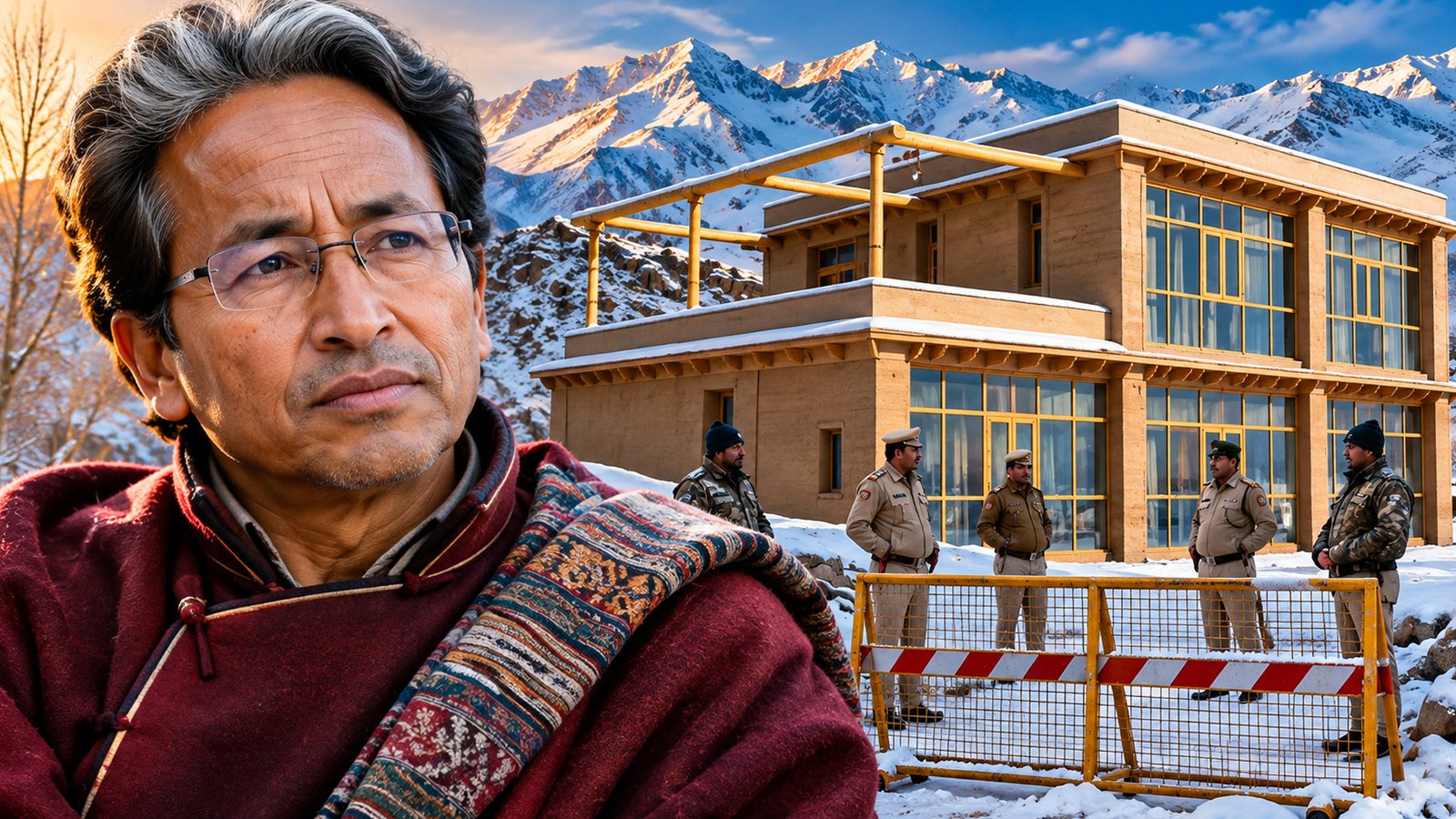
Climate activist Sonam Wangchuk has claimed that he has been placed under house arrest in Ladakh as protests against the administration’s election schedule and restrictions on public gatherings entered their second day on Friday. Wangchuk alleged that armed police and paramilitary personnel had been deployed outside his residence, preventing him from stepping out and participating in the agitation.
The latest developments have intensified tensions between the Ladakh administration and local organisations demanding greater democratic representation, constitutional safeguards and the postponement of the upcoming Ladakh Autonomous Hill Development Council (LAHDC) elections.
Wangchuk, a prominent member of the Leh Apex Body (LAB), said around 20 to 25 security personnel, along with vehicles and tents, had been stationed outside his residence. In a video message shared on social media, he questioned the administration’s claim that he had merely been advised to remain indoors.
The activist argued that the heavy security deployment effectively amounted to house arrest, even though no formal detention order had been issued against him. He also questioned the delay in releasing the judicial inquiry report into the September 2025 violence in Leh and criticised the decision to conduct local elections during the harsh winter months.
Describing the restrictions as arbitrary, vague and disproportionate, Wangchuk said he would challenge the order before the appropriate legal authorities, including the magistrate, High Court and Supreme Court.
The restrictions follow an order issued by the Additional District Magistrate of Leh on November 11 under Section 163 of the Bharatiya Nagarik Suraksha Sanhita (BNSS), 2023.
The order prohibits Wangchuk from organising or participating in unauthorised rallies, processions and public gatherings or engaging in activities that could disturb public peace or interfere with the ongoing electoral process. The restrictions will remain in force for 60 days unless withdrawn or modified earlier.
According to reports, police personnel removed Wangchuk from the protest site on Wednesday evening and escorted him to his residence. The administration has maintained that the action was taken in compliance with prohibitory orders issued by the Chief Electoral Officer of Ladakh and the District Magistrate of Leh.
Authorities have defended the preventive measures, citing the need to maintain public order and ensure the smooth conduct of local elections.
Wangchuk, however, has questioned the legal justification for restricting his movement. He has sought clarification on whether he is legally permitted to leave his residence and under which provision he is being prevented from doing so.
The immediate reason for the agitation is the decision to conduct the LAHDC elections on December 4. The Leh Apex Body and Kargil Democratic Alliance (KDA) have opposed the schedule, arguing that holding elections during peak winter could prevent a significant section of the population from participating.
December and January are among the coldest months in Ladakh, with temperatures dropping well below freezing. Heavy snowfall and difficult road conditions can also disrupt transport and communication.
Local leaders argue that many residents, including students and working people, temporarily move outside the region during winter. They believe conducting elections during this period could affect voter participation and undermine the democratic process.
The organisations have demanded that the hill council elections be postponed until May or June 2027, when weather conditions are expected to be more favourable.
The agitation is being led by the Leh Apex Body, with the Kargil Democratic Alliance extending its support. The protest began on Thursday at NDS Memorial Park in Leh. Despite restrictions on public gatherings, the organisation said residents from different sections of society had participated in the peaceful dharna.
The protesters have also demanded the resumption of political dialogue with the Centre, withdrawal of the new liquor policy and publication of the judicial inquiry report into the September 24, 2025 violence in Leh.
The latest protests are part of a wider movement seeking statehood and constitutional safeguards for Ladakh.
Since the region became a Union Territory in October 2019, local organisations have repeatedly demanded stronger political representation and protection for their land, employment opportunities, cultural identity and demographic character.
One of their principal demands is the inclusion of Ladakh under the Sixth Schedule of the Constitution. The provision offers special administrative and legislative safeguards to certain tribal areas, allowing local communities greater control over decisions affecting their interests.
The Kargil Democratic Alliance has also reiterated its demand for safeguards under Article 371 and a stronger elected governing structure for the region.
The movement gained national attention following the violence in Leh on September 24, 2025. Four people were killed and more than 40 injured in police firing during protests linked to demands for statehood and constitutional protection.
The judicial inquiry report into the incident has not been made public, prompting repeated questions from Wangchuk and other local leaders. They have called for transparency and accountability, arguing that residents deserve to know the findings of the investigation.
The Kargil Democratic Alliance has announced its support for the agitation and is coordinating with the Leh Apex Body on the next course of action. A KDA delegation led by co-chairman Sajjad Kargili is expected to meet LAB leaders in Leh to discuss the developments.
The KDA has also announced a candle march in Kargil on Saturday to express solidarity with Wangchuk and the ongoing protests.
Leaders from both organisations have appealed to President Droupadi Murmu, Prime Minister Narendra Modi, Union Home Minister Amit Shah and Leader of Opposition Rahul Gandhi to intervene. They have urged the Centre to defer the elections, restart discussions on Ladakh’s political future and release the inquiry report into the 2025 violence.
With protests continuing and Wangchuk preparing to challenge the movement restrictions legally, the situation has brought Ladakh’s long-pending political demands back into focus.