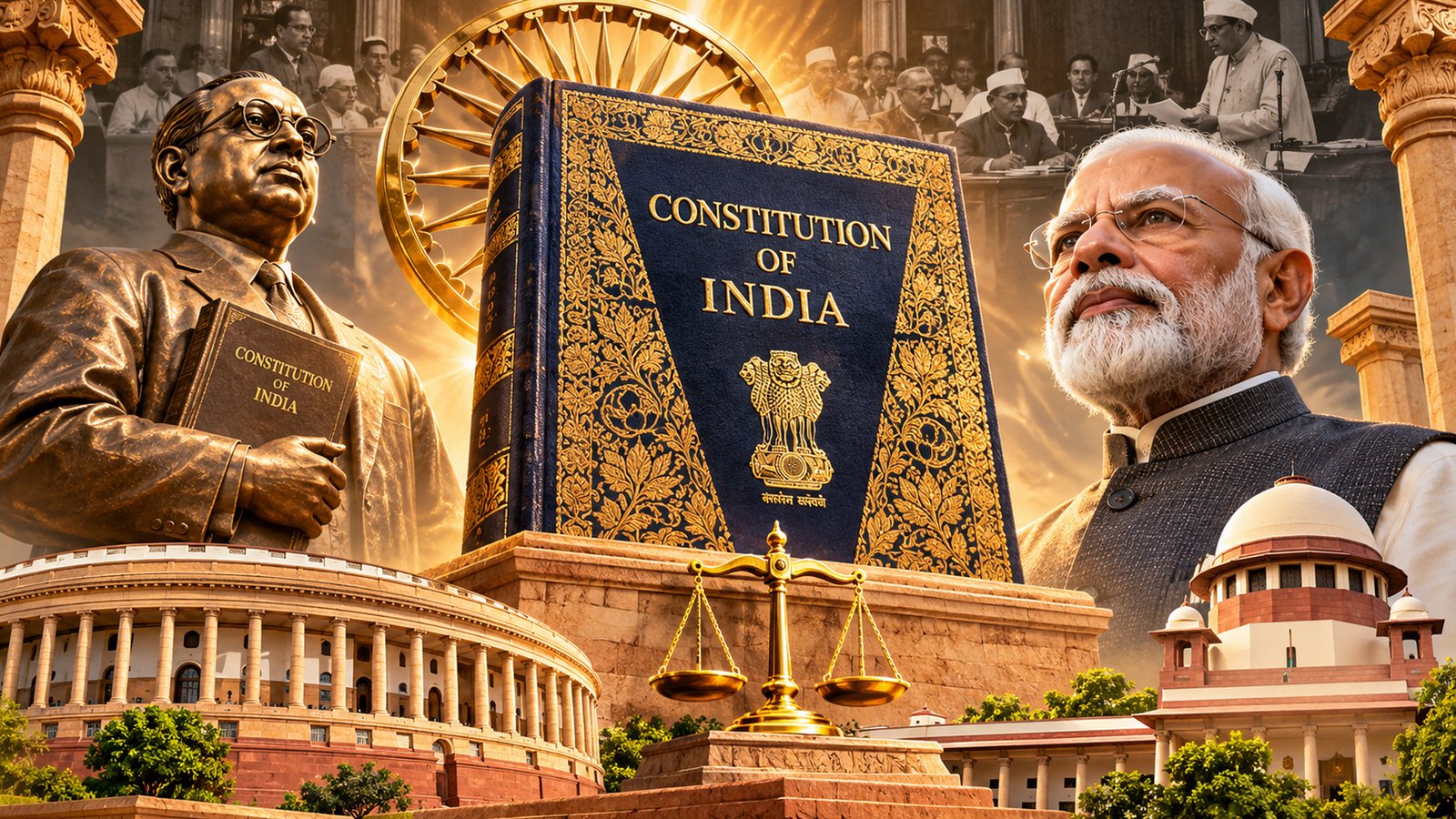
India marked Constitution Day on Thursday with Prime Minister Narendra Modi highlighting the importance of constitutional values, welfare initiatives and institutional reforms, while the Congress organised nationwide marches to raise concerns over democratic institutions and electoral rights.
The annual observance commemorates the adoption of the Indian Constitution by the Constituent Assembly on November 26, 1949. The Constitution came into effect on January 26, 1950, establishing India as a sovereign democratic republic. The government declared November 26 as Constitution Day in 2015 to promote awareness about the country’s founding document and encourage citizens to understand their constitutional rights and responsibilities.
In an article titled The Constitution – Our Guiding Force, Modi paid tribute to Dr BR Ambedkar, Dr Rajendra Prasad and the other members of the Constituent Assembly. He said their collective efforts produced a Constitution that reflected India’s diversity, democratic aspirations and civilisational values.
The Prime Minister stressed that the Constitution should not remain confined to Parliament, courts and government institutions. Instead, its principles must find expression in the everyday lives of citizens. He called for greater constitutional awareness, particularly among young people, and said every Indian should understand the importance of fundamental rights, duties and democratic participation.
PM Modi also reflected on his personal journey, describing the Constitution as a framework that creates opportunities for people from different social and economic backgrounds. He said India’s constitutional system had enabled ordinary citizens to aspire to positions of responsibility and contribute to nation-building.
A significant part of the Prime Minister’s message focused on the government’s welfare programmes. He linked initiatives in housing, healthcare, financial inclusion and women’s empowerment to constitutional principles such as equality, dignity and social justice.
Modi cited the Pradhan Mantri Awas Yojana as an example of efforts to provide families with secure housing and improve their quality of life. He also highlighted the Pradhan Mantri Ujjwala Yojana, which provides LPG connections to women from economically weaker households. Access to clean cooking fuel, he said, had reduced the hardship faced by women who earlier depended on traditional fuels.
The Prime Minister also referred to Ayushman Bharat, which provides eligible families with health insurance coverage. He said the programme had helped economically vulnerable households access medical treatment without facing the full burden of healthcare expenses.
He included the Pradhan Mantri MUDRA Yojana and PM-SVANidhi among the initiatives designed to expand economic opportunities. These programmes provide credit support to small entrepreneurs, micro-businesses and street vendors, helping them sustain and grow their livelihoods.
Digital financial services also featured in his address. Modi cited the Unified Payments Interface (UPI) as an example of how technology had made financial transactions more accessible and reduced barriers to participation in the formal economy.
He further referred to a World Bank report which, according to his article, indicated that nearly 50 crore Indians had moved out of poverty. He presented this as evidence of progress in improving living standards and expanding opportunities.
The Prime Minister also discussed several constitutional amendments introduced over the years. These included the 101st Constitutional Amendment, which paved the way for the Goods and Services Tax (GST), the 102nd Amendment, which gave constitutional status to the National Commission for Backward Classes, and the 103rd Amendment, which introduced 10% reservation for Economically Weaker Sections.
He said the government had made the Constitution available in all 22 languages listed in the Eighth Schedule to improve accessibility and help citizens understand its provisions in their mother tongues.
Modi also highlighted the introduction of the Bharatiya Nyaya Sanhita, which replaced the Indian Penal Code as part of the new criminal law framework. He described the change as an effort to move the justice system away from a colonial approach towards one that places greater emphasis on justice and citizens’ rights.
The Prime Minister used the occasion to raise concerns about earlier constitutional changes. He referred to the First Constitutional Amendment of 1951, arguing that it placed restrictions on fundamental freedoms. He also criticised the 42nd Constitutional Amendment, introduced during the Emergency in 1976, saying it affected the balance between constitutional institutions and the scope of judicial review.
PM Modi questioned the repeated use of Article 356, which provides for President’s Rule in states under specified circumstances. He alleged that previous governments had used the provision nearly 100 times to dismiss elected state governments.
He also referred to the government’s campaign against Left-wing extremism, particularly in tribal regions, saying improved security had helped people in affected areas exercise their constitutional rights without fear.
Women’s representation in legislatures formed another part of his message. Modi reiterated the government’s commitment to greater political participation for women and criticised the Opposition over its position on the proposed reservation framework.
Meanwhile, the Congress marked Constitution Day with nationwide Samvidhan Raksha Marches organised through its state units. The campaign focused on protecting constitutional values, democratic institutions and citizens’ voting rights.
The party directed its Pradesh Congress Committees to organise marches beginning near statues of Dr BR Ambedkar or Mahatma Gandhi. Participants were expected to pay tribute to the leaders, read the Preamble and take a pledge to safeguard the Constitution.
Congress president Mallikarjun Kharge and Leader of the Opposition Rahul Gandhi were associated with the party’s planned programmes in Lucknow. The campaign also sought to mobilise citizens over alleged irregularities in electoral rolls and concerns surrounding the Special Intensive Revision (SIR) exercise.
Through its Vote Rakshak initiative, the party plans to involve workers in checking electoral rolls, identifying alleged wrongful deletions and helping affected voters seek corrections. Congress maintains that the right to vote forms the foundation of representative democracy. Its allegations concerning voter deletions remain contested.
The government also encouraged public participation through online Preamble readings, Constitution quizzes and educational programmes. The MyGov portal facilitated readings in 23 languages, including English and the 22 Scheduled Languages. Constitution quizzes and the Viksit Bharat Yuva Samvad programme also sought to involve students and young people.
As India marked another Constitution Day, the messages from the government and the Opposition brought constitutional rights, social justice, democratic accountability and electoral integrity into focus. The occasion served as a reminder that the Constitution’s principles depend not only on institutions but also on citizens’ awareness and participation.