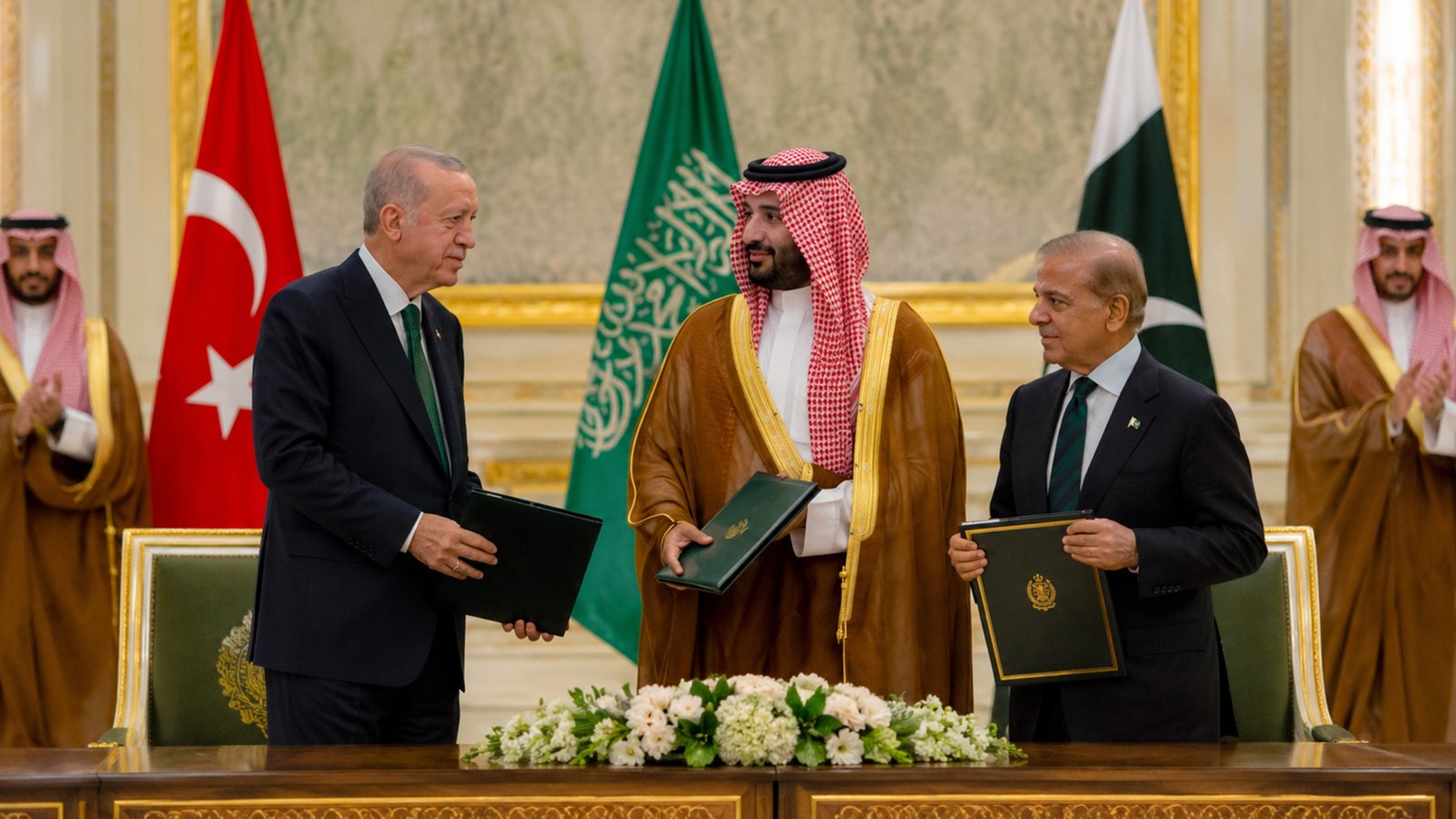
Saudi Arabia, Pakistan and Turkey have signed a new defence agreement in Mecca, committing to closer military cooperation and declaring that an armed attack on any one of the three countries would be treated as an attack on all.
The agreement was signed on Friday by Saudi Crown Prince Mohammed bin Salman, Turkish President Recep Tayyip Erdogan and Pakistani Prime Minister Shehbaz Sharif. Pakistan Army chief Field Marshal Asim Munir also accompanied Sharif during the visit to Saudi Arabia.
The Saudi Arabia-Pakistan-Turkey defence pact comes at a time of heightened tensions across the Middle East, with regional conflicts threatening Gulf security, energy infrastructure and key shipping routes.
The three countries said the agreement is defensive in nature and is intended to strengthen security cooperation. Turkish officials said the pact is not directed against any particular country.
The agreement follows months of negotiations between the three governments. It provides a framework for greater coordination in defence and security, although the countries have not publicly detailed how they would respond militarily if one member came under attack.
The pact also does not replace existing defence agreements that Saudi Arabia, Pakistan and Turkey have with other countries.
For Saudi Arabia, the agreement comes amid growing concerns over regional security. The kingdom has faced attacks linked to Iran-backed groups in recent years, while the wider conflict involving Iran and Israel has increased risks for Gulf states.
Riyadh has also been investing heavily in infrastructure, tourism and other sectors under its Vision 2030 economic programme. Protecting the country’s territory and critical infrastructure has therefore become a key priority as it seeks to attract foreign investment and expand its economy beyond oil.
Pakistan has longstanding defence ties with Saudi Arabia. Pakistani military personnel have provided training and other support to Saudi forces for decades. The two countries have also expanded security cooperation amid the current regional crisis.
Pakistan‘s military relationship with Turkey has also grown in recent years. The two countries cooperate in areas including defence production, military training and naval equipment.
Turkey brings significant defence-industrial capabilities to the new partnership. Its domestic defence sector has expanded rapidly, particularly in areas such as drones, naval systems and other military equipment.
Saudi Arabia has already strengthened its defence relationship with Turkey. In 2023, Riyadh signed major agreements with Turkish defence companies, including a deal involving Turkish drones.
The three countries could now explore wider cooperation in military training, defence technology, intelligence sharing and equipment development. However, the precise scope of such cooperation under the new agreement remains unclear.
The pact is particularly significant because the three countries have different strategic relationships with major global powers.
Turkey is a member of NATO, while Saudi Arabia remains a major security partner of the United States. Pakistan, meanwhile, maintains close defence relations with both Saudi Arabia and Turkey.
The agreement could give the three countries another platform to coordinate their security policies while maintaining their existing international partnerships.
The signing also comes against the backdrop of continuing concerns over the Strait of Hormuz, one of the world’s most important routes for oil and gas shipments. Any prolonged disruption in the region could affect global energy markets and increase pressure on oil-importing countries.
Saudi Arabia is one of the world’s largest oil exporters, making the security of energy infrastructure and shipping routes particularly important for Riyadh.
The agreement does not formally identify Iran or Israel as a threat. Turkish officials have emphasised that the pact is defensive and is not aimed at a specific country.
However, the regional security environment remains an important backdrop to the deal. The conflict involving Iran and Israel has already affected several countries in the region and raised concerns about attacks spreading beyond the immediate areas of conflict.
For Pakistan, closer defence ties with Saudi Arabia could further strengthen its strategic position in the Gulf. Islamabad has traditionally maintained strong relations with Riyadh and relies on the kingdom as an important economic and diplomatic partner.
For Turkey, the agreement provides another avenue to expand its role in Middle Eastern security while deepening its ties with two influential Muslim-majority countries.
The agreement is not being described as a NATO-style military alliance, and its effectiveness will depend on how the three governments implement it.
T