
It is often treated as a joke — the nightly rumble that drives a spouse to the sofa, becomes family folklore or inspires the purchase of earplugs. But snoring is not always harmless background noise.
The question I often ask patients is not simply, “Do you snore?”
It is: “What happens between the snores?”
A steady, gentle snore may be caused by nasal congestion, sleeping on the back or drinking alcohol before bedtime. More concerning is loud, irregular snoring interrupted by stretches of silence, followed by choking, gasping or a sudden explosive snort. That silence may mean the person has temporarily stopped breathing.
This pattern is one of the classic signs of obstructive sleep apnoea (pronounced ap-nee-uh), or OSA, a disorder that repeatedly narrows or closes the airway during sleep. Not everyone who snores has sleep apnoea. But nearly everyone with OSA is likely to have some form of disturbed night-time breathing, and persistent snoring may be the first warning available.
What actually causes snoring?
As we fall asleep, the muscles of the tongue, soft palate and throat relax. If the airway becomes narrow, air has to move through it more forcefully. The surrounding tissues vibrate, producing the familiar harsh sound we call snoring. The narrower the passage, the more turbulent the airflow and, frequently, the louder the snore.
A cold, allergy, deviated nasal septum, enlarged tonsils, excess tissue around the neck, alcohol consumption and sleeping on the back can all contribute. Even sleep deprivation can make snoring worse because it allows the throat muscles to relax more deeply. Mayo Clinic provides a useful explanation of this mechanism and its common causes.
In obstructive sleep apnoea, however, the airway does more than vibrate — it repeatedly becomes partly or completely blocked. Airflow falls or stops, blood oxygen may dip and the brain briefly wakes the sleeper sufficiently to reopen the airway. The person may gasp, snort or change position and then fall asleep again, usually with no memory of the event.
This cycle can happen five, 30 or even more times in every hour of sleep. In effect, someone may spend eight hours in bed while never receiving eight hours of restorative sleep.

A condition affecting millions
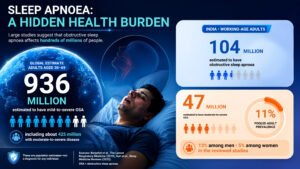
The scale of the problem is striking. A major analysis published in The Lancet Respiratory Medicine estimated that approximately 936 million adults aged 30 to 69 worldwide have mild-to-severe OSA, including about 425 million with moderate-to-severe disease.
India carries a particularly heavy burden. A systematic review and meta-analysis estimated that around 104 million working-age Indians may have OSA and about 47 million may have moderate-to-severe disease. The pooled prevalence among Indian adults in the studies examined was approximately 11% to 13% among men and 5% among women.
These figures do not mean that every loud snorer has a dangerous illness. They do show why habitual snoring should not automatically be dismissed as a personality trait or an unavoidable part of ageing.
Why the heart and brain care about your sleep
Sleep is supposed to be a period of recovery. With untreated OSA, it can instead become a nightly sequence of obstruction, falling oxygen, brief arousal and renewed breathing.
Each episode activates the body’s stress response. Heart rate and blood pressure fluctuate, oxygen levels repeatedly rise and fall, and normal sleep architecture is fragmented. Over months and years, this repeated strain is associated with cardiovascular and metabolic health risks including hypertension, atrial fibrillation and other abnormal heart rhythms, coronary artery disease, heart failure, stroke, metabolic syndrome and type 2 diabetes.
The American Heart Association notes that OSA is especially common among people already living with cardiovascular disease: its prevalence may be as high as 40% to 80% in patients with conditions including hypertension, heart failure, coronary artery disease, atrial fibrillation and stroke.
The brain pays a price as well. Repeated micro-awakenings prevent deep, restorative sleep, even when the person believes they slept throughout the night. The result may be poor concentration, slower reactions, memory problems, irritability, low mood and reduced productivity.
Daytime sleepiness can also become a safety issue. A person who nods off at a meeting may feel embarrassed; someone who experiences the same loss of alertness behind the wheel could be in danger. If you struggle to keep your eyes open while driving, pull over safely and do not continue until you are alert. Turning up the radio or opening a window is not a reliable remedy.
The signs that should not be ignored
Snoring deserves medical attention when it is frequent, unusually loud or accompanied by other symptoms. Warning signs include:
- Pauses in breathing witnessed by a partner or family member
- Choking, gasping or snorting during sleep
- Waking with a dry mouth or morning headache
- Feeling unrefreshed despite apparently sleeping for seven or eight hours
- Excessive daytime sleepiness, poor concentration or irritability
- Waking repeatedly to urinate during the night
- High blood pressure, particularly when it is difficult to control
- Falling asleep while reading, watching television, attending meetings or driving
The sleeper is often the last person to recognise the problem. A bed partner may provide the most valuable clue by noticing that the snoring repeatedly stops — and that breathing stops with it. The US National Heart, Lung, and Blood Institute lists loud snoring, interrupted breathing and gasping among the principal night-time symptoms.
A short phone recording may help demonstrate the pattern to a doctor, but an app or audio clip cannot diagnose sleep apnoea or reliably determine its severity.
It is not only a condition of overweight men
Obesity is an important risk factor because additional tissue around the neck can narrow the airway. But it is not the whole story. Thin people can also develop OSA because of a small or receding jaw, a large tongue, enlarged tonsils, chronic nasal obstruction or inherited facial and airway anatomy.
Age, family history, smoking, alcohol, certain sedating medicines, hypothyroidism and other hormonal conditions may increase risk. Alcohol is particularly relevant because it relaxes the throat muscles and can make an already vulnerable airway more likely to collapse. The NHLBI’s overview of risk factors emphasises that OSA can affect people of different ages and body types.
Women may be missed because they do not always fit the stereotype of the loud male snorer. Their symptoms may instead include insomnia, fatigue, morning headaches, anxiety, depression or frequent awakenings. Risk also rises during and after menopause. These differences can delay recognition and diagnosis.
Children can have OSA too. Persistent snoring in a child should never simply be labelled cute or inherited from a parent. Children may show hyperactivity, aggression, poor attention, bed-wetting, morning headaches, poor school performance or impaired growth rather than obvious daytime sleepiness. Enlarged tonsils and adenoids are common causes. Sleep apnoea is most frequently seen between the ages of two and eight, although it can occur at any age.

How is it diagnosed?
Diagnosis begins with a careful history, including information from the person who shares the bedroom. A doctor will assess symptoms, weight, blood pressure, neck and jaw structure, nasal passages, tonsils, medicines and associated conditions.
The decisive investigation is a sleep study. This may be performed overnight in a sleep laboratory, where brain activity, breathing, oxygen levels, heart rhythm and body movements are monitored. Selected adults may undergo a simpler home sleep-apnoea test, although this is not suitable for everyone.
The study calculates the apnoea-hypopnoea index, or AHI — the average number of complete or partial breathing interruptions per hour of sleep. An AHI of five or more, together with appropriate symptoms or clinical features, can support a diagnosis. The result also helps determine whether the condition is mild, moderate or severe and guides treatment.
Treatment is not one-size-fits-all
For uncomplicated snoring, modest changes may make a meaningful difference: losing excess weight, exercising regularly, treating nasal congestion, quitting smoking, avoiding alcohol near bedtime and sleeping on the side rather than the back.
But lifestyle measures should not be used to postpone assessment when breathing pauses, gasping or marked daytime sleepiness are present.
For many people with OSA, positive airway pressure therapy, most commonly CPAP (continuous positive airway pressure), is the most effective treatment. A machine delivers gently pressurised air through a mask, creating an “air splint” that prevents the throat from collapsing. Modern devices are quieter and more adaptable than many patients expect, although finding the right mask, humidity and pressure settings is important.
Custom-fitted oral devices can help selected patients by gently moving the lower jaw or holding the tongue forward during sleep, helping keep the airway open. Surgery may be considered when a correctable anatomical problem is causing airway blockage, such as enlarged tonsils, nasal obstruction, excess soft tissue in the back of the throat, or certain jaw abnormalities. Treatment therefore needs to be matched to the individual rather than chosen from an online advertisement. The NHLBI describes the established options, including lifestyle measures, positive airway pressure, oral appliances and selected surgical procedures.
There are newer developments too. In 2024, the US Food and Drug Administration approved tirzepatide as the first medication for moderate-to-severe OSA in adults with obesity, alongside a reduced-calorie diet and increased physical activity. This is an option for a specific group of patients, not a universal snoring treatment, and requires medical supervision.
To most people, snoring may be only a sound. But when it is loud, persistent and punctuated by silence, the body may be signalling that breathing has become a nightly struggle.
Listen to the snoring — but pay even closer attention to the silence between the snores. That silence may be the warning that protects a heart, a brain and, sometimes, a life.
This article provides general health information and is not a substitute for individual medical assessment.
(The author is an interventional pulmonologist and respiratory medicine consultant in Bengaluru.)