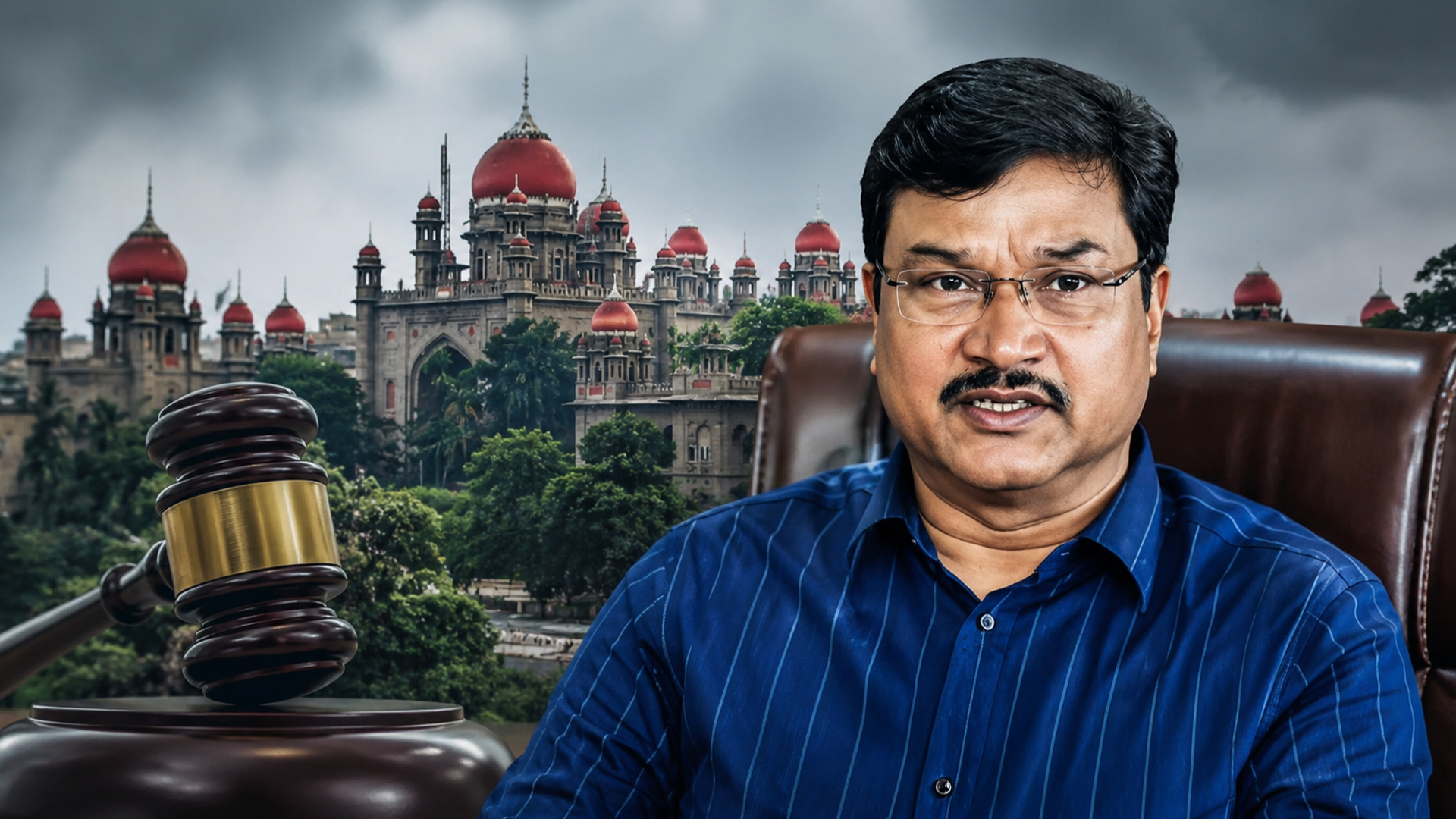
The Telangana High Court has ordered the immediate removal of HYDRAA Commissioner A.V. Ranganath, holding that he repeatedly violated court orders during anti-encroachment operations and failed to demonstrate respect for the judicial process. The ruling is being viewed as a major setback for the Telangana government, which has strongly supported HYDRAA’s crackdown on illegal encroachments across Hyderabad.
In a strongly worded order, the High Court directed Chief Secretary Sanjay Jaju to transfer Ranganath from the Hyderabad Disaster Response and Asset Protection Agency (HYDRAA) and appoint another officer to head the organisation. The court observed that allowing him to continue in the post would send the wrong message about accountability and compliance with judicial directions.
The order came during contempt proceedings linked to alleged violations of earlier court directives by HYDRAA. According to the bench, the agency had continued to act despite clear judicial instructions, raising serious concerns over its approach to executing demolition and anti-encroachment drives.
The judges noted that the issue was not a one-time lapse but a pattern of repeated non-compliance. They said public officials entrusted with enforcing the law are equally bound to follow the law and respect court orders. Ignoring judicial directions, the bench observed, weakens public confidence in both governance and the justice system.
Ranganath appeared before the court during the hearing and tendered an apology. However, the judges refused to accept it, stating that the apology did not appear genuine and came only after repeated instances of non-compliance were highlighted. The court said an apology cannot erase repeated violations of judicial orders.
The bench also referred to the large number of contempt petitions pending against the HYDRAA commissioner. It noted that around 63 contempt cases involving Ranganath were before the court, reinforcing its concern that the violations were not isolated incidents but part of a continuing pattern.
The High Court stressed that every government authority, irrespective of its mandate, must function within the framework of the Constitution. It said officials cannot selectively follow court orders or justify violations on the grounds of administrative necessity or public interest.
HYDRAA was established to protect government land, lakes and other public assets from encroachment in Hyderabad. Since its formation, the agency has led several high-profile demolition drives that have received public support in some quarters while also drawing criticism from affected landowners and residents over alleged procedural lapses.
While the court acknowledged the importance of protecting public land, it clarified that enforcement agencies cannot overlook due process. The judges emphasised that even actions taken in public interest must strictly comply with judicial directions and established legal procedures.
Following the order, Ranganath defended HYDRAA’s work, saying the agency had acted to safeguard public property and prevent illegal encroachments. He also alleged that vested interests and land grabbers were attempting to obstruct the agency’s efforts through legal challenges. However, he said he would continue to serve in whatever role the government assigns him.
The High Court’s decision is expected to have wider implications for the functioning of enforcement agencies across Telangana. Legal experts say the ruling reinforces the principle that administrative powers must always be exercised within the limits of the law and that government officials remain accountable to the judiciary.
The order has also sparked political debate, with opposition parties describing it as evidence of administrative overreach, while supporters of HYDRAA argue that the agency’s campaign against encroachments should continue under new leadership without compromising legal safeguards.
The Telangana government is now expected to implement the court’s direction by appointing a new HYDRAA commissioner. It has not yet indicated whether it will challenge the order or comply with it immediately.
The ruling serves as a reminder that while governments have the authority to protect public assets and enforce the law, those objectives must be pursued through lawful means. By directing the removal of the HYDRAA chief, the Telangana High Court has underlined that no public official is above judicial scrutiny and that respect for court orders remains a fundamental pillar of democratic governance.
The High Court‘s observations are expected to influence how enforcement agencies conduct future anti-encroachment drives in Telangana. Legal experts say the ruling reinforces that protecting public land and ensuring development cannot come at the cost of due process. Every administrative action, they say, must remain accountable to the Constitution and judicial oversight.