
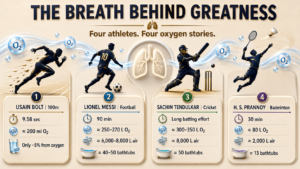
During his 9.58-second world-record sprint, Usain Bolt probably used less than a small glassful of oxygen. Over 90 minutes, Lionel Messi may use about 250 litres. During a long innings, Sachin Tendulkar may have used even more. H. S. Prannoy’s breathing rises and falls with every rally. Together, they show what elite sport asks of the lungs.
Every great sporting performance has an invisible soundtrack: the athlete’s breathing. Air comes in, oxygen enters the blood, the heart carries it to working muscles and carbon dioxide is carried away. This happens quietly at rest. In elite sport, it becomes a high-speed delivery service.
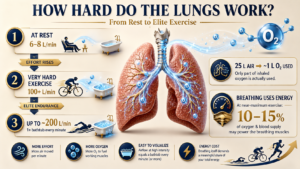
A resting adult moves about six to eight litres of air through the lungs each minute — three or four large soft-drink bottles. During very hard exercise, a trained athlete may move more than 100 litres a minute. The biggest endurance athletes can approach 200 litres — that amounts to more than a full bathtub of air every minute.
But breathing in air is not the same as using oxygen. Air is only about one-fifth oxygen — and we breathe much of that oxygen out again. As a useful rule of thumb, during steady exercise the lungs may have to move about 25 litres of air for every litre of oxygen the body uses. That is why the figures for air breathed are so much larger than the figures for oxygen consumed.
First, a word about the numbers
Nobody has published breath-by-breath laboratory readings from the particular races, matches and innings discussed here. The figures for Bolt, Messi, Tendulkar and Prannoy are therefore sensible estimates based on studies of comparable elite athletes. They show the scale of the effort. They should not be mistaken for personal medical measurements.
Usain Bolt uses less than a glass of oxygen
A 100-metre sprint looks as though it must require an enormous gulp of oxygen. In fact, the race is over before the body’s oxygen-delivery system can fully get going. Bolt’s muscles begin by using tiny stores of ready-made fuel — rather like chemical batteries charged before the starting gun.
A scientific analysis of the 100 metres, based on Bolt’s 9.58-second world record, produced a startling estimate. Oxygen supplied only about 5 per cent of the energy used during the race. The other 95 per cent came from fuel released rapidly inside the muscles.
At his explosive peak, Bolt’s body was producing energy at nearly 15,000 watts — roughly 20 horsepower. Yet during the race itself, he probably used only about 200 millilitres of oxygen, which is less than what a small drinking glass holds. The horsepower describes energy produced inside the body, not the amount of force that reached the track.
So, why did he breathe so hard after finishing? Because the bill arrived late. Oxygen was then needed to recharge those muscle batteries, deal with the by-products of the sprint and cool the body. Bolt’s post-race panting was the sound of recovery after nine and a half extraordinary seconds.
Lionel Messi: 40 to 50 bathtubs of air
Football is the opposite kind of test. A player walks, jogs, accelerates, brakes, turns and sprints, then repeats the sequence for 90 minutes. Much of a match may look unhurried, but an elite player like Messi still performs about 150 to 250 brief, intense actions — a hard run, jump, tackle, change of direction or sprint every few dozen seconds.
Studies of elite footballers allow us to make a broad estimate. A Messi-sized outfield player weighing roughly 70 kilograms may use about 250 to 270 litres of oxygen over 90 minutes.
To collect that oxygen, his lungs may move roughly 6,000 to 8,000 litres of air. Picture 40 to 50 ordinary bathtubs, or 3,000 to 4,000 two-litre bottles. It would take several thousand breaths. The true number changes with position, tactics, weather and stoppage time, and Messi does not cover the pitch in the same way as a box-to-box midfielder. This is a scale, not a personal meter reading.
The striking thing is not merely that oxygen keeps a footballer jogging. It also helps him recover between sprints. A three-second burst may rely mainly on stored muscle fuel — being able to produce another burst two minutes later depends heavily on oxygen. The goal-scoring sprint is dramatic. The quiet recovery that makes the next sprint possible is just as important.
Sachin Tendulkar: a day’s oxygen in one long innings
Cricket refuses to fit into one neat number. A match may last three hours, eight hours or five days. A batter stands, walks, strikes the ball and then sprints at least 17.68 metres between the opposing popping creases — sometimes turning immediately to run the distance again. The effort comes in instalments, but the instalments add up.
Tendulkar gave us the perfect picture of such accumulation in 2010, when he became the first man to make an ODI double century: 200 not out from 147 balls. No one measured his oxygen use that day. But a study that asked 17 batsmen to complete a 126-minute simulated one-day international century found that their heart rates climbed from about 124 to 159 beats a minute as the innings progressed. Their oxygen use rose sharply too. This was not gentle standing around — the body was working progressively harder.
For a batter weighing 70 to 75 kilograms, that two-hour laboratory effort works out to roughly 300 to 350 litres of oxygen and perhaps 8,000 litres of air — about 50 bathtubs. A resting adult uses roughly the same amount of oxygen over an entire day. A long Tendulkar-like innings may therefore have squeezed something close to a day’s resting oxygen demand into a little over two hours.
The pauses are deceptive. Heat, pads, helmet, concentration and repeated running all add to the strain. In actual T20 batting, researchers found that players stood for more than half their time and walked most of their distance, yet batters in different positions showed very different heart-rate loads. Cricket breathing is not a steady endurance rhythm. It rises and falls like the teeth of a saw.
H. S. Prannoy — sprint, breathe, recover, repeat
Badminton can look both thunderous and casual from the stands. At court level, it is a succession of lunges, jumps, twists and smashes, each followed by a few seconds in which the body must hurriedly rebuild itself. The shuttle stops. The athlete’s physiology does not.
Prannoy’s 2023 World Championships quarter-final against the defending champion and then World No. 1 Viktor Axelsen is a vivid example. Prannoy lost the first game, then fought back to win 13-21, 21-15, 21-16 in a 68-minute contest that secured him a medal. For more than an hour, explosive effort and rapid recovery kept taking turns.
Measurements from internationally ranked badminton players explain what those quiet-looking pauses conceal. In two 15-minute sets, the average rally lasted about seven seconds and the rest between rallies about 12 seconds. A 75-kilogram player used roughly 80 litres of oxygen in half an hour and moved nearly 2,000 litres of air — around 13 bathtubs.
Extend that laboratory average to 68 minutes and the arithmetic approaches 180 litres of oxygen and 4,500 litres of air — nearly 30 bathtubs. That is not a specific measurement of Prannoy’s match — it is a comparison that shows its possible scale. The important point is that the 12-second gap is not empty time. Oxygen is helping to recharge the muscles for the next lunge, leap and smash.
Breathing is hard work too
We often imagine that breathing simply supplies the muscles doing the real work. But the diaphragm and chest muscles are working too. During near-maximum sustained exercise, they may take 10 to 15 per cent of the body’s oxygen and blood supply. Put simply, out of every ten litres of oxygen used, more than one litre may be spent just moving air in and out.
If those breathing muscles tire, the body may protect them by sending more blood their way and less to the limbs. The legs can literally pay part of the price of breathing. This helps explain why a runner or footballer may feel the legs fail at the same time that breathing becomes desperate.
The lungs are the gateway, not the whole engine
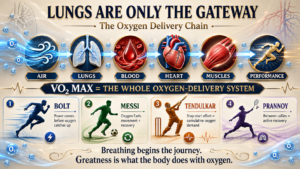
Athletes often talk about VO2 max as though it were a score for the lungs. It is really a score for the body’s entire oxygen delivery chain: lungs, heart, blood and muscles. Strong lungs are only the front door. Oxygen still has to enter the blood, be pumped around the body and be used by the muscles.
Training greatly improves the heart, blood vessels and muscles, but it does not usually make adult lungs much larger. In fact, the rest of the body may improve more dramatically than the lungs. At the very highest level, the athlete’s heart can pump blood through the lungs so quickly that there is barely time to load it fully with oxygen. Some athletes cannot breathe out any faster, or experience a small fall in blood oxygen. The athlete may become so powerful that perfectly normal lungs are the narrowest part of the delivery chain.
This is why noisy breathing is a poor test of fitness. A champion may sound exhausted after a sprint and recover quickly. Someone else may breathe quietly but perform poorly because of anaemia, narrowed airways or illness. Repeated cough, wheeze, chest tightness or breathlessness that seems excessive deserves medical attention — even in a very fit person.
Four athletes, four different oxygen stories
Bolt shows that the body can release astonishing power before oxygen catches up. Messi shows how oxygen quietly pays for 90 minutes of movement and repeated recovery. Tendulkar shows how stop-start effort can build an enormous total over time. Prannoy shows that the seconds between explosive rallies are not rest for the body but urgent repair time.
The memorable numbers are these: less than a glass of oxygen for Bolt to sprint 100 metres, about 250 litres for Messi to complete a football match, roughly 300 to 350 litres for Tendulkar to bat through a long day and about 80 litres for half an hour of badminton at Prannoy’s elite level. The events look completely different because effort is not only about how hard the body works. It is also about how long it must keep working, and how often it must recover and go again.
Champions do not win simply because they take bigger breaths. They win because their lungs, heart, blood and muscles work as one remarkably efficient delivery team. Breathing begins the journey. Greatness lies in what the body does with the oxygen that arrives.
This article provides general health information and is not a substitute for individual medical assessment.
(The author is an interventional pulmonologist and respiratory medicine consultant in Bengaluru.)