The United States has rolled out a tough new visa restriction policy aimed at cybercriminals, sending a clear message that hackers, online scammers and those helping them could lose the chance to enter the country.
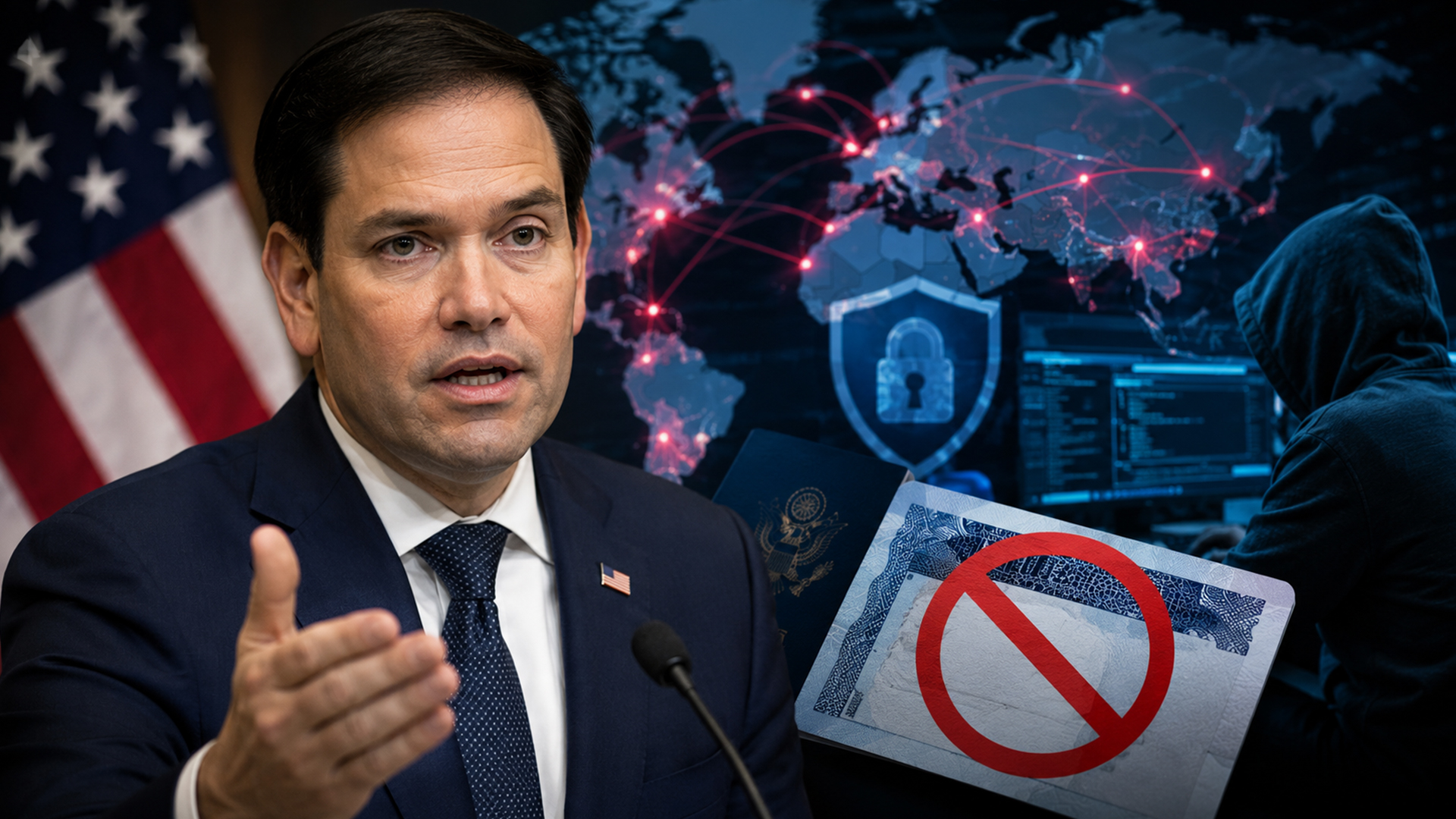
Announced by US Secretary of State Marco Rubio, the policy expands America’s efforts to curb the growing threat of cyber-enabled crime, which has cost individuals and businesses billions of dollars worldwide. The move is designed to target not only cybercriminals themselves but also those who knowingly assist, finance or benefit from such illegal activities.
The new rules allow the US government to deny or revoke visas of foreign nationals linked to crimes such as ransomware attacks, online investment scams, phishing, identity theft, sextortion and other forms of digital fraud. In a notable step, the restrictions can also extend to the immediate family members of those found responsible, increasing pressure on organised cybercrime networks.
Announcing the decision, Rubio said the United States would “go after” people who exploit the internet to target Americans. He stressed that cybercriminals often operate across borders, making it difficult for law enforcement agencies to bring them to justice. The visa restrictions, he said, add another tool to hold offenders accountable.
The announcement comes at a time when cyber fraud has become one of the fastest-growing forms of organised crime. Criminal gangs are increasingly using fake investment schemes, romance scams, business email fraud and phishing attacks to steal money and personal information. Many of these operations are run by sophisticated international networks that move funds across multiple countries, making investigations more complex.
US officials believe these criminal groups depend on facilitators who provide financial services, technology infrastructure, forged documents or other logistical support. The new policy is intended to target this wider ecosystem rather than only the individuals carrying out the attacks.
The State Department said the visa restrictions are part of a broader strategy to disrupt global cybercrime. Along with immigration measures, the US government plans to continue using criminal prosecutions, sanctions, financial investigations and international cooperation to identify and dismantle cybercrime networks.
Officials argue that limiting access to the United States could serve as a strong deterrent, particularly for individuals who travel frequently for business or personal reasons. By extending restrictions to close family members, Washington hopes to increase the personal cost of participating in organised cybercrime.
The policy also aligns with the Trump administration’s wider campaign against international criminal networks. Earlier this year, President Donald Trump directed federal agencies to strengthen action against foreign groups involved in ransomware, digital fraud and other cyber-enabled offences. The administration has repeatedly described cybercrime as both an economic and national security threat.
In recent years, US agencies have highlighted the rise of scam centres operating in several parts of the world. These centres are often linked to organised crime groups that use fake investment platforms, cryptocurrency fraud and social engineering tactics to trick victims into handing over large sums of money. Some investigations have also uncovered links between cyber fraud, money laundering and human trafficking.
While the State Department has not named any countries or individuals under the new visa policy, officials said it has a global scope. Any foreign national found to be involved in cyber-enabled crime targeting Americans could face visa restrictions, regardless of where they are based.
The government has also not revealed how many people may be affected initially. Visa decisions will continue to be made under existing US immigration laws and will be based on available evidence gathered through intelligence, law enforcement investigations and cooperation with international partners.
Cybersecurity experts say the policy alone is unlikely to stop cybercrime, but it adds another layer of pressure on criminal organisations. Many believe that combining visa restrictions with financial sanctions, arrests and international policing efforts could make it harder for cybercriminals to operate freely across borders.