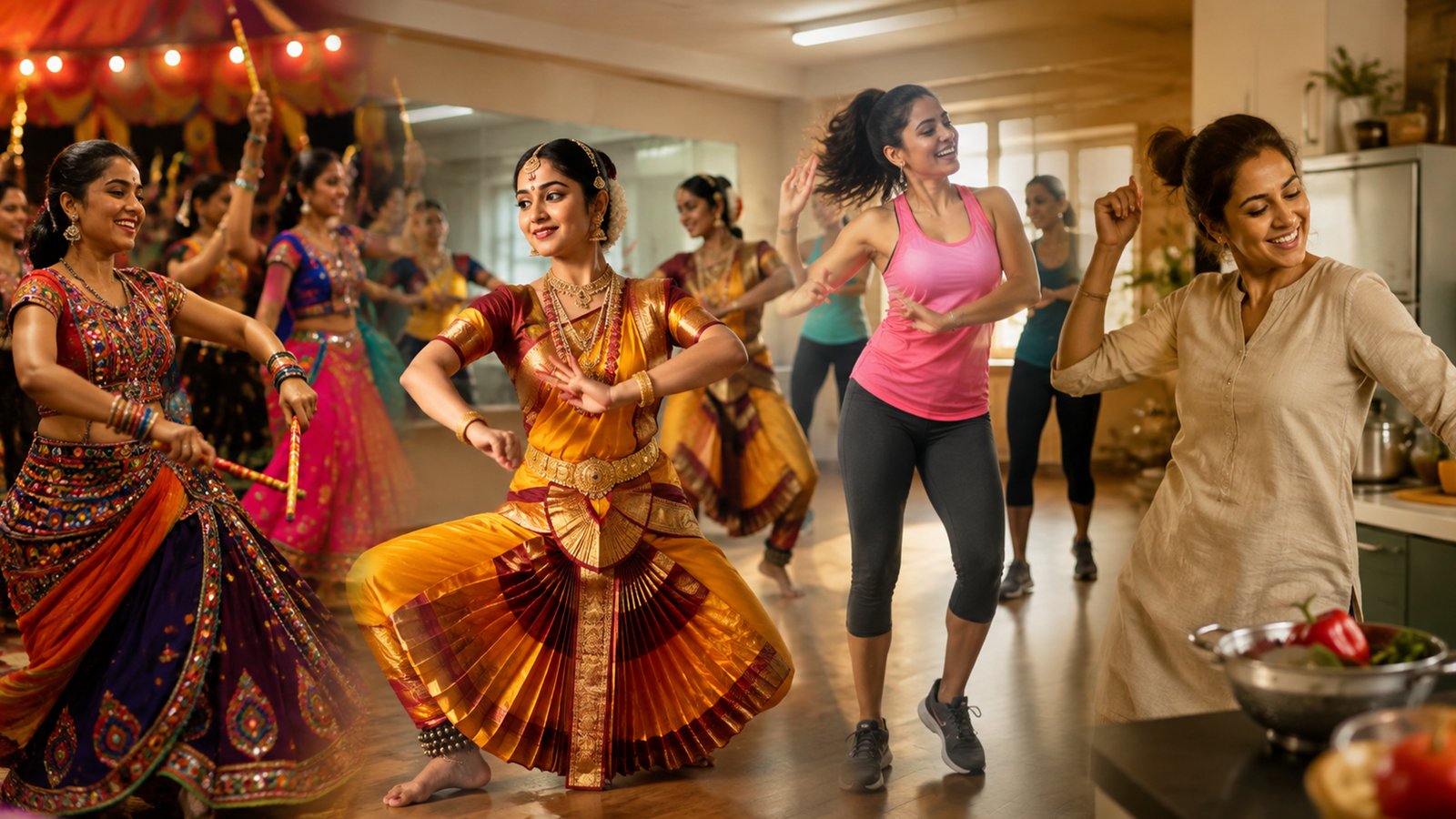
At an Indian wedding, it can happen before the first full line of the song. A familiar beat begins, shoulders loosen, a foot starts tapping and, within minutes, people who had been sitting politely are laughing, turning and pulling others onto the floor. The same thing can happen in a garba circle, a Bharatanatyam class, a Zumba session or alone in the kitchen with a favourite playlist.
Why does dancing feel so disproportionately good?
Part of the answer is simple: dance is physical activity. But it is also memory, balance, rhythm, anticipation, expression and, very often, social connection happening at the same time. That combination helps explain why dancing can feel less like a health chore and more like an experience we want to repeat.
Exercise that does not always feel like exercise
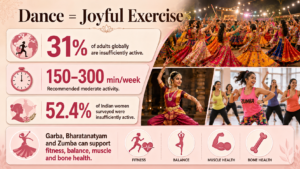
The public-health case for moving more is already strong. The World Health Organization says 31% of adults worldwide do not meet recommended activity levels, and regular physical activity is associated with better cardiovascular, metabolic, mental and brain health. Adults are generally advised to accumulate 150 to 300 minutes of moderate-intensity aerobic activity a week, or 75 to 150 minutes of vigorous activity, along with muscle-strengthening work on at least two days.
For India, the issue is especially relevant to women. In a nationally representative survey of adults aged 18 to 69, 41.4% were insufficiently active; the figure was 52.4% among women and 51.7% among urban adults. The exact numbers vary by survey and definition, but the message is consistent: many Indians are not moving enough.
Dance offers a practical way to change that because intensity can be scaled. Ballroom or line dancing can be moderate-intensity activity, while vigorous dancing can count as vigorous activity. Garba, bhangra, aerobic dance and sustained choreography can therefore range widely depending on pace and the dancer. You do not have to be technically accomplished for the movement to count. The health benefit comes from doing the work, not from looking graceful while doing it.
There is also a particularly important advantage for women across the life course: many forms of dance are weight-bearing. The US National Institute of Arthritis and Musculoskeletal and Skin Diseases lists dancing among weight-bearing activities that can help maintain bone health. That matters increasingly after menopause, when women may lose bone mass more quickly for several years as oestrogen levels fall.
Dance is not a complete osteoporosis program — strength training, adequate protein and calcium, vitamin D where appropriate and medical treatment when indicated still matter — but it can be one enjoyable part of protecting muscle, balance and bone.
Your brain is doing choreography too
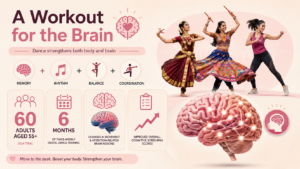
When you dance, the brain is not merely issuing a command to the legs. It is listening for the beat, predicting what comes next, recalling sequences, mapping the body in space, correcting balance, coordinating vision with movement and adapting to other people. A simple-looking step can therefore be a surprisingly rich cognitive task.
That is one reason researchers are interested in dance and healthy ageing. In a 2024 randomised trial, 60 adults over 55 were assigned either to six months of twice-weekly digital dance training or to healthy-ageing education. The dance group showed changes in brain regions involved in movement, attention and sensorimotor processing, as well as an improvement in overall cognitive screening scores. Another randomised trial in older adults found that 12 weeks of dance was associated with improvements in attention and mental flexibility and with higher blood levels of brain-derived neurotrophic factor, or BDNF, a protein involved in neuronal health and plasticity.
These studies are encouraging, but they should not be oversold. Small trials cannot prove that dancing prevents dementia, and different dance programs produce different results. Still, newer controlled studies continue to suggest that learning and performing movement patterns may challenge cognition in ways that are not identical to simply repeating the same aerobic motion. In a 2025 trial of 150 older adults, square dance improved cognitive scores compared with health education, while different movement programs produced different patterns of physical and psychosocial benefit.
Why the mood can change before the song ends
Many people do not need a laboratory to tell them that dancing can shift a bad mood. The important scientific point is that there is no single magical “dance chemical” responsible. The effect is more plausibly a combination of physical exertion, music, attention being pulled into the present moment, mastery of a skill, emotional expression and social interaction.
Physical activity itself can reduce symptoms of anxiety and depression and improve well-being, as recognised by the WHO. Dance may add something psychologically useful because enjoyment and music make exertion feel meaningful. In a 2025 pilot randomised trial in university students, a 10-week program combining dancing, drumming and creative movement improved stress and aspects of quality of life compared with a control group. The program was multi-component, so the result cannot be credited to dance alone, but it captures an important real-world point: people often move better when movement is embedded in pleasure, music and community.
This is clinically relevant. The “best” form of exercise on paper is of limited value if a person dislikes it enough to stop after two weeks. Dance can solve part of the adherence problem because the reward is immediate: there is a song, a skill, a partner, a class or a cultural ritual to return to.
The social effect may be more than conversation
Group dancing has another unusual ingredient: synchrony. We do not only stand beside other people; we move with them. That shared timing seems to matter.
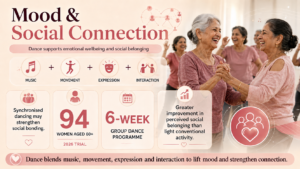
In an experimental study, participants who danced with greater synchrony reported stronger in-group bonding, while exertion and synchrony were each associated with higher pain thresholds. Pain threshold was used as an indirect marker related to endorphin activity, so this does not prove that endorphins are the whole explanation. But it supports the idea that coordinated movement can make strangers feel more connected surprisingly quickly.
More recent work points in the same direction. A randomised five-week online hip-hop program in adolescents produced larger gains in social bonding and well-being than a wait-list control. And in 2026, a randomised trial in 94 community-dwelling women aged 60 and above found that a six-week virtual-reality group dance program produced a substantially greater improvement in perceived social belonging than dose-matched light conventional activity. The technology is novel, but the principle is ancient: humans have been moving in rhythm together long before anyone measured it with a questionnaire.
A gynecologist’s view: movement should change with life, not disappear
For women, the relationship with exercise often changes because the body changes. Periods may be painful or heavy. Pregnancy alters balance and joint stability and increases the need to avoid overheating. The postpartum months bring sleep loss and pelvic-floor recovery. Perimenopause and menopause can affect sleep, mood, muscle and bone. Later life may add arthritis, osteoporosis or fear of falling.
The answer is usually not to stop moving, but to choose the right movement for the stage of life. In an uncomplicated pregnancy, professional guidance supports regular moderate-intensity activity, with about 150 minutes a week as a common target. Someone who already dances may often continue with sensible modifications, but routines with a high risk of falling, overheating or abdominal trauma are inappropriate, and individual obstetric advice matters. After childbirth, the timing of return depends on the delivery and any complications; after a Caesarean birth or complications, ACOG advises asking the obstetrician when it is safe to resume exercise.
Similarly, a woman with low bone density or osteoporosis should get advice on which activities are safe for her before starting a new exercise program. A person with significant balance problems, chest pain, unexplained breathlessness, recent surgery or an unstable medical condition needs assessment before beginning vigorous dance. Safety does not make dance less joyful; it makes the joy sustainable.
You do not need a dance floor
The practical prescription is wonderfully undramatic. Start with music you genuinely like. Dance for ten minutes if thirty feels unrealistic. Use a stable surface and footwear that suits the style. Increase duration and intensity gradually. If you can talk but not sing during the activity, that is a useful rule of thumb for moderate intensity. Add separate strength work because adults are advised to include muscle-strengthening activity on at least two days a week.
And do not confuse performance with benefit. You can miss steps, laugh, dance in a chair, learn one sequence repeatedly or close the door and dance alone. The body still moves. The brain still predicts and adjusts. Music still changes the experience of effort. With other people, rhythm can create a sense of “us” remarkably fast.
Perhaps that is why dance survives across cultures and generations. It can be exercise without feeling like punishment, cognitive work without feeling like a test, and social connection without requiring a formal conversation.
Sometimes the healthiest movement is the one that makes you forget you are exercising.
This article provides general health information and is not a substitute for individual medical assessment.
(The author is a consultant obstetrician and gynaecologist based in Bengaluru.)