
For many women, a period is treated as a monthly inconvenience — something to endure, manage discreetly and forget until the next one arrives. But menstruation is more than bleeding. It is the visible result of a carefully coordinated conversation between the brain, ovaries, uterus, thyroid gland and several hormones.
When that conversation changes, the menstrual cycle often changes with it.
A period cannot diagnose a medical condition on its own. Nor does every late, painful or heavy period mean something is wrong. Stress, travel, illness, medication and changes in sleep, diet, exercise or weight can temporarily affect a cycle. What matters is recognising your usual pattern, and noticing when it changes.
That is why doctors increasingly regard the menstrual cycle as another indicator of health, much like pulse, temperature or blood pressure. It is, in effect, a health report card delivered every month.\

The 28-day cycle is not a rule.
One of the most persistent myths about menstruation is that every healthy cycle should last exactly 28 days. In reality, bodies do not follow calendars so neatly.
The cycle is counted from the first day of one period to the first day of the next. In adults, menstrual bleeding commonly occurs every 24 to 38 days and may last for up to eight days. Cycles may be less predictable during the first few years after periods begin and again as menopause approaches.
Regular does not necessarily mean arriving on precisely the same date every month. A cycle that shifts by a few days may still be entirely healthy. The more useful question is: What is normal for you?
If your periods have usually arrived every 29 to 31 days and suddenly begin coming every 18 days, or disappear for three months, that change is more informative than whether you match somebody else’s idea of a “perfect” cycle.
When periods become irregular.
A late or missed period is often associated with pregnancy, and that should be considered whenever pregnancy is possible. But it is far from the only explanation.
Mental stress can interfere with the signals between the brain and ovaries. Severe illness, rapid weight loss, significant weight gain, undernutrition and intense physical training can also delay or stop ovulation. When ovulation is delayed, the period is delayed too.
Repeatedly irregular or absent periods may point towards an underlying hormonal condition. One common possibility is polyendocrine metabolic ovarian syndrome (PMOS), previously known as polycystic ovary syndrome or PCOS. The condition can also cause acne, increased facial or body hair, weight-related difficulties and problems with ovulation.
PMOS replaced PCOS internationally in May 2026 because the older term PCOS was misleading: women with the condition do not necessarily have ovarian cysts, and its effects extend well beyond the ovaries to hormonal, metabolic, reproductive, skin and mental health. PMOS affects approximately one in eight women worldwide, that’s more than 170 million people, although estimates vary according to the population and diagnostic criteria used.
An irregular cycle does not automatically mean PMOS. Thyroid disorders, elevated prolactin levels, certain medications, premature ovarian insufficiency and other medical conditions can produce a similar pattern. Diagnosis requires a proper medical history and, where appropriate, examination and tests — not an ultrasound report interpreted in isolation.
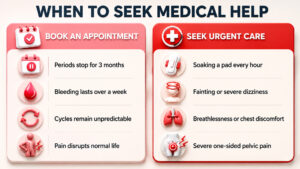
A woman whose periods stop for more than three months without pregnancy, or become persistently unpredictable after previously being regular, should seek medical advice.
Heavy bleeding is not something you must simply tolerate.
Period flow is difficult to measure accurately at home. Rather than trying to calculate blood loss in millilitres, look at what the bleeding makes you do.
- Do you soak through a pad or tampon every hour or two?
- Does the bleeding continue beyond a week or interfere with work, school, sleep or exercise?
- Do you need to use two forms of protection together, wake repeatedly at night to change them, pass large clots or avoid leaving home during your period?
If so, it may qualify as heavy menstrual bleeding.
Heavy periods can be caused by fibroids, adenomyosis, hormonal disturbances, thyroid problems, copper intrauterine devices, certain medicines or, less commonly, abnormalities of the uterine lining. Sometimes the cause is a disorder affecting the blood’s ability to clot. The US Office on Women’s Health estimates that as many as one in ten women with heavy periods may have a bleeding disorder, such as von Willebrand disease.
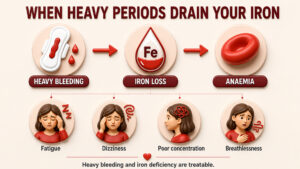
Repeated blood loss can gradually deplete the body’s iron stores and cause anaemia. The signs may be easy to dismiss fatigue, headaches, paleness, poor concentration, dizziness, a racing heart or breathlessness while climbing stairs.
The important point is not merely that the bleeding is heavy. It is that something may be causing it, and that both the cause and the resulting iron deficiency may be treatable.
Pain is common but disabling pain is not “normal.”
Mild to moderate cramps around the start of a period are common. They occur because the uterus contracts to shed its lining. But pain that repeatedly keeps a woman away from school or work, causes vomiting or fainting, wakes her from sleep or does not improve with usual pain relief deserves evaluation.
Severe period pain may be associated with endometriosis, adenomyosis, fibroids, ovarian conditions or pelvic infection.
Endometriosis occurs when tissue similar to the uterine lining grows outside the uterus, leading to inflammation and scarring. The World Health Organization estimates that it affects about 10% of women of reproductive age, approximately 190 million people worldwide. Yet diagnosis commonly takes between four and twelve years.
One reason for this delay is the belief that extreme period pain is simply part of being a woman. It is not. Pain that repeatedly disrupts normal life is a symptom, not a character-building exercise.
Pain during sex, bowel movements or urination, particularly if it becomes worse around the period, should also be discussed with a gynaecologist.

Very light periods can carry clues too.
A lighter-than-usual period is not necessarily a problem. Hormonal contraceptives, including some pills and hormonal intrauterine devices, may make periods much lighter or stop them altogether. That can be an expected and safe effect.
But a marked change in flow, especially when accompanied by irregular or missed periods, may reflect changes in ovulation or in the uterine lining. Low body weight, inadequate nutrition, excessive exercise and prolonged stress can suppress the hormones needed for ovulation.
This matters beyond fertility. Oestrogen helps maintain bone strength. When periods disappear because the body is consistently under-fuelled or under excessive physical strain, bone health may also suffer.
Athletes, dancers and women following highly restrictive diets should therefore not assume that losing their period is proof of fitness. It may instead be the body signalling that it does not have enough energy to support all its normal functions.
Bleeding between periods needs attention.
Occasional light spotting can occur around ovulation, after sex or when starting or changing hormonal contraception. Nevertheless, repeated bleeding between periods should not be ignored.
Possible causes include cervical or uterine polyps, infections, fibroids, hormonal fluctuations and medication effects. Bleeding after sex may result from inflammation or changes affecting the cervix. Less commonly, unexpected bleeding can be linked to precancerous or cancerous changes.
Bleeding after menopause, defined as any vaginal bleeding after 12 consecutive months without a period, should always be medically assessed, even if it happens only once or consists of a small amount of spotting.
Your premenstrual symptoms matter as well.
The menstrual cycle can affect much more than bleeding. Hormonal changes before a period may cause breast tenderness, bloating, food cravings, headaches, irritability, low mood or disturbed sleep. These symptoms are often grouped under premenstrual syndrome, or PMS.
For most women, they are manageable. But when emotional symptoms are severe, such as intense depression, anxiety, anger, hopelessness or difficulty functioning, they may indicate premenstrual dysphoric disorder, a more serious cyclical condition.
A symptom diary maintained over at least two or three cycles can help establish whether changes reliably occur before menstruation and improve after the period begins. Severe depression or thoughts of self-harm require urgent professional help, regardless of where they occur in the cycle.
Become a detective, not a diagnostician.
Tracking your period is one of the simplest ways to understand it. A calendar, diary or period-tracking app can be useful, but the first day alone does not tell the full story.
Make a record of:
- when bleeding begins and ends
- whether the flow is light, moderate or heavy
- how frequently you change menstrual products
- the size and frequency of clots
- pain and whether it limits normal activity
- spotting between periods or bleeding after sex
- headaches, digestive symptoms, sleep and mood changes, and
- major changes in stress, exercise, medication or weight.
After a few months, patterns often become visible. This record is also far more useful to a doctor than trying to reconstruct several cycles from memory.
Period-tracking apps, however, should be treated as diaries — not diagnostic tools. Predictions are based on past entries and may be unreliable when cycles are irregular.
When should you seek prompt medical care?
Consult a doctor if periods suddenly change and remain different, repeatedly occur fewer than 24 or more than 38 days apart, stop for three months when you are not pregnant, last longer than about a week, become unusually heavy or cause severe pain.
Seek urgent medical attention if bleeding is extremely heavy, particularly if you are soaking through a pad or tampon every hour for several hours, or if it is accompanied by fainting, marked dizziness, chest discomfort, breathlessness or severe weakness.
Severe one-sided pelvic pain, shoulder-tip pain, dizziness or bleeding when pregnancy is possible also requires urgent assessment because it may indicate an ectopic pregnancy.
Listen to the pattern.
Periods naturally change across life — from adolescence and the reproductive years to pregnancy, breastfeeding and the approach to menopause. Not every variation requires treatment, and the aim is not to make every woman’s cycle identical.
The aim is to recognise what the cycle may be communicating.
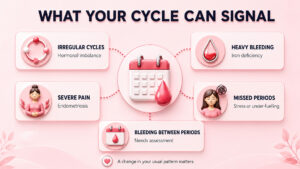
A missed period may reflect pregnancy, stress or disturbed ovulation. Heavy bleeding may reveal fibroids, a clotting disorder or iron deficiency. Severe pain may point towards endometriosis. Irregular cycles may offer an early clue to a hormonal or metabolic condition.
Your period is not merely a date on the calendar. It is a recurring report from your body. Learn its usual language, pay attention when the message changes and do not be afraid to ask what it is trying to tell you.
This article provides general health information and is not a substitute for individual medical assessment.
(The author is a consultant obstetrician and gynaecologist in Bengaluru.)