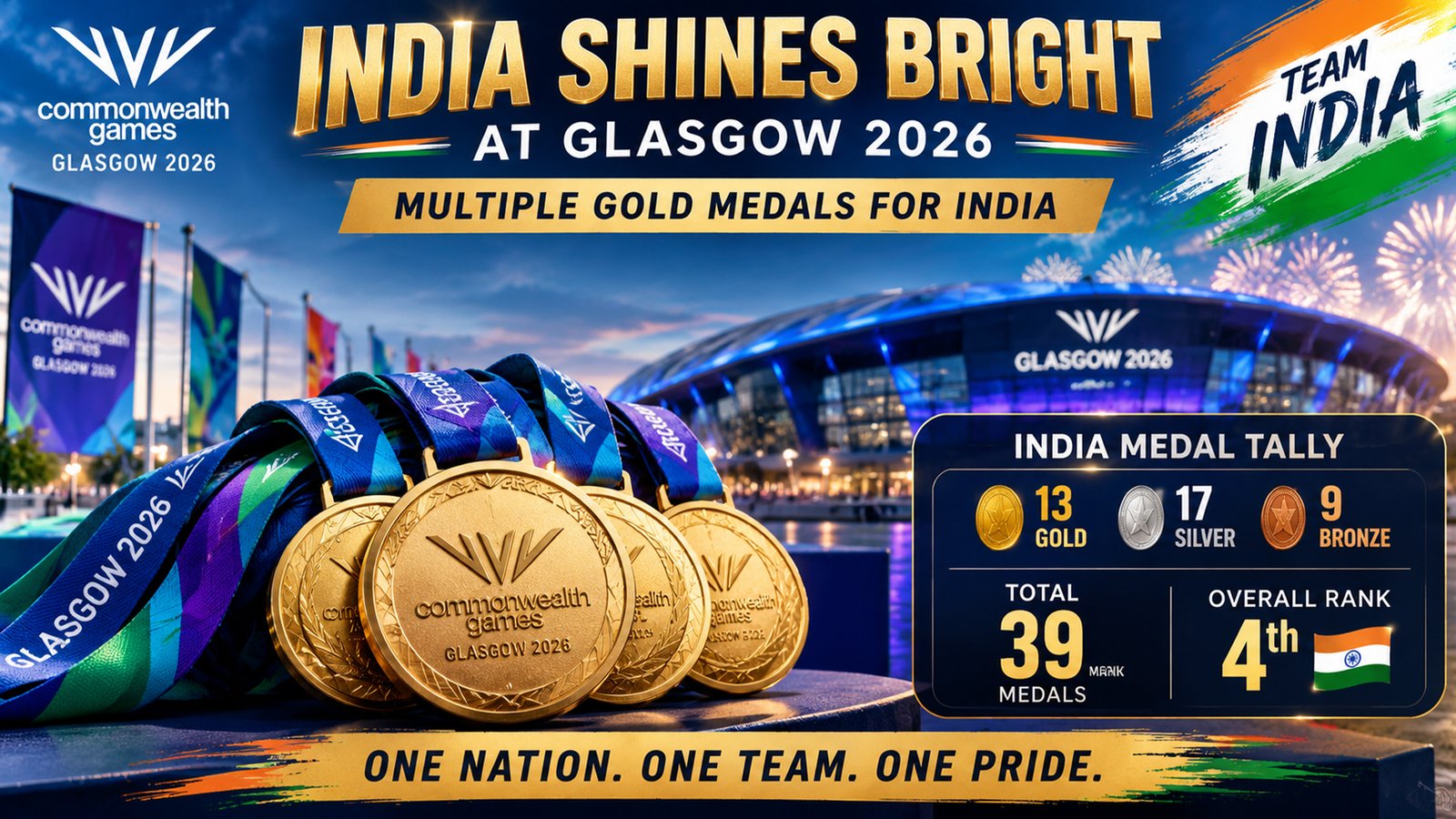
India signed off from the Commonwealth Games 2026 (CWG) in Glasgow with 39 medals, finishing fourth on the overall medal table. The Indian contingent won 13 gold, 17 silver and nine bronze medals, ending the Games with several standout performances across boxing, weightlifting, athletics, judo and para-sports.
The final tally gave India a strong finish despite the team competing in a reduced sporting programme compared with some previous editions. The 39-medal haul also came as Indian athletes continued to broaden the country’s medal base beyond its traditional strengths.
Australia topped the CWG 2026 medal table, followed by England and Canada, while India finished fourth. Australia dominated the Games with 70 gold medals and 171 medals overall, underlining the gap at the top of the standings.
For India, however, the Glasgow campaign was less about the overall ranking and more about the depth of performances across different disciplines.
Boxing was the standout sport for India, producing a record 10 medals, including seven golds. The performance represented India’s best-ever boxing showing at the Commonwealth Games and became one of the biggest talking points of the campaign.
Indian boxers consistently delivered in the ring, turning the sport into one of the biggest contributors to the country’s gold medal tally. The success also highlighted the growing depth in Indian boxing, with athletes competing strongly across several weight categories.
The performance will provide confidence ahead of future multi-sport events, particularly as India prepares to host the 2030 Commonwealth Games in Ahmedabad.
India’s athletics contingent also made its presence felt in Glasgow.
Gulveer Singh was the only Indian athlete to win two medals at the Games, contributing to India’s overall tally and emerging as one of the country’s notable performers. Athletics and para-athletics together provided several memorable moments for the Indian team.
The performances were significant because athletics has traditionally been an area where India has looked to expand its medal base. Strong results in Glasgow suggest that the country’s track and field programme is gradually producing greater depth at the international level.
The para-athletics campaign was particularly encouraging. India’s performance in para-sport was described as its best at a Commonwealth Games, reflecting the growing contribution of para-athletes to the country’s international sporting success.
India also produced important results in weightlifting and judo.
Weightlifting has long been one of India’s reliable medal-winning sports at the Commonwealth Games, and the Glasgow edition continued that tradition. At the same time, Indian judokas enjoyed a historic campaign, strengthening India’s presence in a sport where the country has traditionally had a smaller medal base.
The spread of medals across disciplines is perhaps one of the more encouraging aspects of India’s Commonwealth Games performance. While boxing dominated the gold medal count, athletes from several other sports also contributed to the overall tally.
That broader base could prove important as India looks towards the 2028 Los Angeles Olympics and the 2030 Commonwealth Games on home soil.
The Glasgow CWG were unlike some recent editions because organisers reduced the number of sports and events. The revamped format was designed to make the Commonwealth Games more financially sustainable while retaining a strong multi-sport programme.
The Games featured a greater emphasis on para-sport, while several sports that have traditionally featured at the Commonwealth Games were not part of the programme.
That meant comparisons with India’s medal totals from previous editions need to be made carefully.
India’s 39 medals are still a significant achievement, but the country’s overall medal count is lower than its haul at some recent Commonwealth Games. At Birmingham in 2022, India won 61 medals, while the Glasgow edition offered fewer opportunities across sports.
Even so, India’s fourth-place finish and 13 gold medals underline the competitiveness of the contingent.
Indian women athletes also played a major role in the Glasgow campaign.
Of India’s 39 medals, 23 were won by women, according to reports, highlighting the growing contribution of female athletes to India’s performance at major international competitions.
That trend has become increasingly visible across Indian sport. From boxing and weightlifting to athletics and para-sport, women athletes are becoming central to India’s medal campaigns.
The Glasgow results therefore offer another reminder that India’s sporting success is no longer dependent on a handful of established disciplines or male athletes.
The conclusion of the Commonwealth Games 2026 also marks the beginning of India’s preparations for the next edition.
At the closing ceremony in Glasgow, the Commonwealth Games baton was passed to Ahmedabad, which will host the 2030 edition. India will therefore have four years to prepare athletes and infrastructure for a Games being staged on home soil.
Hosting the Commonwealth Games will bring greater expectations. Indian athletes will be under pressure to improve on the Glasgow performance and make the most of home advantage.
The country’s sporting authorities will also have an opportunity to identify areas that need attention. While boxing delivered an exceptional return, disciplines such as athletics, swimming and other Olympic sports will remain important for India’s longer-term ambitions.
The Glasgow campaign leaves Indian sport with plenty to build on.
The 39-medal haul, including 13 golds, shows that India remains one of the leading sporting nations in the Commonwealth. More importantly, the medals came from a wider group of disciplines, while India’s women and para-athletes made particularly strong contributions.
The challenge now is to convert that momentum into sustained success at bigger global events.
For the athletes, Glasgow offered medals, experience and confidence. For Indian sport administrators, it provided a clearer picture of where the country is progressing and where further investment is needed.
As the focus moves towards Los Angeles 2028 and Ahmedabad 2030, India’s Commonwealth Games 2026 campaign could ultimately be remembered not simply for finishing fourth, but for showing how quickly the country’s sporting base is expanding.