
For years, women were told they had “polycystic ovary syndrome”, or PCOS. The name might have encouraged them to think it is mainly as an ovarian condition involving cysts and irregular periods.
In late May 2026, the condition was officially renamed polyendocrine metabolic ovarian syndrome, or PMOS. The new name, PMOS, matters because it describes the condition more accurately. PMOS is a complex hormonal and metabolic disorder that can affect several parts of the body — not merely the ovaries.
The name change followed a global consensus process involving medical specialists, researchers and patient organisations. The old name was considered misleading because the structures seen in the ovaries are usually immature follicles rather than true ovarian cysts. More importantly, some women with the condition do not have the characteristic ovarian appearance at all.
PMOS, the new name, therefore shifts the focus from what an ultrasound may show to what is happening throughout the body.
More common than many realise
PMOS is among the most common hormonal disorders affecting women. According to the international PMOS guideline programme, it affects around one in eight women worldwide, or more than 170 million people. That is no small number. 170 million is roughly equal to the population of Bangladesh or around half the population of the United States!
Yet the condition frequently remains unrecognised. The World Health Organization estimates that as many as 70 per cent of affected women may not know they have it.
Some consult a doctor because their periods have become unpredictable. Others seek treatment for acne, excessive facial hair, thinning scalp hair, unexplained weight changes or difficulty becoming pregnant. Many live with symptoms for years without realising that these seemingly unrelated problems may share a common cause.
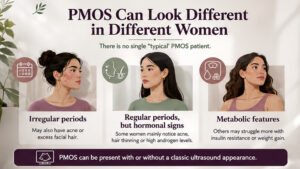
PMOS can also look different in different women. One woman may be lean and have regular-looking ovaries but high androgen levels. Another may have irregular periods and insulin resistance without noticeable acne or excessive hair growth. A third may first discover the condition while seeking fertility treatment. In other words, there is no single “typical” PMOS patient.

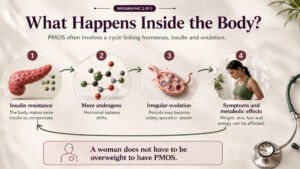
What happens inside the body?
Hormones act as chemical messengers, coordinating bodily functions ranging from menstruation and ovulation to appetite, sleep, mood and the way the body uses energy.
In PMOS, several of these signalling systems may become disrupted. Many affected women have higher-than-usual levels or activity of androgens — hormones such as testosterone that are present in everyone but generally occur at lower levels in women.
Higher androgen activity can interfere with the regular development and release of an egg. Ovulation may occur infrequently or not at all, causing periods to become widely spaced, unpredictable or absent. Androgens can also contribute to acne, increased facial or body hair and thinning hair over the scalp.
Another important part of the condition is metabolism. Many women with PMOS have some degree of insulin resistance. Insulin is the hormone that helps glucose move from the bloodstream into cells, where it is used for energy. When cells respond poorly to insulin, the body may compensate by producing more of it.
High insulin levels stimulate the ovaries to produce more androgens, while increased androgen activity can further disturb metabolism. This can create a self-reinforcing cycle involving hormones, insulin, ovulation and weight regulation.
Insulin resistance is frequently associated with excess weight, but it can occur in women of any body size as she does not have to be overweight to have PMOS or its metabolic complications.
It is not diagnosed by ultrasound alone
An ultrasound report mentioning “polycystic ovaries” does not automatically mean that a woman has PMOS. Such an ovarian appearance can sometimes be seen in healthy women, particularly younger women, without the hormonal or menstrual features of the syndrome.
Conversely, a woman can have PMOS without having polycystic-appearing ovaries. In adults, diagnosis usually requires at least two of three principal features:
- irregular or absent ovulation, commonly reflected in irregular periods;
- clinical or laboratory evidence of increased androgen activity;
- a characteristic ovarian appearance on ultrasound, or an elevated anti-Müllerian hormone level when appropriately used by a clinician.
Other conditions capable of producing similar symptoms must first be excluded. These can include thyroid disorders, elevated prolactin, certain adrenal conditions, pregnancy and, rarely, androgen-producing tumours.
Diagnosis in adolescents requires particular care. Irregular periods and acne are common during the first few years after menstruation begins and do not necessarily indicate PMOS. Ultrasound is also less useful in teenagers because a multi-follicular ovarian appearance can be normal at that age.
A label should therefore not be applied hastily on the basis of one symptom, one blood test or one scan.

Periods are only one part of the story
Irregular menstruation is often the most visible sign of PMOS, but its significance extends beyond inconvenience or uncertainty.
When ovulation does not occur regularly, the lining of the uterus may remain exposed to oestrogen without the balancing effect of progesterone. Over time, this can cause the lining to become excessively thick, a condition known as endometrial hyperplasia.
Women who go for several months without a period should not simply wait indefinitely for menstruation to return. Your doctor may recommend hormonal treatment at appropriate intervals to protect the uterine lining.
The overall risk of endometrial cancer remains low in young women, but prolonged, untreated absence of periods can increase that risk. Regular medical follow-up is an important part of prevention.
PMOS and fertility
PMOS is one of the most common causes of infertility related to failure to ovulate. However, a diagnosis does not mean that a woman cannot become pregnant.
Some women with PMOS ovulate occasionally and conceive without treatment. Others benefit from measures that improve metabolic health or medicines that stimulate ovulation. Letrozole is commonly recommended as a first-line medicine for inducing ovulation in women with PMOS-related infertility, although treatment must be individualised and medically supervised.
Where necessary, additional fertility treatments — including injectable medicines or assisted reproductive techniques — may be considered.
The encouraging fact is that fertility treatment for PMOS is often effective. The difficulty lies less in the number of eggs in the ovaries than in helping an egg mature and be released predictably.
Pregnancy in women with PMOS may require closer monitoring because the chances of gestational diabetes, high blood pressure during pregnancy and certain other complications can be higher.
A long-term metabolic condition
The word “metabolic” in PMOS deserves attention. Women with the condition have an increased likelihood of insulin resistance, impaired glucose tolerance and type 2 diabetes. High cholesterol, elevated blood pressure, sleep apnoea and other long-term health risks are also more common.
This does not mean that every woman with PMOS will develop these conditions. It means that the diagnosis should prompt appropriate screening rather than being treated only with tablets to regulate periods.
Depending on a woman’s age and risk factors, her doctor may check blood glucose, cholesterol, blood pressure, weight or waist circumference. A glucose tolerance test may identify problems that a fasting glucose test alone can miss.
These checks remain important even when a woman is not planning a pregnancy and even after her periods become more predictable.
PMOS does not disappear when the reproductive years end. Its symptoms may change, but its metabolic implications can continue into later life.
The emotional burden is real
The effects of PMOS are not purely physical. Unpredictable periods, infertility, acne, excessive hair growth, hair loss and difficulty managing weight can affect confidence, relationships and quality of life. Women with PMOS experience higher rates of anxiety, depression, body-image distress and disordered eating.
Unfortunately, some women are told that their symptoms are merely cosmetic or that they simply need greater “willpower” to lose weight. Such responses can deepen distress and discourage them from seeking further care.
Weight is influenced by many biological, psychological and social factors. PMOS itself can make weight management more difficult through insulin resistance, appetite regulation and hormonal changes. Treatment should support health without blame or stigma.
Mental-health symptoms should be discussed openly and treated with the same seriousness as menstrual or metabolic concerns.
Treatment is not one-size-fits-all
There is currently no single cure for PMOS, but its symptoms and health risks can be managed effectively. Treatment depends on what matters most to the individual woman — regulating periods, reducing acne or unwanted hair, improving metabolic health, protecting the uterine lining, managing emotional wellbeing or becoming pregnant.
Healthy eating, regular physical activity, adequate sleep and stress management form the foundation of care. These habits can improve metabolic health even when the number on the weighing scale changes little. Women should not be made to feel that treatment has “failed” simply because they have not achieved dramatic weight loss.
Combined oral contraceptive pills may help regulate periods and reduce androgen-related symptoms. Metformin may be considered particularly where insulin resistance, impaired glucose regulation or higher metabolic risk is present. Anti-androgen medicines may sometimes be used for excessive hair growth or acne, but they require reliable contraception because of their potential effects during pregnancy.
Skin and hair symptoms may take several months to improve. Dermatological treatments, laser hair reduction and other cosmetic therapies can form part of care when desired.
Supplements and internet-promoted “hormone cures” should be approached cautiously. “Natural” does not necessarily mean effective or harmless, and some products can interact with medicines or contain uncertain doses of active ingredients.
When should you seek medical advice?
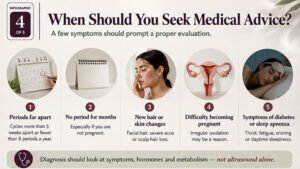
A medical consultation is advisable when periods repeatedly occur more than about five weeks apart, fewer than eight periods occur in a year, menstruation stops for three months or more without pregnancy, or symptoms such as new facial hair, severe acne or scalp hair loss become troublesome.
Rapidly developing hair growth, deepening of the voice or other sudden signs of markedly increased androgen activity require prompt assessment because they are not typical of ordinary PMOS.
Women should also seek help when they have difficulty becoming pregnant, symptoms of diabetes, loud snoring with daytime sleepiness, or persistent anxiety, low mood or distress about eating and body image.
Keeping a record of menstrual dates, symptoms, medicines and relevant family history can make the consultation more productive.
A better name can lead to better care
The change from PCOS to PMOS is more than a revision of medical vocabulary. It asks patients and doctors to see the whole condition. The ovaries are part of the picture, but so are the pancreas, liver, skin, hair follicles, brain, uterine lining and cardiovascular system. Menstruation and fertility matter, but so do sleep, metabolism and mental health.
Most importantly, PMOS should not be reduced to a woman’s appearance, body weight or ability to become pregnant.
With timely diagnosis, appropriate screening and individualised treatment, women with PMOS can manage their symptoms, protect their long-term health and live full, healthy lives. The first step is recognising and accepting that an irregular period may be not merely a menstrual inconvenience, but one signal in a much larger hormonal and metabolic story.
This article provides general health information and is not a substitute for individual medical assessment.
(The author is a consultant obstetrician and gynaecologist based in Bengaluru.)