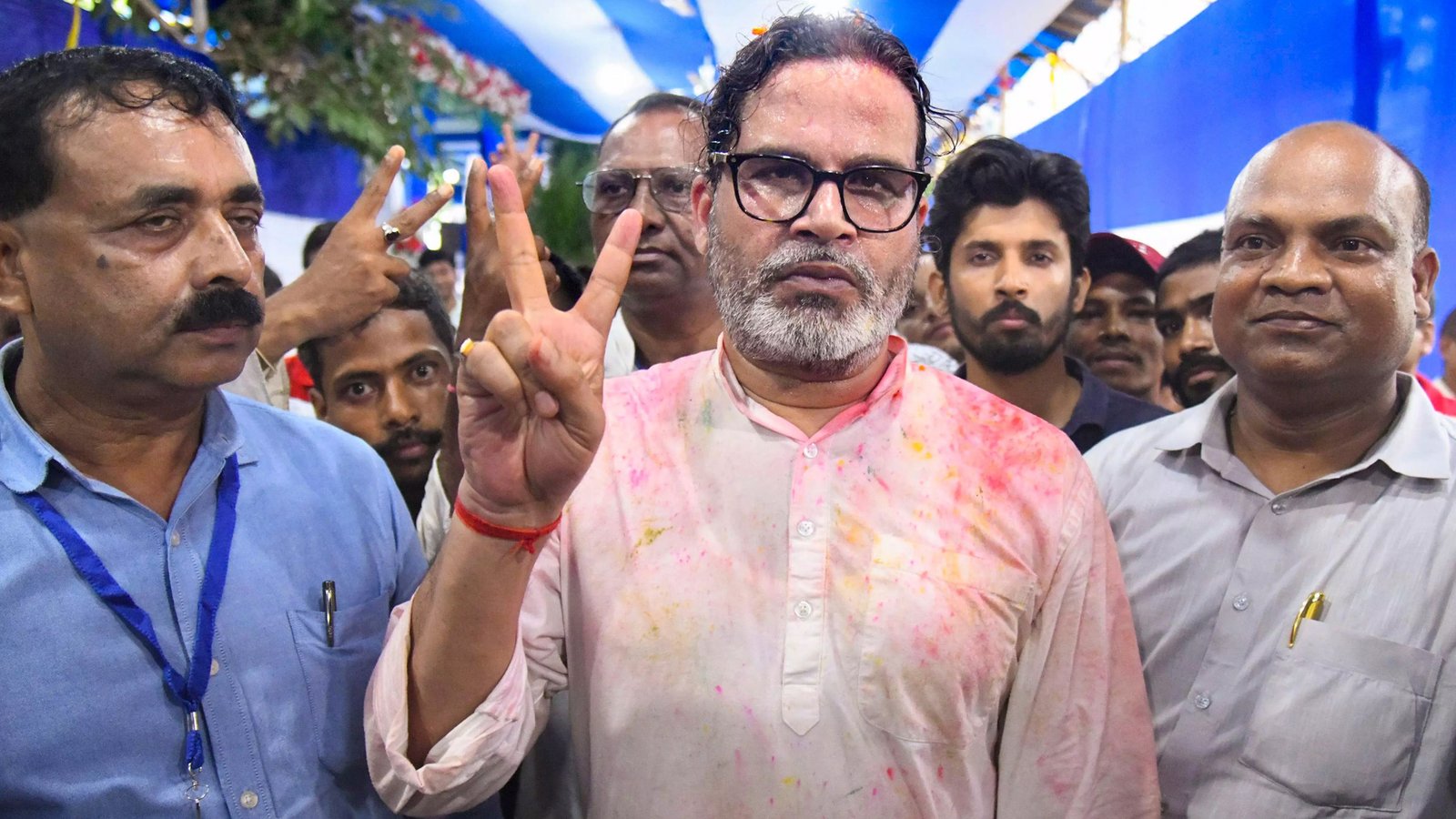
The Bankipur by-election was only for one Assembly seat, but its result has delivered a political message far larger than the constituency itself. Jan Suraaj Party founder Prashant Kishor defeated Bharatiya Janata Party (BJP) candidate Neeraj Kumar Sinha by 19,324 votes, ending the BJP’s nearly three-decade hold over the Patna seat and scoring the first electoral victory of his political career. Kishor secured 64,151 votes, turning what was expected to be a difficult contest into a decisive win.
The Bankipur result is particularly significant because the seat had been one of the BJP’s most dependable urban strongholds in Bihar. The party had retained it continuously since 1995, first through veteran leader Navin Kishore Prasad Sinha and later through his son Nitin Nabin. Nabin, who served as the constituency’s MLA for five terms, vacated the seat after being elected to the Rajya Sabha and taking on a larger organisational role as BJP national president.
That history made the bypoll a test of more than just the popularity of an individual candidate. For the BJP, Bankipur represented organisational strength, a loyal urban voter base and the ability to retain a constituency even when the sitting MLA was no longer on the ballot. Losing it to a relatively new political force has therefore triggered questions within the party about voter sentiment, candidate selection and the effectiveness of its local campaign.
BJP leaders have responded cautiously. The party has said it accepts the verdict and will conduct a detailed review of the defeat. BJP national president Nitin Nabin, whose departure from the constituency triggered the by-election, has also acknowledged that the party did not receive the expected mandate.
For Kishor, the victory marks a dramatic turnaround. He entered electoral politics with Jan Suraaj after years of working as a political strategist for major leaders and parties. His decision to personally contest Bankipur transformed the bypoll into a high-profile battle between an established political organisation and a new challenger seeking space in Bihar’s crowded political landscape.
Kishor’s campaign focused heavily on issues affecting young voters, particularly employment, education and inflation. His pitch sought to move the political conversation away from the traditional BJP-versus-RJD contest and towards questions of jobs, governance and opportunities within Bihar. His direct criticism of the state government and emphasis on the aspirations of young people appear to have helped him connect with sections of the urban electorate.
The symbolism of the victory was also important. Bankipur has traditionally been associated with the BJP’s saffron political identity and a relatively secure urban support base. Kishor’s Jan Suraaj campaign introduced a distinct political colour and identity, with the party’s yellow branding becoming increasingly visible across Patna during the campaign. The result has consequently been interpreted as the emergence of a third political space in a state long dominated by the BJP-led NDA and the RJD-led opposition.
The BJP also faced an unusual disruption before polling. Its original candidate, Abhishek Kumar Sinha, withdrew from the race citing family reasons shortly after filing his nomination. The party then replaced him with Neeraj Kumar Sinha. The candidate change became a talking point during the campaign and gave Kishor an opportunity to portray the BJP as unsettled.
The contest itself was triangular, with RJD candidate Rekha Kumari also in the fray. The presence of the RJD ensured that the anti-BJP vote was not simply a two-way contest. Yet Kishor managed to build a winning coalition despite competing against two established political formations. That makes the margin particularly noteworthy and raises questions about whether Jan Suraaj can convert the Bankipur breakthrough into a wider political base.
The result has wider implications for Bihar politics because it comes after the BJP-led NDA’s strong performance in the 2025 Assembly election. The NDA had secured a dominant majority in the State, making the loss of Bankipur an unexpected setback rather than part of a broader electoral collapse.
It would, therefore, be premature to treat one by-election as evidence of a statewide political realignment. By-elections often have their own local dynamics, candidate factors and turnout patterns. Bankipur is also an urban constituency with a political profile different from much of rural Bihar. Still, the scale of Kishor’s victory makes the result difficult for political parties to dismiss.
The BJP’s concern is not simply that it lost a seat. It lost a seat that had symbolised its organisational durability in Patna. The defeat also came against a candidate who had never before won an election. That combination gives the result an unusual psychological impact.
For Jan Suraaj, meanwhile, the challenge begins now. Winning Bankipur gives Kishor a foothold in the Bihar Assembly and strengthens his claim that voters are willing to consider an alternative to the state’s traditional political choices. But converting one high-profile victory into a sustainable organisation will require a much broader network, stronger local leadership and continued voter engagement beyond election campaigns.
The Bankipur bypoll has thus opened a new chapter in Bihar politics. The BJP remains a powerful political force, while the RJD continues to command a substantial opposition base. But Prashant Kishor’s victory shows that the space between the two is no longer necessarily empty.
For voters, the result may ultimately be less about colours and party labels and more about a growing demand for alternatives. For the BJP, it is a warning that even long-standing urban strongholds cannot be treated as permanently secure. And for Kishor, Bankipur is the first tangible proof that his transition from poll strategist to politician can produce electoral results.
The immediate winner is Jan Suraaj. The larger story, however, is about a Bihar electorate that has shown it is willing to experiment, even in a constituency where the BJP had built one of its strongest political fortresses.