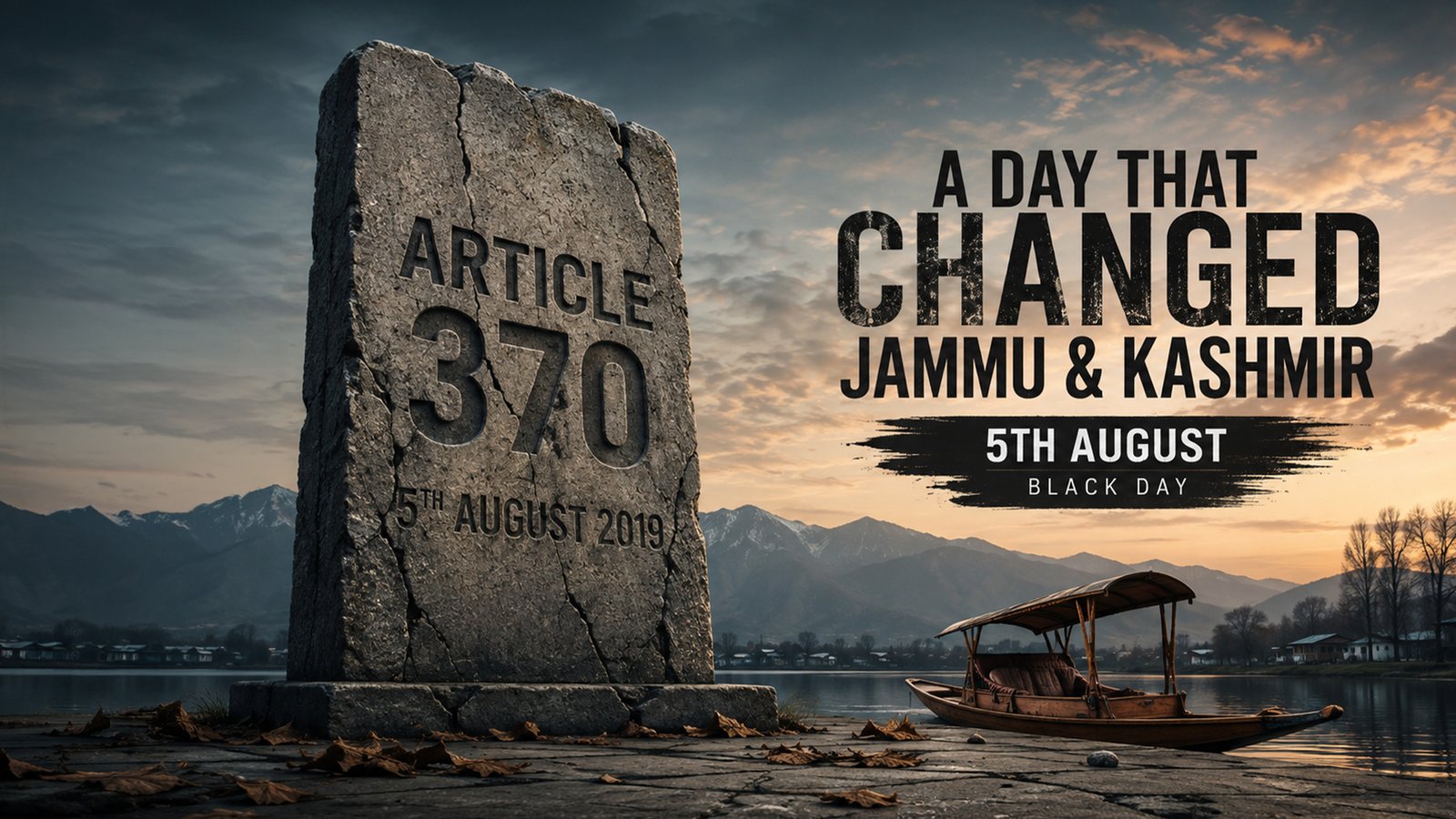
Jammu and Kashmir marked seven years of the Article 370 abrogation with protests by major regional parties, tight security and fresh calls for the restoration of statehood. The National Conference (NC), Peoples Democratic Party (PDP) and Congress observed August 5 as a “Black Day”, while the BJP maintained that the 2019 decision marked greater integration, development and progress in the Union Territory.
The anniversary has once again brought the political debate over Article 370, Jammu and Kashmir statehood and the region’s future to the centre of public attention. The ruling National Conference held protests at its headquarters in Srinagar and across districts, describing August 5 as a day to remember what it calls the unilateral removal of Jammu and Kashmir’s constitutional guarantees. The party has also stepped up its campaign demanding the restoration of statehood.
The PDP, led by former chief minister Mehbooba Mufti, has also organised protests across Jammu and Kashmir. The party has continued to demand the restoration of Article 370 and 35A, along with the release of political prisoners. On Tuesday evening, Mehbooba Mufti led a candlelight demonstration in Srinagar ahead of the anniversary. Her daughter Iltija Mufti was detained during the protest, according to the PDP.
The Congress has joined the protests, observing August 5 as a Black Day and calling for the restoration of Jammu and Kashmir’s statehood. Its demands also include constitutional safeguards relating to land, jobs and natural resources. These demands reflect a wider political concern that the Union Territory’s present status should not become permanent.
Security arrangements have been significantly strengthened across Jammu and Kashmir ahead of the anniversary. Authorities have increased checkpoints, vehicle inspections and frisking, while additional paramilitary forces have been deployed in sensitive areas. Security agencies are also maintaining a close watch on possible militant activity, particularly after recent targeted attacks and inputs about suspected terrorist movement.
In the Jammu region, additional vigilance has been maintained along sensitive areas near the International Border, including Kathua, Samba and Akhnoor. Security forces have also carried out search operations in Poonch after receiving information about the suspected movement of terrorists in forested areas. The security build-up reflects concerns that political demonstrations could coincide with attempts by militant groups to disrupt peace.
August 5, 2019 remains a defining moment in Jammu and Kashmir’s recent history. On that day, the Centre effectively ended the special constitutional status associated with Article 370 through a presidential order and subsequently reorganised the former state into two Union Territories — Jammu and Kashmir, and Ladakh. The move fundamentally changed the region’s constitutional and political structure.
For the BJP and the Centre, the decision is presented as a major step towards national integration and development. The government has repeatedly argued that the post-Article 370 period has brought greater political participation, improved security conditions and increased development activity. The Centre has also pointed to progress in sectors including tourism, infrastructure, education and investment.
Government data has previously highlighted a sharp decline in organised stone-pelting and hartals and a reduction in terrorist incidents compared with the years before the abrogation. The government has used these changes to argue that Jammu and Kashmir has moved towards greater stability and normalcy.
But for regional parties, the question is no longer only about Article 370. The restoration of statehood has emerged as the more immediate political demand. The National Conference argues that the Centre had indicated a roadmap involving delimitation, Assembly elections and eventual restoration of statehood. With delimitation completed and Assembly elections held in 2024, the party says the remaining commitment should now be fulfilled.
Jammu and Kashmir held Assembly elections in September 2024, and an elected government led by Omar Abdullah subsequently took office. The new administration passed a resolution seeking restoration of statehood. However, the Centre has not announced a specific timeline for returning statehood to the Union Territory. This delay has increasingly become a source of political friction between Srinagar and New Delhi.
The statehood issue has also moved beyond party politics. An Indian Express analysis marking seven years since August 5 argued that continuing to delay statehood risks weakening public trust, particularly among people who participated in the electoral process after the restoration of an elected government. The argument reflects a broader question about how long the Union Territory arrangement should continue after the return of electoral politics.
At the same time, the anniversary remains deeply polarised. While NC, PDP and Congress are using the occasion to highlight constitutional rights and statehood, BJP supporters have marked the day as a celebration of Jammu and Kashmir’s fuller integration with India. Residents and political groups therefore continue to view the legacy of the 2019 decision very differently.
Seven years on, the debate over Jammu and Kashmir has consequently shifted from the legality and political impact of Article 370 abrogation towards questions of governance, representation and statehood. The Supreme Court upheld the Centre’s decision in December 2023, while the political demand for restoration of statehood has continued.
Seven years after the Article 370 decision, Jammu and Kashmir remains at a political crossroads. While the Centre highlights security, development and integration, regional parties continue to press for restoration of statehood and greater constitutional safeguards. The latest protests show that August 5 continues to carry strong political and emotional significance across the Union Territory.